 Last year for our Week of Ocean Pseudoscience, we counted down our top seven marine cryptids. Number seven was the elusive Steller’s Sea Ape, documented only once by renowned naturalist Georg Wilhelm Steller. Even though the Sea Ape has not been seen since, Steller’s deserved reputation as a world class naturalist has kept the Sea Ape story alive. In his journal, he reports that:
During this time we were near land or surrounded by it we saw large numbers of hair seals, sea otters, fur seals, sea lions, and porpoises…. On August 10, we saw a very unusual and unknown sea animal, of which I am going to give a brief account since I observed it for two whole hours. It was about two Russian ells in length, the head was like a dog’s, with pointed, erect ears. From the upper and lower lips on both sides whiskers hung down which made it look almost like a Chinaman, The eyes were large; the body was longish round and thick, tapering gradually towards the tail. The skin seemed thickly covered with hair, of a grey color on the back, but reddish white on the belly; in the water, however, the animal appeared equally reddish and cow colored. The tail was divided into two fins, of which the upper, as in the case of sharks, was twice as large as the lower.
To get to the heart of the mysterious sea ape, we need to step back and take a look at the history of Steller, the details of his groundbreaking research, and his relationship with his captain, Vitus Bering. Bering, was the only Dane among an otherwise German and Russian crew. In order to join the expedition, Steller had to trek across thousands of miles to reach Okhotsk, a journey that took him nearly two years (he left St. Petersburg in January, 1738 and joined the expedition in March, 1740). From the start, Steller and Bering did not get along, and during the entire nearly two year cruise he was allowed ashore only twice, once for ten hours while the ship resupplied, and at the disastrous end of the cruise when the crew was shipwrecked on Bering Island, where Bering, along with half the crew, died of scurvy. This was, incidentally, the island where the now-extinct Steller Sea Cow was discovered.
Steller described his sea ape in August, 1741, a month after his first, and only, scientific expedition to shore. Although it appears in his personal journal, it was never recorded in official reports to the government, nor in his scientific publications. De Bestiis Marinis was written primarily during his stay on Bering Island and published posthumously, compiled from journal entries and other documents. Even so, Steller was a precise and careful naturalist, and many find it unlikely that he would misidentify and animal that he observed for two hours at close range.
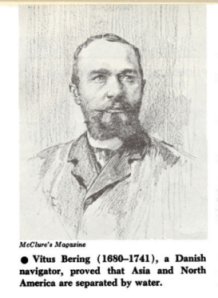
The tensions with Bering were likely at an all time high, compounded by rampant sickness among the crew, including the Captain. Bering remained confined to his quarters and rarely ventured on deck, making it impossible for Steller to direct any scientific expeditions. In my original post, I posited that Steller was having a laugh and the sea ape was a joke. In rereading some of the original texts, the answer now seems obvious. Although most sites report that Steller referred to his creature as Simia marina, the Sea Ape, the actual text refers to it as Simia marina danica, the Danish Sea Ape.
In his frustration and anger at the captain, the only Dane on the ship, perhaps Steller decided to take a jab at Vitus Bering, and immortalize him in unflattering taxonomy. Steller’s untimely death before his descriptions were published would have prevented him from removing the Sea Ape from his final work.