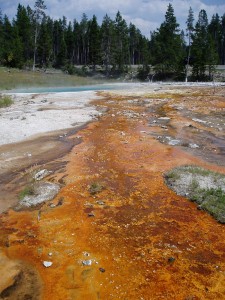
 Yellowstone National Park was established to preserve the American West, largely held up as the iconic American landscape. Picturesque Yellowstone houses the hopes and dreams of the frontier, the wilderness that is a large part of American heritage, and the final refuge for North American wildlife. Despite such a colorful and large part of American history, Yellowstone should perhaps be famous not for its astounding trees and bouncing elk, but instead for the ecosystems that depend on Yellowstone’s geysers. They are the unsung heroes of modern biotechnology and place Yellowstone’s wilderness leaps and bounds above other temperate forests in terms of biodiversity.
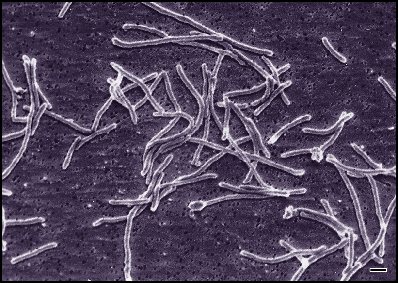
Thermus aquaticus, a bacteria that lives within the superheated regions of the geysers, fumaroles, and mudspots, are thought to be related to cyanobacteria. However, unlike photosynthetic cyanobacteria, they metabolize sulfur compounds released from the geysers and fumaroles. This and their capability to deal with extreme environments places them at one of the earliest points in evolutionary history, possibly similar to some of the earliest life forms on earth. Their claim to fame, however, is their use to amplify DNA through a process known as a polymerase chain reaction (PCR). PCR has revolutionized genetic research by allowing a relatively fast way to investigate the genome (see end of article for my related twitter challenge).
So what causes these extreme environments in the Yellowstone region? Due to intense geologic activity in the past, (Yellowstone is actually the giant caldera of a dormant volcano) the earth’s crust is only about 40 miles thick as opposed to the usual 90. Geysers occur where there is nearby water, while the rest of the region is pock-marked with other forms of thermal features. Each of these is constantly warmed by the nearby magma. Differences in temperatures and water flow make each thermal feature a slightly different ecosystem, complete with a different arrangement of plants and animals depending on temperature, mineral content, and water availability. Each of these micro-ecosystems is dependent upon a different microbial community at its base. And some of these communities are still being described.
Fortunately, much of these unique systems are protected within the boundaries of Yellowstone National Park. Widely considered a national treasure, conservation efforts in the region are likely to continue in perpetuity.
twitter challenge: “my challenge to you all: in one tweet, why is PCR so amazing?”
@ShipLives: “PCR is the magnifying glass that lets us open the genetic blueprint large enough to try and read the fine print”
@DrKlapperich: “If it weren’t for PCR, I wouldn’t have a lab”
@dnatured PCR makes the undetected detectable – the unknown, discovered – and still highest amount ever paid for patent #whyPCRamazing