Skip to content

Southern Fried Science

Over 15 years of ocean science and conservation online

  • Home
  • About SFS
  • Authors
  • Support SFS

Dipping a Toe in the Confluence

Posted on March 17, 2015 By Chuck Bangley 1 Comment on Dipping a Toe in the Confluence
Uncategorized

North Carolina is well known for both its distinctive barrier islands (making Pamlico Sound the largest lagoon in the U.S.) and highly productive fisheries.  Both of these features exist in large part because North Carolina sits that the point where two of the largest ocean currents in the Atlantic meet. From the north, the Labrador Current meanders from the Arctic Circle along the Canadian, New England, and Mid-Atlantic shorelines and crashes into the Gulf Stream at Cape Hatteras, deflecting this warm current off its own shore-hugging course from the south and out across the Atlantic Ocean.  Aside from literally defining the shape of the Outer Banks, the collision zone represents the boundary between temperate waters to the north and subtropical waters to the south.  This presence of this border means that, depending on the time of year and local weather conditions, you can catch just about any marine fish native to the Northwest Atlantic Ocean off of the Outer Banks.
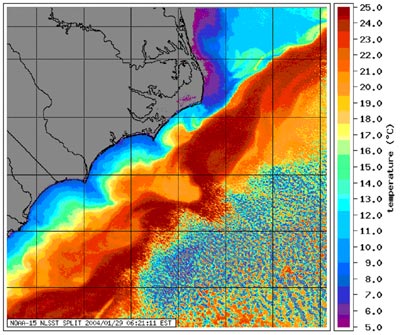
This satellite image of sea surface temperatures shows the Gulf Stream (warm red current coming from the south) meeting the Labrador Current (cold purple current coming from the north). Image from Woods Hole Oceanographic Institute (whoi.edu).

Environmental fronts, areas where environmental factors suddenly change, are great places for marine predators.  This particular spot has proven important to the shark research I’ve been working on, so when I was invited by the Cape Hatteras National Seashore to give two talks in the Outer Banks during Spring Break, I decided that part of my trip would be to see the currents collide myself.  So after giving the talks, I took advantage of the unseasonably warm weather to dip my toes in the confluence of the Labrador Current and Gulf Stream.
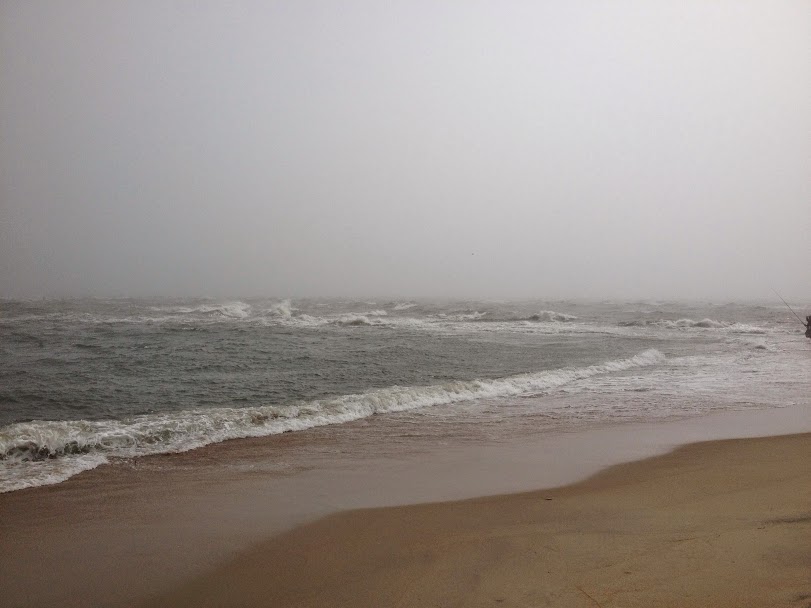
The point of Cape Hatteras. You can almost literally see the dividing line between temperate and subtropical waters. The foam line is likely a result of the waves hitting the base of Diamond Shoals, an expanse of shifting sandbars that extend straight out from the point and act as a magnet for shipwrecks.
As you’d expect from an area where two massive currents slam into each other, the water was pretty rough.
Though the nearby fishermen didn’t pull in anything while I was there, the bird activity suggested ready availability of food in this productive environment.

One of the jobs of a scientist is to reduce natural phenomena down to the base elements that make them work.  This may seem like it would strip the wonder from a place like Cape Hatteras, but knowing how this place works only served to make it more impressive to me.  Knowing why the Outer Banks come to a point in this place didn’t diminish it, and in fact it was totally worth the half-mile walk from the parking lot.  It seemed important that the first time I put a foot in the ocean in 2015 would be here.

Of course, this was the second week of March.  It was pretty damn cold.
Share this:

  • Click to share on Bluesky (Opens in new window) Bluesky
  • Click to share on Facebook (Opens in new window) Facebook
  • Click to share on Reddit (Opens in new window) Reddit
  • Click to share on Threads (Opens in new window) Threads
  • Click to share on WhatsApp (Opens in new window) WhatsApp
  • Click to share on Mastodon (Opens in new window) Mastodon

Related

Tags: Cape Hatteras Gulf Stream Labrador Current

Post navigation

❮ Previous Post: How to write and publish a scientific paper in the field of marine ecology and conservation
Next Post: The place where dissertations go to die … ❯

You may also like

Blogging
Of all the things that haven’t happened, these are the things that haven’t happened in the Ocean so far this year
February 16, 2024
Science
Saying goodbye to an old friend: The R/V Cape Hatteras returns home from her final voyage
January 30, 2013

One thought on “Dipping a Toe in the Confluence”

  1. ElOceanografo says:
    March 17, 2015 at 3:25 pm

    I had a similar feeling once in college, when I walked out to the tip of Point Arena, where the San Andreas Fault heads out to sea. Standing there at the intersection of the North American and Pacific tectonic plates, and the cliff between the land and sea…a unique sensation, which was made even more impressive by my knowledge of the geology around me.

Comments are closed.

Popular Posts

I can serve on your graduate thesis committee. Here’s what you can expect of me, and what I expect in return.I can serve on your graduate thesis committee. Here’s what you can expect of me, and what I expect in return.October 16, 2025David Shiffman
Florida angler catches (and likely kills) Endangered great hammerhead sharkFlorida angler catches (and likely kills) Endangered great hammerhead sharkFebruary 13, 2012David Shiffman
Marine Biology Career AdviceMarine Biology Career AdviceMay 30, 2025David Shiffman
Full video of injured shark shows numerous natural injuriesFull video of injured shark shows numerous natural injuriesMay 3, 2011David Shiffman
Severely injured great white shark found, are scientists responsible?Severely injured great white shark found, are scientists responsible?March 29, 2011David Shiffman
What Ocean Ramsey does is not shark science or conservation: some brief thoughts on "the Shark Whisperer" documentaryWhat Ocean Ramsey does is not shark science or conservation: some brief thoughts on "the Shark Whisperer" documentaryJuly 2, 2025David Shiffman
That's not a blobfish: Deep Sea Social Media is Flooded by AI SlopThat's not a blobfish: Deep Sea Social Media is Flooded by AI SlopDecember 19, 2025Andrew Thaler
Bipartisan Concern Expressed Over Deep Sea Mining at Congressional HearingBipartisan Concern Expressed Over Deep Sea Mining at Congressional HearingJanuary 23, 2026Angelo Villagomez
Ocean Anti-Kickstarter of the Month: Triton Gills is almost certainly a scamOcean Anti-Kickstarter of the Month: Triton Gills is almost certainly a scamMarch 25, 2016Andrew Thaler
What does the new species of hammerhead mean for shark science and conservation?What does the new species of hammerhead mean for shark science and conservation?November 11, 2013David Shiffman
Subscribe to our RSS Feed for updates whenever new articles are published.

We recommend Feedly for RSS management. It's like Google Reader, except it still exists.

Southern Fried Science

  • Home
  • About SFS
  • Authors
  • Support SFS


If you enjoy Southern Fried Science, consider contributing to our Patreon campaign.

Copyright © 2026 Southern Fried Science.

Theme: Oceanly Premium by ScriptsTown