Skip to content

Southern Fried Science

Over 15 years of ocean science and conservation online

  • Home
  • About SFS
  • Authors
  • Support SFS

What kind of scientist do you want to – and should you – be?

Posted on September 2, 2015 By Bluegrass Blue Crab
Uncategorized

Last month, I had the great privilege of attending the 100th Ecological Society of America meeting. This meant there were many opportunities to reflect upon the last century of ecological science and think about what worked, what didn’t, and where we go from here. As with many of the sciences, this involved a lot of hypothesizing about what a future successful scientific career will look like. Almost unanimously agreed upon was the fact that the rigid and one-track paths of the past are crumbling around us as we speak. Ecology also has much to teach the world, in an age of trying to deal with global issues of climate change, food security, and ecosystem service conservation.

In one of these sessions, a number of the speakers pointed to a book written about 1990’s scientific practice by Donald Stokes called Pasteur’s Quadrant. While an old reference now, the speakers encouraged us that we haven’t truly taken the message to heart yet, and that the type of inward gaze on scientific culture is exactly what we need today. In short, Stokes classified scientists into four types, depending on whether their mission was to advance understanding of the universe, help solve real-life issues, both, or neither. He then aligned some well-known scientists with each category.pasteur_quadrant
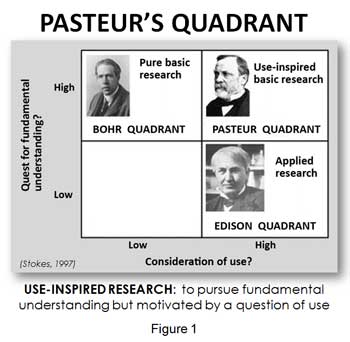
 

In the ecological world and the talks at ESA, the lower right quadrant was occupied by natural historians – people with deep local knowledge but without much practical use. Each person who presented the quadrants included a different natural historian, which made the general point: no one remembers people who work in this quadrant, but that doesn’t mean that they’re not important or that folks in other quadrants don’t rely on their work regularly.

More generally, the conversation of who goes where brings up an overlay of professional rewards. People who win Nobel prizes, or MacArthur awards in ecology, almost all fit in the Bohr quadrant. People remembered popularly by members of the public over centuries  almost all fit in the Edison quadrant. However, potentially the most impactful (if unappreciated) work falls within Pasteur’s quadrant, where it can meet the needs of both scientific and public audiences. Stokes went on to say that more people should be trained and rewarded for use-inspired research.

In the coming century of ecology, and all science, we are tasked with advancing our knowledge of the universe while also contributing to some very large global issues. Pasteur and others like him are living proof that achieving both goals simultaneously is possible. Not everyone can be Pasteur, as we rely on workers in all four quadrants to put together a complete scientific profile. But we could help out future generations by redefining one kind of success as use-inspired theory building. By cutting down the basic/applied divide and admitting that doing applied work does not make you a lesser scientist. And remember to give credit to your natural historians.

Share this:

  • Click to share on Bluesky (Opens in new window) Bluesky
  • Click to share on Facebook (Opens in new window) Facebook
  • Click to share on Reddit (Opens in new window) Reddit
  • Click to share on Threads (Opens in new window) Threads
  • Click to share on WhatsApp (Opens in new window) WhatsApp
  • Click to share on Mastodon (Opens in new window) Mastodon

Related

Tags: applied science basic science pasteur's quadrant use-inspired basic research

Post navigation

❮ Previous Post: Three ways to support Southern Fried Science and Ocean Outreach
Next Post: When conservation scientists talk the talk but don’t walk the walk ❯

Popular Posts

Shark scientists want their research to help save threatened species, but don’t know how. Our new paper can help.Shark scientists want their research to help save threatened species, but don’t know how. Our new paper can help.December 1, 2025David Shiffman
Norway and Cook Islands put their deep-sea mining plans on pause.Norway and Cook Islands put their deep-sea mining plans on pause.December 3, 2025Andrew Thaler
What Ocean Ramsey does is not shark science or conservation: some brief thoughts on "the Shark Whisperer" documentaryWhat Ocean Ramsey does is not shark science or conservation: some brief thoughts on "the Shark Whisperer" documentaryJuly 2, 2025David Shiffman
What we know we don't know: impacts of deep-sea mining on whales, dolphins, sharks, turtles, and other migratory species.What we know we don't know: impacts of deep-sea mining on whales, dolphins, sharks, turtles, and other migratory species.November 20, 2025Andrew Thaler
2025: My year in writing, public speaking, and media interviews2025: My year in writing, public speaking, and media interviewsDecember 3, 2025David Shiffman
The Trouble with Teacup PigsThe Trouble with Teacup PigsOctober 14, 2012Andrew Thaler
Urea and Shark OsmoregulationUrea and Shark OsmoregulationNovember 15, 2010David Shiffman
How tiny satellites are tracking marine wildlifeDecember 1, 2025Andrew Thaler
Shark of Darkness: Wrath of Submarine is a fake documentaryShark of Darkness: Wrath of Submarine is a fake documentaryAugust 10, 2014Michelle Jewell
Build a dirt cheap, tough-as-nails field computer in a Pelican caseBuild a dirt cheap, tough-as-nails field computer in a Pelican caseJuly 21, 2015Andrew Thaler
Subscribe to our RSS Feed for updates whenever new articles are published.

We recommend Feedly for RSS management. It's like Google Reader, except it still exists.

Southern Fried Science

  • Home
  • About SFS
  • Authors
  • Support SFS


If you enjoy Southern Fried Science, consider contributing to our Patreon campaign.

Copyright © 2025 Southern Fried Science.

Theme: Oceanly Premium by ScriptsTown