Skip to content

Southern Fried Science

Over 15 years of ocean science and conservation online

  • Home
  • About SFS
  • Authors
  • Support SFS

Comparing the OpenCTD to a YSI Castaway

Posted on September 21, 2024September 21, 2024 By Andrew Thaler
Education, Featured, Oceanography for Everyone

For close to two decades now, the venerable YSI Castaway has been the gold standard for small, relatively cheap, handheld CTDs. In the early days of OpenROV, the robot’s little payload bay was sized explicitly to fit a Castaway. When Kersey and I started building the OpenCTD, our benchmark for viability was how well the device stacks up against a YSI Castaway.

It stacks up pretty well, but for a variety of logistical reasons, every time I’ve gone out to do a head to head comparison with the OpenCTD, we’ve either ended up deploying against a more expensive commercial CTD or the Castaway we wanted to test against was out of calibration (in practice, at least half of the small handheld CTDs we’ve tested, not all of which were YSI Castaways, were out of calibration, largely because small labs working on limited research grants don’t often have the resources, time, or personnel to keep up with proprietary maintenance programs).

By good fortune, at the last OpenCTD workshop I ran, we did finally manage to deploy in tandem with a YSI Castaway.
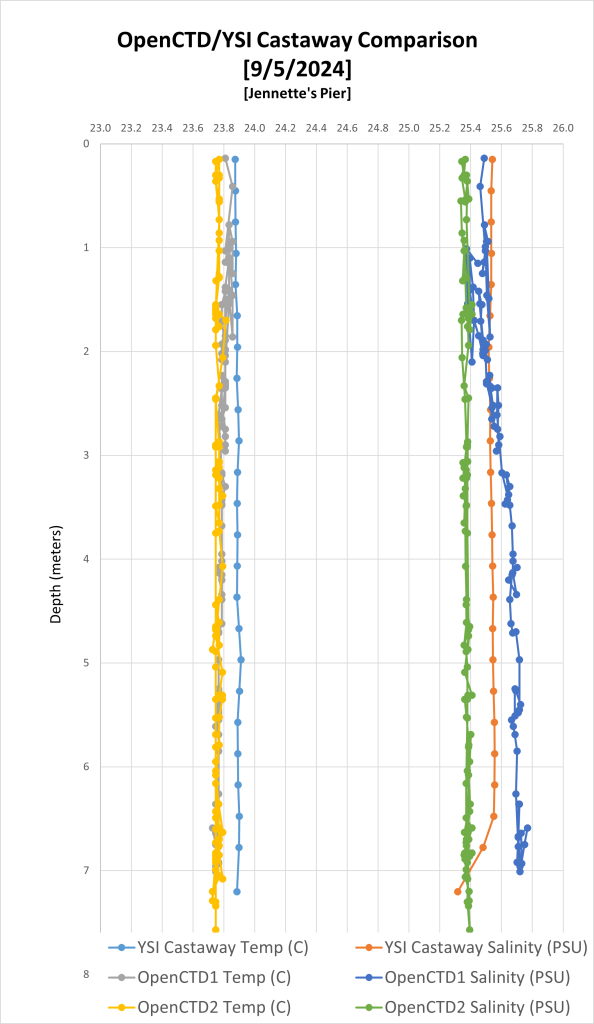
Two freshly build OpenCTDs compared against a commercial YSI Castaway.

Not too shabby! Our target has been 5% error, but this pair of freshly built CTDs was well below 1% deviation from the commercial sensor package. The unintuitive thing I’ve learned about low-cost instrumentation over the last decade is that the trade-off with cheap DIY sensors is often the speed rather than the accuracy. The OpenCTD is slow and you have to take your time to get good readings, but the data itself is often just as good as commercial alternatives.

This month, I’m in Alaska training students and educators to build, maintain, calibrate, and deploy their own CTDs for a fraction of the cost of commercial units without sacrificing data quality. You can follow along on Instagram (and occasionally Bluesky).

I am beginning to schedule OpenCTD workshops for 2025. If you want to host an OpenCTD building workshop at your institution, please get in touch through Oceanography for Everyone. Over the course of 3 days, we can go from a pile of electronics and hardware store components into working CTDs, ready for research. No experience needed.


Southern Fried Science is free and ad-free. Southern Fried Science and the OpenCTD project are supported by funding from our Patreon Subscribers. If you value these resources, please consider contributing a few dollars to help keep the servers running and the coffee flowing. We have stickers.
Share this:

  • Share on Bluesky (Opens in new window) Bluesky
  • Share on Facebook (Opens in new window) Facebook
  • Share on Reddit (Opens in new window) Reddit
  • Share on Threads (Opens in new window) Threads
  • Share on WhatsApp (Opens in new window) WhatsApp
  • Share on Mastodon (Opens in new window) Mastodon

Related

Tags: OpenCTD

Post navigation

❮ Previous Post: Catching up with the Cephalosquad on Dugongs and Sea Dragons
Next Post: My remarks for Biodiversity Leaders for Harris Walz ❯

You may also like

Weekly Salvage
Building the future with open hardware. Monday Morning Salvage: March 27, 2017
March 26, 2017
Featured
A calling card for oceanographers
May 24, 2024
Science
What does an OpenCTD mean to marine ecologists?
July 26, 2013
Uncategorized
Watch Blue Pints Episode 9: Building a low cost open-source CTD and why dolphins make terrible midwives
May 27, 2013

Popular Posts

What Ocean Ramsey does is not shark science or conservation: some brief thoughts on "the Shark Whisperer" documentaryWhat Ocean Ramsey does is not shark science or conservation: some brief thoughts on "the Shark Whisperer" documentaryJuly 2, 2025David Shiffman
At least 74 practicing shark researchers: How a silly thing I said online raised thousands for conservationAt least 74 practicing shark researchers: How a silly thing I said online raised thousands for conservationFebruary 26, 2025David Shiffman
That's not a blobfish: Deep Sea Social Media is Flooded by AI SlopThat's not a blobfish: Deep Sea Social Media is Flooded by AI SlopDecember 19, 2025Andrew Thaler
Here are some ocean conservation technologies that I'm excited aboutHere are some ocean conservation technologies that I'm excited aboutFebruary 19, 2026David Shiffman
Shark of Darkness: Wrath of Submarine is a fake documentaryShark of Darkness: Wrath of Submarine is a fake documentaryAugust 10, 2014Michelle Jewell
Alberta, Canada is the proud owner of the largest man-made pyramid on the planetAlberta, Canada is the proud owner of the largest man-made pyramid on the planetOctober 16, 2012Andrew Thaler
The story of the pride flag made from NASA imagery: Bluesky's most-liked imageThe story of the pride flag made from NASA imagery: Bluesky's most-liked imageSeptember 27, 2024David Shiffman
The Urgency Does Not Exist: My statement on Deep-sea Mining to the Subcommittee on Energy and Mineral ResourcesThe Urgency Does Not Exist: My statement on Deep-sea Mining to the Subcommittee on Energy and Mineral ResourcesJanuary 24, 2026Andrew Thaler
A quick and dirty guide to making custom feeds on BlueskyA quick and dirty guide to making custom feeds on BlueskyFebruary 7, 2024Andrew Thaler
Here's what I teach my students about finding jobs in marine biology and conservationHere's what I teach my students about finding jobs in marine biology and conservationApril 10, 2024David Shiffman
Subscribe to our RSS Feed for updates whenever new articles are published.

We recommend Feedly for RSS management. It's like Google Reader, except it still exists.

Southern Fried Science

  • Home
  • About SFS
  • Authors
  • Support SFS


If you enjoy Southern Fried Science, consider contributing to our Patreon campaign.

Copyright © 2026 Southern Fried Science.

Theme: Oceanly Premium by ScriptsTown