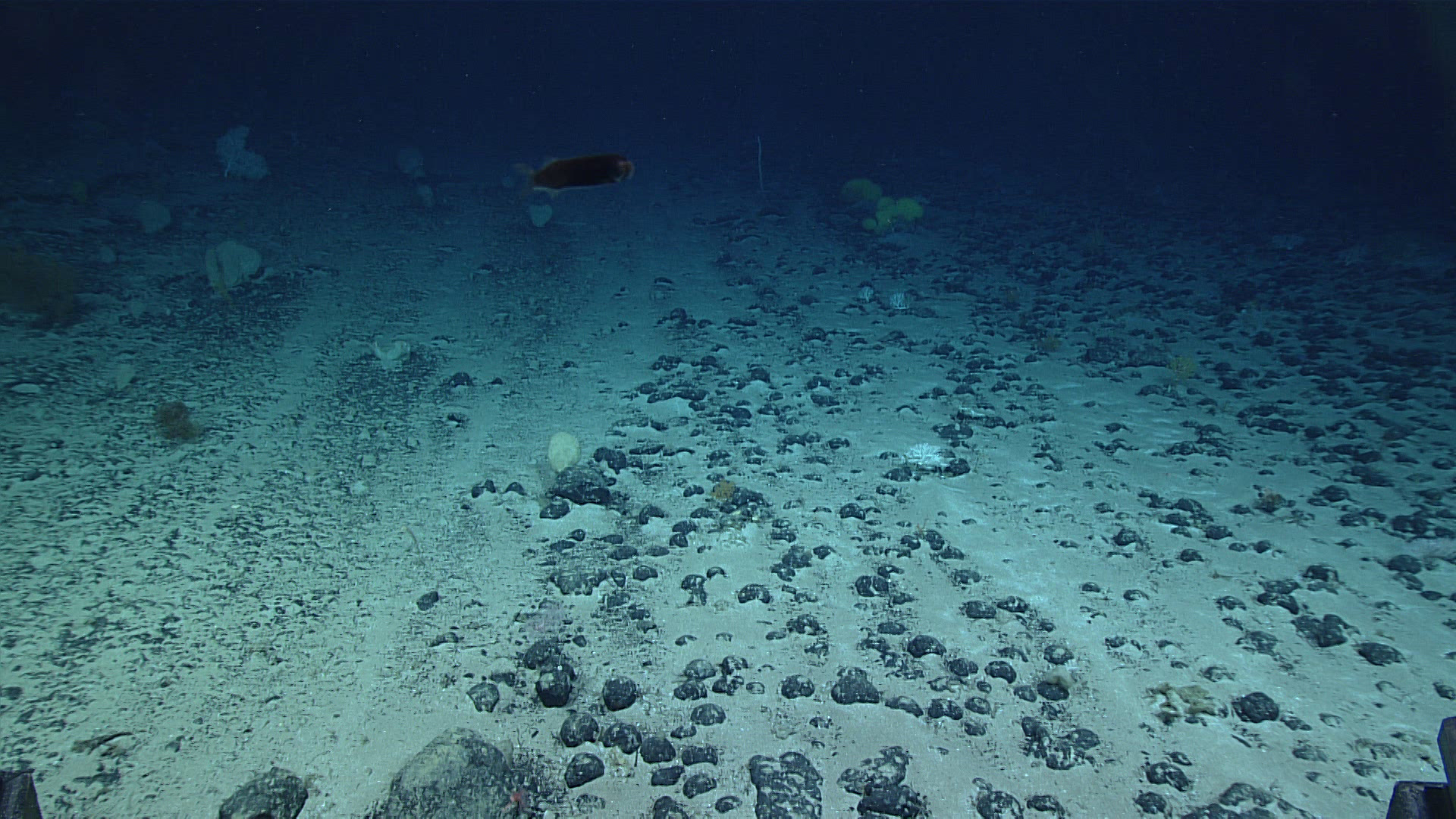
Late yesterday afternoon, the President signed and executive order on Unleashing America’s Offshore Critical Minerals and Resources. This order accelerates the US’s expansion into the nascent deep-sea mining industry, asserts its claims over minerals of the US outer continental shelf, and reasserts its claims over mineral deposits in the high seas, with some interesting caveats.
The message is clear: the United States intends to enter the Deep-sea Mining Industry.
Deep-sea mining is fundamentally an industry of energy transition. The strongest and most compelling argument for going to sea is that, if battery technology stays stagnant, we need metals, particularly cobalt and nickel, to move towards renewable energy and avoid the worst projected outcomes of fossil-fuel driven climate change. That includes a lot of big ifs and a lot of big opportunities. I have long argued that the urgency of deep-sea mining is artificial. We have time to perfect the technology, to comprehensively understand the scope of environmental impacts, and to build an international industry that rejects the historic injustices of terrestrial mining.
The ocean is not beholden to the burn-rate of private companies.
Deep-sea Mining is Three Different Industries
Though often lumped together, deep-sea mining is really three different industries. Polymetallic nodules mining is the removal of polymetallic (née manganese) nodules from the surface of the abyssal plain. Cobalt-rich crust mining is the comprehensive removal of the top layers of seamounts. Seafloor massive sulphide mining is the strip mining of hydrothermal vents, both active and inactive.
These are three very different kinds of mining, for different resources, using vastly different techniques. Though geared towards nodule mining, the Executive Order parrots the central flaw of the UN International Seabed Authority mining code by lumping all three kinds of resources into one pot. The EO strays even further afield, defining seabed mineral resources as “polymetallic nodules, cobalt-rich ferromanganese crusts, polymetallic sulfides, heavy mineral sands, phosphorites, and other mineral-bearing materials.”
A unitary mining code is a poison pill that will likely expose any future legislation built on this definition of seabed mineral resources to further legal challenges.
What Critical Minerals are we talking about?
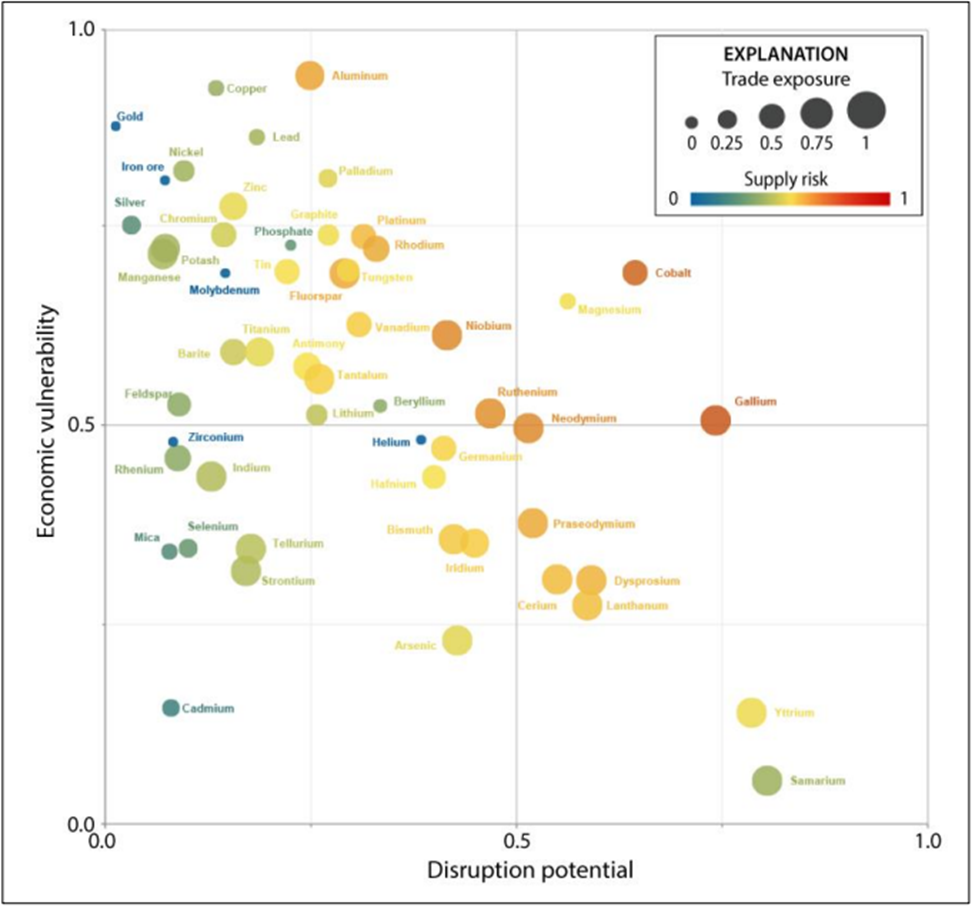
The primary value proposition for deep-sea polymetallic nodule mining is the abundance of cobalt, nickel, and manganese, with some rare earth elements also occurring in quantity. Of those, there are only five critical minerals that the US is entirely import-dependent on that would be derived from deep-sea nodule mining: manganese, gallium, niobium, scandium, and yttrium. Cobalt and nickel enjoy some US production and, counterintuitively, both are currently experiencing historic surpluses. They are economically volatile, but not particularly vulnerable to supply chain issues.
Manganese is the only major product of deep-sea mining that the US is wholly import-dependent, and those imports come largely from Gabon, South Africa, and Mexico. Notably, while manganese represents about half of the projected profit from a deep-sea nodule mine, even the smallest proposed nodule mine would nearly double the global manganese supply, almost certainly causing a massive drop in manganese prices and significantly reducing the profitability of any subsequent nodule-mining operation.
Niobium and yttrium are not particularly vulnerable to supply chain disruption and scandium is produced in such small amounts globally that its vulnerability has not even be assessed. That leaves gallium, which is increasingly important in high-speed charging systems among other renewable energy support technologies. It’s produced from aluminum tailings, but processed almost entirely within China. While gallium does occur in polymetallic nodules, it does not occur in exception quantities, like cobalt and nickel.
Where are we mining?
The Executive Order provides provisions for both mining within the US EEZ through the Outer Continental Shelf Lands Act and the High Seas through the Deep Seabed Hard Minerals Resources Act. With the US, one mining company has submitted a proposal to conducted test mining off the coast of American Samoa. A Canadian-company has long been working with the ISA for permits to mine in international waters in the Clarion-Clipperton Zone, between Hawai’i and the continental US.
No one, however, is mining yet. No mining company has a full-scale commercial nodule production system ready to deploy today. If deep-se mining advances under the US regime, the next few years will likely involve smaller scale test mining.
Southern Fried Science is free and ad-free. Southern Fried Science and the OpenCTD project are supported by funding from our Patreon Subscribers. If you value these resources, please consider contributing a few dollars to help keep the servers running and the coffee flowing. We have stickers.