Skip to content

Southern Fried Science

Over 15 years of ocean science and conservation online

  • Home
  • About SFS
  • Authors
  • Support SFS

Author: Andrew Thaler

Marine science and conservation. Deep-sea ecology. Population genetics. Underwater robots. Open-source instrumentation. The deep sea is Earth's last great wilderness.

Breaching Blue: Because Mermaids are the new Vampires.

Posted on September 1, 2014September 1, 2014 By Andrew Thaler 2 Comments on Breaching Blue: Because Mermaids are the new Vampires.
Popular Culture

breakingblueOriginally posted here: Attack of the paranormal mermaid romance novel: Why you should never, ever lose a bet to David Shiffman, the mermaid novel has taken some surprising turns in the last few months. I recognition, I’ve decided to repost the significantly revised first chapter to entertain. Happy Labor Day, US readers!


They drifted, mindlessly, in an eternal, ocean-spanning arc, bare particles of life, unassuming among the myriad. They drifted, wordlessly, no mouths to speak nor eyes to see. No hands to grasp, not that there was anything to grasp in the great circling gyre. They drifted, aimlessly, their purpose obscured by the haze of their own perception, brains unformed, uninformed ganglia pressing against a translucent carapace. They drifted, ruthlessly, the indomitable walls of baleen sheets, the brutal rasp of gill rakers, the insatiable grasp of dangling tentacles, winnowing their numbers. They drifted, together, a cohort growing stronger even as their siblings fell to the inevitable fate of prey among the flotsam. They drifted until they could drift no more, until their bodies, no longer mindless particles, but tiny facsimiles of their future selves, could challenge the current, assert their dominance over the drift.

No longer drifting, they sought refuge.

***

The reef was old. It rose from the seamount, a honeycomb of chambers stacked one on top of the other. They swam around the perimeter, cautiously. The Ocean was a dangerous place. Who knew what strange predators lurked inside the labyrinthine palace? Janthina went first. She squeezed through a small opening, close to the sea floor. The once generous entrance was overgrown with corals, generation stacked upon generation, each polyp building upon the skeletal remains of its ancestors. Whatever creatures carved this chamber, they abandoned it long ago.

Read More “Breaching Blue: Because Mermaids are the new Vampires.” »

Throwback Thursday: The Birth of @WhySharksMatter

Posted on August 28, 2014 By Andrew Thaler 2 Comments on Throwback Thursday: The Birth of @WhySharksMatter
Blogging

Today we celebrate the 30th birthday of David Shiffman, but the entity known as WhySharksMatter was born on an entirely different day. On January 26, 2009, David officially joined Southern Fried Science and assumed the handle that would soon become the most prolific shark conservation activist online. Here, for posterity, is the original chatlog where we discussed his future handle.

Read More “Throwback Thursday: The Birth of @WhySharksMatter” »

OpenROV is changing the way we think about ocean outreach and citizen science

Posted on August 16, 2014 By Andrew Thaler
Conservation

The SS Tahoe, once the only means of travel across Lake Tahoe, lies in 150 meters of icy, alpine water, scuttled after she outlived her usefulness. The remote lake presents an extreme technical challenge for divers and the wreck has spent her afterlife relatively undisturbed. Only a few dive teams have ever visited her.

Naturally, she makes the perfect target to test out the new, deeper-diving OpenROV.

OpenROV from Fallen Leaf Films on Vimeo.

Read More “OpenROV is changing the way we think about ocean outreach and citizen science” »

A roundup of misleading, deceptive, and dangerous shows produced by Discovery Communications

Posted on August 12, 2014August 12, 2014 By Andrew Thaler 1 Comment on A roundup of misleading, deceptive, and dangerous shows produced by Discovery Communications
Blogging

It’s no secret that we’ve produced quite a bit of critical commentary regarding Discovery Communications (whose properties include Shark Week, Animal Planet, TLC, and many others) over the years. This Shark Week, we’re seeing a massive spike in interest around their less-than-factual productions. Here, for your convenience, is a quick roundup of articles we’ve written about misleading, deceptive, and dangerous shows produced by Discovery Communications.

The Big Three:

  • Mermaids: The New Evidence is a Fake Documentary
  • Megalodon: the New Evidence is a fake documentary
  • Shark of Darkness: Wrath of Submarine is a fake documentary

Read More “A roundup of misleading, deceptive, and dangerous shows produced by Discovery Communications” »

About those lionfish

Posted on July 28, 2014July 28, 2014 By Andrew Thaler 3 Comments on About those lionfish
Blogging

We’ve been monitoring the situation surrounding a south Florida lionfish study that’s been blowing up the headlines thanks to a feel-good story about a young student’s science fair project and a subsequent controversy surrounding a former grad student who feels slighted for having his name left out of the research. We decided not to comment … Read More “About those lionfish” »

Busting Ocean Myths: This anglerfish is not as kink as you think.

Posted on July 28, 2014August 4, 2014 By Andrew Thaler
Science

The claim: Deep-sea Anglerfish have parasitic dwarf males that fuse to their mates and become nothing more than wibbly gonads hanging off of the much larger female. 

Who said it: Well, pretty much everyone. This Oatmeal Comic, Ze Frank, me.

Status: Sometimes true, sometimes false.

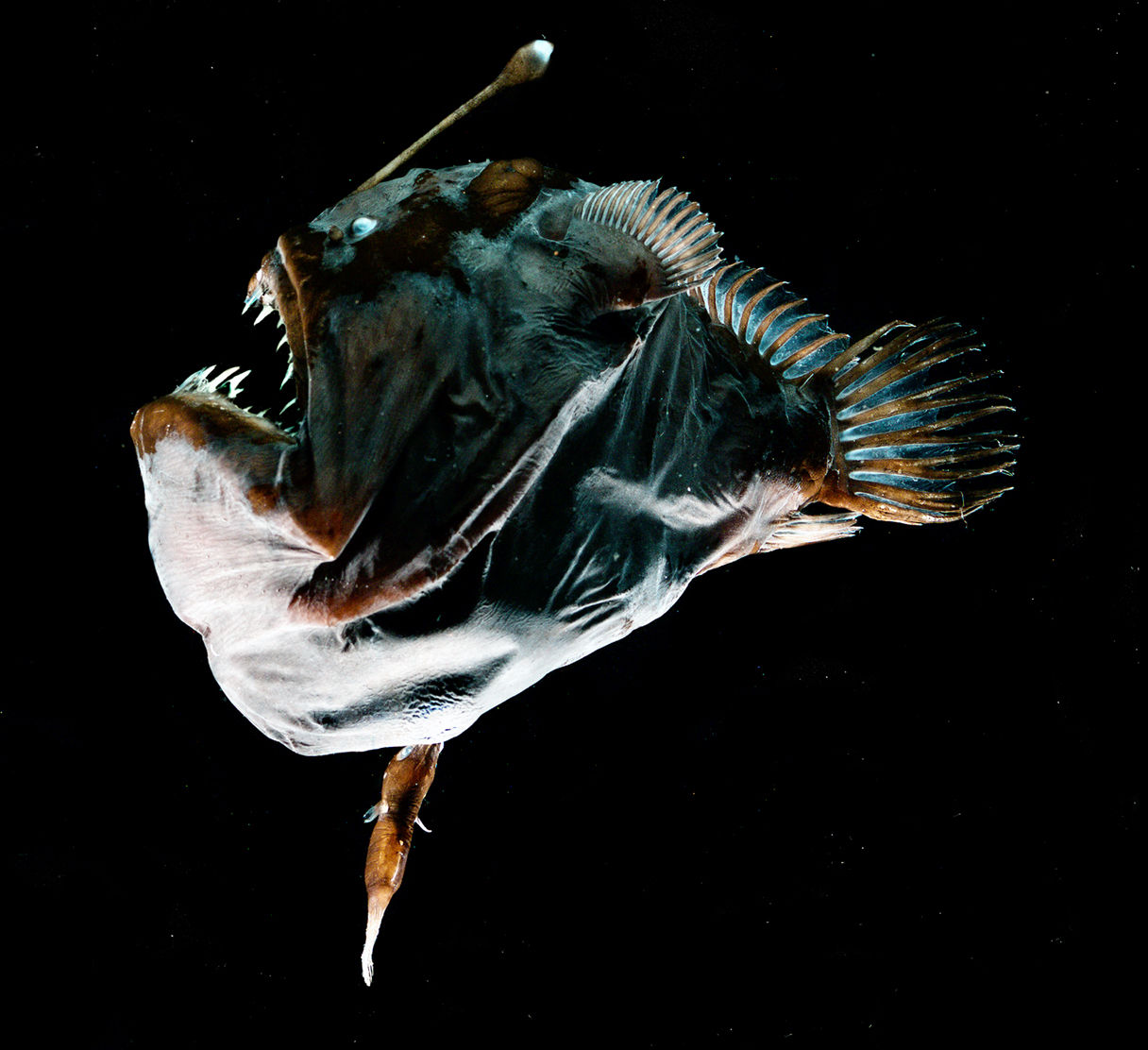
Melanocetus johnsonii. Photo by Edith Widder.

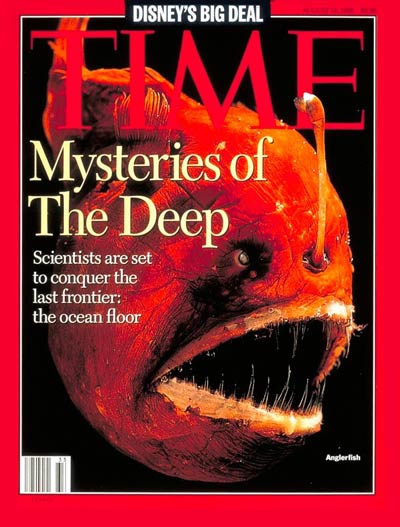
cover-Time-19950814-82066I’d like you to meet a very dear friend of mine. This is Melanocetus johnsonii, the humpback anglerfish. If you follow the deep sea at all, you’ve probably met this delightful creature. She was featured on the cover of time magazine, barely losing out to Newt Gingrich for 1995 Vertebrate of the Year. Since then, she has been a standard-bearer for the deep sea, an iconic species, immediately recognizable. Stories of her exploits abound, and no story is more compelling that the tale of the hapless male anglerfish, a parasitic dwarf that lives its entire adult life fused to the larger, more capable female angler fish.

There’s just one problem.

Melanocetus johnsonii, along with the four other anglerfish that make up genus Melanocetus, don’t have parasitic males. Males of this genus are still significantly smaller and lack lures, but they retain their free-swimming lifestyle into adulthood, occasionally biting into the side of a much larger female for a temporary coupling, where gametes and food are exchanged. This temporary coupling, in which no tissue fusion takes place, has been observed only three times: once during the filming of the BBC Blue Planet documentary; once off the coast of Japan; and once, confusingly between a male Melanocetus johnsonii and a completely different species, Centrophryne spinulosa. In none of these instances was the connection permanent, and no reduced males have even been found attached to a Melanocetus.

Read More “Busting Ocean Myths: This anglerfish is not as kink as you think.” »

Busting Ocean Myths: How many containers are really lost at sea?

Posted on July 27, 2014July 27, 2014 By Andrew Thaler
Uncategorized

The Claim: 10,000 containers are lost at sea every year.

Who said it: Monterey Bay Aquarium Research Institute, Slashdot, Yahoo News, NOAA, me, and many others.

Status: False.

10,000 is one of those numbers that’s big enough to be surprising, but not so huge to inspire immediate incredulity. The worldwide shipping industry is enormous and containers do get lost overboard. With a few recent high-profile maritime accidents, it’s not hard to believe that 10,000 containers could be sent to swim with the fishes every year.

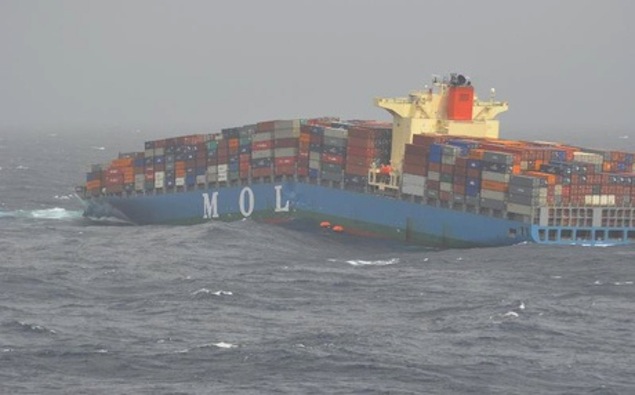
The MOL Comfort breaks its back. Image via gCaptain.

Fortunately, it’s pretty hard to hide a missing container and the number of containers lost at sea is actually much lower than 10,000. In 2011 and 2014, the World Shipping Council surveyed it’s members to find out exactly how many containers are lost at sea each year. What they found was that not only was the number of lost containers an order of magnitude less than the 10,000 figure, but that the average was driven up by two catastrophic accidents–the sinking of the MOL Comfort and the grounding of the MV Rena.

Read More “Busting Ocean Myths: How many containers are really lost at sea?” »

Beyond the Edge of the Plume: understanding environmental impacts of deep-sea mining

Posted on July 21, 2014July 21, 2014 By Andrew Thaler 1 Comment on Beyond the Edge of the Plume: understanding environmental impacts of deep-sea mining
Conservation, Science
Ifremeria nautilei from the Manus Basin. Source: MARUM

The mining of deep-sea hydrothermal vents for gold, copper, and other precious metals, is imminent. Over the last seven years I’ve worked with industry, academia, and international regulatory agencies to help craft guidelines for conducting environmental impact studies and assess the connectivity and resilience of deep-sea ecosystems. Deep-sea mining, particularly at hydrothermal vents, is a complicated endeavor. As an ecologist and environmentalist, I’d like to see all deep-sea ecosystems receive extraordinary levels of protection. As a pragmatist and someone who recognizes that access to technology is a human right, I realize that demand for essential resources like copper, cobalt, and rare earth elements is only going to increase.

Mining a deep-sea hydrothermal vent presents a conundrum. Across the world, vents vary in their longevity and proximity to each other. A fast spreading center like those found in western Pacific back-arc basins, can have numerous, densely packed vents that persist for tens of years. In contrast, ultra-slow spreading centers, like the central Indian Ridge, may have a few, sparsely distributed vents that remain active for centuries. The sustainability of deep-sea mining is completely dependent on the type of vents being mined. Vents in slow spreading centers may never recover from any anthropogenic impact, while those in fast spreading centers could be extremely resilient to the disturbance caused by mining.

Read More “Beyond the Edge of the Plume: understanding environmental impacts of deep-sea mining” »

These things are related.

Posted on July 16, 2014July 16, 2014 By Andrew Thaler 3 Comments on These things are related.
Blogging, Science

Exhibit A. At Boing Boing, Maggie Koerth-Baker publishes an article talking about her disenchantment with Richard Feynman after learning that he was a gigantic womanizing creeper. Matthew Francis follows up with more information about Feyman’s inexcusable behavior. Armies of Feyman supporters rush to his defense, arguing that we should judge him as a product of his times or that he was a great physicist, so we should just ignore the fact that he was a misogynistic creep that, as a faculty member, pretended to be an undergraduate to pick up students. Janet Stemwedel has more.

Read More “These things are related.” »

Why exploding whale stories just won’t die and how we can use them to help save the ocean

Posted on July 15, 2014 By Andrew Thaler
Blogging

Exploding whales are an endless source of amusement, even when they don’t explode. When a cetacean detonation made a guest appearance on Saturday Night Live, it was clear that we had reached peak exploding whale saturation. Now that we’ve all had a few months to decompress, it’s time to take a step back and look at why these stories are important and how we can leverage them into effective ocean outreach.

Good, effective outreach has to have a reason to exist. Outreach without a clearly defined objective is flat and meaningless. Deep-sea fauna with googly eyes exists explicitly to remind people, through the proliferation of viral images, that there is life in the deep sea, an ecosystem few people think about on a day to day basis. The Fukushima Debunking Initiative was created to help halt the proliferation of bad science and pseudoscience that distracted from the real tragedy of the Fukushima-Daichi Nuclear Disaster and shifted attention away from real problems impacting the US West Coast. Hasthewhaleexplodedyet.com was designed to leverage the mass media attention focused on the exploding whale to accomplish one simple goal: to disseminate information about what to do when you encounter a stranded marine mammal.

Read More “Why exploding whale stories just won’t die and how we can use them to help save the ocean” »

Posts pagination

Previous 1 … 54 55 56 … 149 Next

Popular Posts

The story of the pride flag made from NASA imagery: Bluesky's most-liked imageThe story of the pride flag made from NASA imagery: Bluesky's most-liked imageSeptember 27, 2024David Shiffman
"Why Sustainable Seafood Matters" is now available for preorder! Here's what it's about, and why I decided to write it."Why Sustainable Seafood Matters" is now available for preorder! Here's what it's about, and why I decided to write it.June 8, 2026David Shiffman
Tackling the least important debate in deep-sea mining: the desultory hyphenTackling the least important debate in deep-sea mining: the desultory hyphenJune 8, 2026Andrew Thaler
The evolution of the International Whaling Commission – from  whaling quotas to whale conservationThe evolution of the International Whaling Commission – from  whaling quotas to whale conservationJune 10, 2026Chris Parsons
What Ocean Ramsey does is not shark science or conservation: some brief thoughts on "the Shark Whisperer" documentaryWhat Ocean Ramsey does is not shark science or conservation: some brief thoughts on "the Shark Whisperer" documentaryJuly 2, 2025David Shiffman
Deep-sea Mining, Domestic Cats, Star Trek, and Ocean Exploration: Andrew's mid-year podcast round-up.Deep-sea Mining, Domestic Cats, Star Trek, and Ocean Exploration: Andrew's mid-year podcast round-up.June 6, 2026Andrew Thaler
Isn’t ironic, don’t you think: dismantling the Ocean Observatories Initiative on World Oceans DayIsn’t ironic, don’t you think: dismantling the Ocean Observatories Initiative on World Oceans DayJune 9, 2026Southern Fried Science
Shark of Darkness: Wrath of Submarine is a fake documentaryShark of Darkness: Wrath of Submarine is a fake documentaryAugust 10, 2014Michelle Jewell
What is a Sand Shark?What is a Sand Shark?November 12, 2017Chuck Bangley
That's not a blobfish: Deep Sea Social Media is Flooded by AI SlopThat's not a blobfish: Deep Sea Social Media is Flooded by AI SlopDecember 19, 2025Andrew Thaler
Subscribe to our RSS Feed for updates whenever new articles are published.

We recommend Feedly for RSS management. It's like Google Reader, except it still exists.

Southern Fried Science

  • Home
  • About SFS
  • Authors
  • Support SFS


If you enjoy Southern Fried Science, consider contributing to our Patreon campaign.

Copyright © 2026 Southern Fried Science.

Theme: Oceanly Premium by ScriptsTown