
Skip to content

Southern Fried Science

Over 15 years of ocean science and conservation online

  • Home
  • About SFS
  • Authors
  • Support SFS

Author: Andrew Thaler

Marine science and conservation. Deep-sea ecology. Population genetics. Underwater robots. Open-source instrumentation. The deep sea is Earth's last great wilderness.

The Incredible Shrinking Cups: Surprise Shark!

Posted on April 12, 2013April 4, 2013 By Andrew Thaler
Science

We actually watched an Oceanic White-tip take several lunges at the ROV Isis on her way down. Sadly, she was only visible on the umbilical camera (a low-res upward facing camera we use to watch the status of the ROV’s tether), which we don’t record. What’s all this about?

Surviving Grad School: Credit Cards, Reimbursement, and International Travel

Posted on April 11, 2013April 11, 2013 By Andrew Thaler
Science

headshot-thalerSMALLReimbursements and International Travel

Graduate school comes with several financial challenges that require planning and careful attention to details. Chief among these challenges are the two big wallet busters: university reimbursements and international travel. Often these two combine to form a deadly, money sucking hydra. You will inevitably need to pay for something – airline tickets, hotels, fuel, equipment, contractors – out of your personal funds, and then file for reimbursement with your university. Depending on how efficient your finance office is, it could take anywhere from four days to several months for your reimbursement to be issued. If you paid with a credit card, during this time you’re paying interest on those charges.

International travel adds another layer to the mix.  Most credit card companies will charge a foreign transaction fee (often 3%), there’s a high degree of variability regarding which networks are accepted where, and many nations have adopted EMV chips (a feature few US cards have) for added security. Whether it’s for a field season or a major scientific conference, you will probably have to make at least one big international trip. If you haven’t planned ahead, you may find yourself stuck with little or no functional currency, and end up leaning heavily on cash advances, travelers checks, or other high fee alternatives.

You should use a credit card to pay for reimbursable expenses, especially travel, if for no other reason than you need money in your bank account for things like food and shelter. If you’ve read my previous post–Credit, why it matters, how to build it, and how to use it–then this should seem familiar. I’m talking about your tank, with some particular caveats for international travel. If you’ve planned ahead and paid attention to the details, you can carry an extra balance for several months without incurring any additional fees.

Read More “Surviving Grad School: Credit Cards, Reimbursement, and International Travel” »

Surviving Grad School: Credit, why it matters, how to build it, and how to use it

Posted on April 10, 2013September 24, 2014 By Andrew Thaler 5 Comments on Surviving Grad School: Credit, why it matters, how to build it, and how to use it
Science

headshot-thalerSMALLGraduate school can be a financially volatile time. Grad students, often living on a low, fixed income, may find that they are required to shoulder unexpected expenses–new computers, travel for research, professional attire, not to mention the cost of relocating to a new area. Many graduate students arrive straight out of university, having never needed to manage a household’s finances. In this situation, credit seems like an appealing solution. If used conservatively, a few reasonable lines of  credit can help the struggling graduate student get the most out of their financial situation. If used carelessly, credit can saddle you with massive debt that will follow you for years after graduate school. As we’ve argued in our previous posts about surviving grad school, beyond student loans, earning an advanced degree shouldn’t put you into debt.

But there is another reason to maintain a few active lines of credit. Your credit score is how banks decide whether or not to give you a loan. If you want to buy a house or a car, most people will need to finance that purchase, and for that you need a decent credit score. Having a good credit score will result in lower interest rates and save you money. Many landlords, especially in big cities, require credit checks just to rent an apartment. Credit can also help you out in an emergency. If the transmission drops out of your truck or you have to make a last minute cross-country trip to visit a sick relative, credit will allow you to pay off that expense over a few months, rather than taking a major hit to your savings all at once.

Relying too heavily on credit, and failing to pay of the bills in a timely manner, will crush you with increasingly growing debt. Learning to manage credit is an important life skill, especially in countries like the United States, where credit is king.

Read More “Surviving Grad School: Credit, why it matters, how to build it, and how to use it” »

The Incredible Shrinking Cups: Anemones

Posted on April 10, 2013April 4, 2013 By Andrew Thaler
Science

The anemones around Beebe weren’t quite this colorful, but they were still fantastic. What’s this all about?

The Incredible Shrinking Cups: Rimicaris hybisae

Posted on April 8, 2013April 4, 2013 By Andrew Thaler
Science

What’s this all about?

The Incredible Shrinking Cups: Welcome to the Cayman Abyss

Posted on April 5, 2013April 4, 2013 By Andrew Thaler 4 Comments on The Incredible Shrinking Cups: Welcome to the Cayman Abyss
Science

One of the great traditions among deep-sea scientists is the shrinking of polystyrene cups by sending them down to our research sites. Polystyrene (or Styrofoam) is mostly empty space. When sent to the bottom of the sea, the massive pressure (an additional atmosphere for every 10 meters depths) squeezes the air out of these empty spaces … Read More “The Incredible Shrinking Cups: Welcome to the Cayman Abyss” »

World’s only giant squid pulls off greatest prank in history

Posted on April 1, 2013April 1, 2013 By Andrew Thaler 1 Comment on World’s only giant squid pulls off greatest prank in history
Science

headshot-thalerSMALLThere is only one giant squid, her name is Ducky, and she’s orchestrated the greatest prank in history.

No, I don’t mean that there’s only one species of giant squid,  Architeuthis dux, as was recently revealed by marine science rising star Inger Winkelmann, although it’s true. I mean that there is only one individual Archituethis dux, her name must naturally be Ducky, and, for the last 3 decades, she’s been messing with us.

Let us review the evidence:

Read More “World’s only giant squid pulls off greatest prank in history” »

Sea Leveler Update

Posted on March 29, 2013October 28, 2013 By Andrew Thaler

Earlier this week I launched the Sea Leveler, and open-source, arduino-powered, water level meter that measure the activity of tweets about #sealevelrise on twitter. Not surprisingly, the first full week of trial revealed a few bugs in the machine. The first thing you’ll notice is that, in addition to recording tweets about sea level rise, … Read More “Sea Leveler Update” »

Meet Sea Leveler: the open source water level gauge that wants you to talk about #sealevelrise

Posted on March 26, 2013March 14, 2022 By Andrew Thaler 2 Comments on Meet Sea Leveler: the open source water level gauge that wants you to talk about #sealevelrise
Science

headshot-thalerSMALL

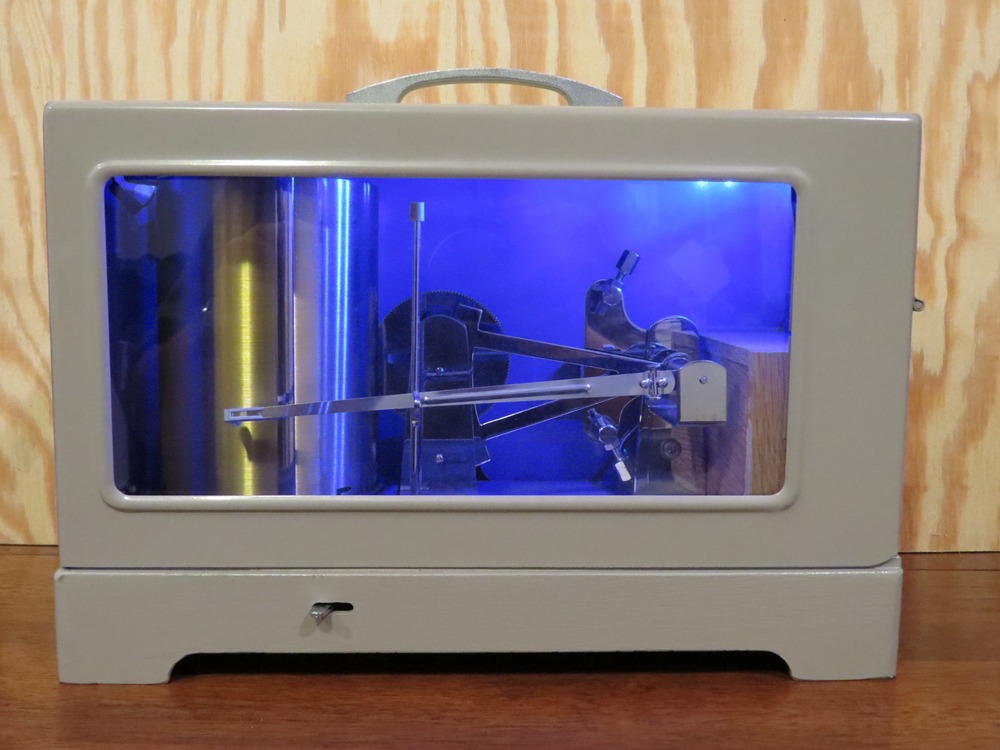
The Sea Leveler, an open source water level gauge that measures activity on twitter.
The Sea Leveler, an open source, arduino-powered, water level gauge that measures activity on twitter.

Two weeks ago, a machine was left on the “free” table at my lab that surprised me–a beautiful stainless steel mechanical water level gauge, on of those old ones with a flywheel in the back that drives the mechanism. Seeing this made me realize that there must be thousands of old scientific devices rusting away in laboratories across the country, obsolete but too well-build to just be thrown out. Then, I thought, there must be some way to take these old tools, some of them elegant, hand crafted works of industrial art, and give them a second life. For Science Online Oceans, I proposed a section on “Hacking the Ocean” developing low-cost, DIY instrumentation to make oceanography accessible to a broader community, but could that work the other way? Can we harness that same maker mentality to take abandoned scientific instrumentation and turn them into tools for education and outreach, or create art through instrumentation?

So I built the Sea Leveler.

http://www.youtube.com/watch?v=UI6p5QxTDEU

Read More “Meet Sea Leveler: the open source water level gauge that wants you to talk about #sealevelrise” »

Watch these giant deep-sea isopods go about their day

Posted on March 20, 2013March 20, 2013 By Andrew Thaler 1 Comment on Watch these giant deep-sea isopods go about their day
Science

headshot-thalerSMALLYou know the good stuff is going to keep rolling in from my research cruise to Mid-Cayman Spreading Center. At the end of JC82, we had the opportunity to join a bolt-on cruise to explore the seabed around Montserrat. During a biological survey of the surrounding abyssal plain, we twice stumbled on a giant deep-sea isopods hanging out on the sea floor, doing their isopod thing. This was my first opportunity to observe a giant deep-sea isopod (Bathynomus giganteus*) alive and in the wild. My previous experiences have been limited to well preserved specimens.

Giant isopod behavior is not something that falls within my expertise. Like Craig McClain at Deep Sea News, I’m fascinated by the evolution of their large body size and how a relatively abundant population of such giants can be supported in the food limited deep benthos. But giant isopods are not common in my study area and what little I know of their behavior comes from the very few videos available, mostly of them scavenging on baited camera traps. So I was pretty surprised when the ROV Isis came across this delightful giant maintaining its burrow.

httpv://youtu.be/5B2uT_Vp-UY

This isn’t the first time Bathynomus burrowing has been observed; the behavior is actually fairly well documented (at least, well-documented for deep-sea species). But as fascinating as watching a 20+ centimeter-long roly-poly digging it’s hole 800 meters deep on the seafloor near one of the most active volcanoes in the Caribbean is, what we found next was even more amazing:

Read More “Watch these giant deep-sea isopods go about their day” »

Posts pagination

Previous 1 … 67 68 69 … 149 Next

Popular Posts

The story of the pride flag made from NASA imagery: Bluesky's most-liked imageThe story of the pride flag made from NASA imagery: Bluesky's most-liked imageSeptember 27, 2024David Shiffman
"Why Sustainable Seafood Matters" is now available for preorder! Here's what it's about, and why I decided to write it."Why Sustainable Seafood Matters" is now available for preorder! Here's what it's about, and why I decided to write it.June 8, 2026David Shiffman
Tackling the least important debate in deep-sea mining: the desultory hyphenTackling the least important debate in deep-sea mining: the desultory hyphenJune 8, 2026Andrew Thaler
The evolution of the International Whaling Commission – from  whaling quotas to whale conservationThe evolution of the International Whaling Commission – from  whaling quotas to whale conservationJune 10, 2026Chris Parsons
What Ocean Ramsey does is not shark science or conservation: some brief thoughts on "the Shark Whisperer" documentaryWhat Ocean Ramsey does is not shark science or conservation: some brief thoughts on "the Shark Whisperer" documentaryJuly 2, 2025David Shiffman
Deep-sea Mining, Domestic Cats, Star Trek, and Ocean Exploration: Andrew's mid-year podcast round-up.Deep-sea Mining, Domestic Cats, Star Trek, and Ocean Exploration: Andrew's mid-year podcast round-up.June 6, 2026Andrew Thaler
Shark of Darkness: Wrath of Submarine is a fake documentaryShark of Darkness: Wrath of Submarine is a fake documentaryAugust 10, 2014Michelle Jewell
Isn’t ironic, don’t you think: dismantling the Ocean Observatories Initiative on World Oceans DayIsn’t ironic, don’t you think: dismantling the Ocean Observatories Initiative on World Oceans DayJune 9, 2026Southern Fried Science
What is a Sand Shark?What is a Sand Shark?November 12, 2017Chuck Bangley
That's not a blobfish: Deep Sea Social Media is Flooded by AI SlopThat's not a blobfish: Deep Sea Social Media is Flooded by AI SlopDecember 19, 2025Andrew Thaler
Subscribe to our RSS Feed for updates whenever new articles are published.

We recommend Feedly for RSS management. It's like Google Reader, except it still exists.

Southern Fried Science

  • Home
  • About SFS
  • Authors
  • Support SFS


If you enjoy Southern Fried Science, consider contributing to our Patreon campaign.

Copyright © 2026 Southern Fried Science.

Theme: Oceanly Premium by ScriptsTown