Skip to content

Southern Fried Science

Over 15 years of ocean science and conservation online

  • Home
  • About SFS
  • Authors
  • Support SFS

Author: David Shiffman

March conservation madness: endangered species mascots in the NCAA basketball tournament

Posted on March 12, 2012 By David Shiffman 8 Comments on March conservation madness: endangered species mascots in the NCAA basketball tournament
Uncategorized
WhySharksMatter at a previous Final 4 (in the midst of the Great Darwin Beard Challenge)

This weekend was Selection Sunday, the annual revealing of brackets for the NCAA men’s basketball tournament and the official start of “March Madness”. This year’s field of 68 teams features some incredible basketball talent, some heartwarming stories of individuals and teams overcoming adversity… and quite a few schools which use threatened or endangered species as mascots. As I am a huge college basketball fan in addition to being a conservationist, I couldn’t resist a quick tour.

South region:

#11 Colorado
Mascot: Buffaloes. Considered “Near Threatened” by the IUCN Red List, American bison are iconic of the U.S. conservation movement.
First game:  Thursday at 9:57 vs. the #6 UNLV Running Rebels
Expected outcome: Though 6/11 games are often popular picks for upsets, we can expect that not too long from now, Colorado’s fans will speak fondly about the time that their team used to roam the plains of the NCAA tournament in huge numbers.

#3 Baylor
Mascot: Bears (specifically black bears), which Baylor University keeps several of in captivity. According to the bear program’s website,  ” Texas [where Baylor University is located] has a population of 50 North American Black Bears, and is an endangered species within the state of Texas. Nationally, bears are not endangered and have a strong, viable population.”
First game:  Thursday at 7:27 vs the South Dakota State Jackrabbits (species not specified, though most North American jackrabbits are IUCN “Least Concern”.
Expected outcome: About what you’d expect from a fight between a bear and a rabbit (when running away isn’t an option).

Read More “March conservation madness: endangered species mascots in the NCAA basketball tournament” »

Wolf conservation and negative media portrayals: A panel discussion about “The Grey” with wolf experts

Posted on February 29, 2012February 29, 2012 By David Shiffman 3 Comments on Wolf conservation and negative media portrayals: A panel discussion about “The Grey” with wolf experts
Conservation, Popular Culture

A red wolf. Photo credit: DeLene Beland

The recently-released movie “The Grey” tells the story of a pack of wolves that hunts the survivors of a plane crash. In addition to both being the subject of inaccurate and negative media portrayals, wolves and sharks share many ecological similarities (sharks have been called “the wolves of the sea”). A panel of wolf scientists and conservation experts agreed to answer my questions about these animals and their thoughts on how “The Grey”  might impact their conservation.

Dr. Sylvia Fallon  is a senior scientist with the Natural Resources Defense Council. She has worked for the American Association for the Advancement of Science, the Environmental Protection Agency, and the National Park Service.

DeLene Beland is an independent science writer whose work has been featured by the Charlotte Observer, Earth Magazine, and Wildlife in North Carolina. She blogs at Wild Muse, and  is the author of an upcoming book about wolves in the Eastern United States.

Cristina Eisenberg is a Ph.D. student at Oregon State University. Her dissertation focuses on the ecological effects of the loss of wolves from forest ecosystems.

Read More “Wolf conservation and negative media portrayals: A panel discussion about “The Grey” with wolf experts” »

Florida angler catches (and likely kills) Endangered great hammerhead shark

Posted on February 13, 2012February 14, 2012 By David Shiffman 158 Comments on Florida angler catches (and likely kills) Endangered great hammerhead shark
Conservation, Science

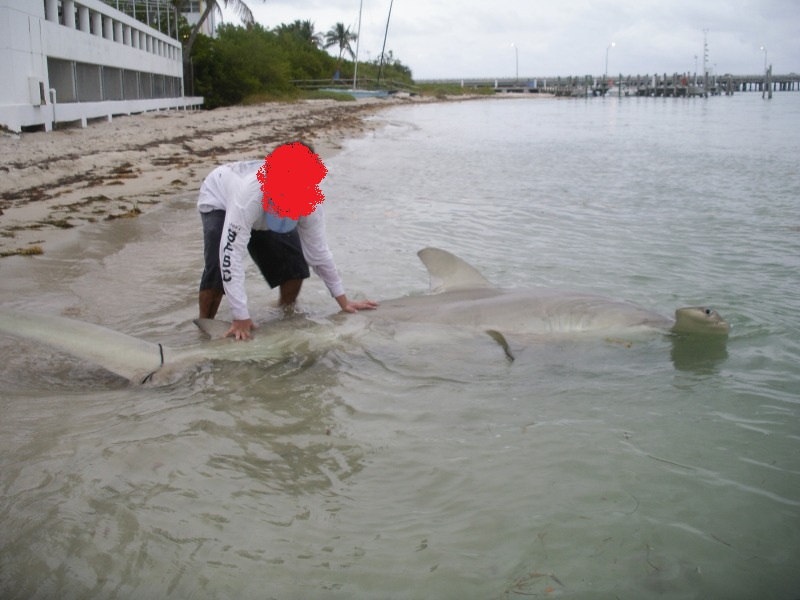
Image taken from the South Florida shark fishing club online forum. Photographer undisclosed. I have blocked out the angler's face to protect his identity

Update: The angler who originally caught the shark has responded. Please see below.

On February 5th, while standing on a beach in Miami,  a fisherman caught a 14 foot great hammerhead shark. According to his account, “we had it beached within an hour of hooking it. The fish weighed too much her girth was huge. Just the 2 of us wasn’t enough to get it out of the water….We snapped some pictures with our dying camera, measured it at 170 inches and spent the next hour walking back and forth with HER reviving her…it swam off slow and steady”

While this might appear to be a simple case of catch-and-release recreational fishing, it is not. My lab and I are  supporters of sustainable catch and release fishing.  However, it is important to note that since January 1, 2012, great hammerheads (an IUCN Red List Endangered species) have been a protected species in Florida state waters and have additional legal protections. The Florida code indicates that:

“(1) No person shall harvest, possess, land, purchase, sell, or exchange any or any part of these species:
…(k) Great hammerhead – Sphyrna mokarran.

…(3) “Harvest” means the catching or taking of a marine organism by any means whatsoever, followed by a reduction of such organism to possession. Marine organisms that are caught but immediately returned to the water free, alive, and unharmed are not harvested”

…(5) “Land,” when used in connection with the harvest of marine organisms, means the physical act of bringing the harvested organism ashore”  Florida code section 68B-44  (Emphasis mine)

In this incident, the shark was brought ashore. We can infer from the statement “the fish weighed too much her girth was huge. Just the 2 of us wasn’t enough to get it out of the water” that the fisherman attempted to pull it all the way out of the water, but was unable to do so (an important legal distinction) . Instead, he ended up beaching it, bringing it so far out that it could not move or breathe. The angler did not immediately release the animal. According to the angler’s account, it was measured and photographed prior to the attempt to resuscitate it. The shark was not released alive and unharmed. By the angler’s own admission, it took over an hour of resuscitation before the animal was able to even swim away slowly.

Read More “Florida angler catches (and likely kills) Endangered great hammerhead shark” »

“Sharks create oxygen”: A scientific perspective

Posted on February 10, 2012 By David Shiffman 14 Comments on “Sharks create oxygen”: A scientific perspective
Conservation, Science

I want to apologize to our regular readers for stating something that should be incredibly obvious. Sharks in in no way connected to the global supply of atmospheric oxygen. If every single species of shark went extinct, there would be a variety of negative ecological effects, but a reduction in the global supply of atmospheric oxygen would not be among them. There is not a shred of scientific evidence supporting the idea that the loss of sharks would affect our oxygen supply- not a single scientific paper, not a single technical report. I’ve attended a dozen scientific conferences focusing on marine ecology or shark biology (including three international conferences) and I’ve never seen or heard of anyone presenting or even discussing this. To the best of my knowledge, not a single person who has authored a scientific paper or technical report supports this idea. Despite the complete lack of any kind of credible evidence, and despite many recent blog posts thoroughly debunking it (see here here here here here here and here ), this pseudoscience  just won’t die.

The premise of the sharks and oxygen claim is as follows:

Read More ““Sharks create oxygen”: A scientific perspective” »

Core Themes for 2012: Focus on nuance

Posted on January 30, 2012January 31, 2012 By David Shiffman
Uncategorized

One of the main advantages of blogs is that they allow knowledgeable parties to write in detail about their area of expertise. Information can now come directly from experts to the interested public.  This provides an  opportunity for those directly involved in an issue to provide context to (and details of) a story. Here at Southern Fried Science, we strive to provide deeper background in topics in which we are knowledgeable, focusing not only on the broader context but on the subtle nuance.

Read More “Core Themes for 2012: Focus on nuance” »

Core themes of 2012: Underrepresented issues in marine science and conservation

Posted on January 26, 2012 By David Shiffman 3 Comments on Core themes of 2012: Underrepresented issues in marine science and conservation
Uncategorized

One of the many unfortunate consequences of the decline in traditional media has been a reduction in science reporting. The formerly great CNN science unit closed in 2008, followed soon after by the health and science page of the Boston Globe. Alarmingly few trained science journalists are left, and people without proper training are being asked to cover the few science stories that still make it on the air ( I was once interviewed about shark research by the weatherman from CNN’s “American Morning”).  With few exceptions, science and conservation stories are no longer considered a priority to the major news networks and newspapers. However, science is no less important to our everyday lives.

Read More “Core themes of 2012: Underrepresented issues in marine science and conservation” »

How to live-tweet a conference: A guide for conference organizers and twitter users

Posted on January 17, 2012January 17, 2012 By David Shiffman 8 Comments on How to live-tweet a conference: A guide for conference organizers and twitter users
Science

Attending scientific conferences is one of my favorite parts of my job. I get to travel to interesting places (and Mobile, Alabama), catch up with colleagues, learn about what smart people all over the world are up to, and get feedback on my own research from those smart people. Conferences help me to learn about the world, network with people in my field, and become a better scientist. To date, I’ve attended 13 conferences (including 3 international ones), and I learn something new at each one.

There are a lot of non-scientists in the world who care about many of the issues discussed at scientific conferences, issues like climate change, endangered species, overfishing, and cool new discoveries about sharks. The overwhelming majority of these non-scientists lack the resources or the time to attend conferences, and many might not even know that they’re happening. In many cases, increased public awareness of a conservation issue is exactly what’s needed to help fix the problem. If the interested public can’t attend conferences and the mainstream media doesn’t typically cover them, how can we get the word out?

Image courtesy twitter.com, used with permission

Part of the answer is social media, the so-called Web 2.0 technologies that simultaneously make it easier than ever before in human history for people to share information with the world (without traditional gatekeepers like the mainstream media), and make it easier than ever before in human history for people to find information about topics they care about. One social media tool that lends itself particularly well to sharing information from a conference is twitter, and live-tweeting conferences is a growing trend. For the purpose of this post, I define live-tweeting (henceforth simply “tweeting”) as simply tweeting about conference presentations and events. This tweeting can take place during the actual conference presentation (in several cases, I’ve been able to relay a question to a presenter from one of my twitter followers during the official question and answer period associated with a presentation), but doesn’t necessarily have to be. At one conference, I simply took notes on talks and tweeted about them later- the only disadvantages of this strategy are that you can’t relay questions from your followers to the presenters and you may be discussing the same topic at a different time as other twitter users.

Presented below is a guide for conference organizers to promote conference tweeting, and a guide for interested twitter users to use the tool to maximum effect. The guide is with specific reference to getting important information from a conference to the interested non-scientist not-present-at-the-conference public. There are many other goals for conference tweeting (taking notes on a conference primarily for personal use, sharing important technical information with colleagues in your field, etc), and the strategies and suggestions below may not be appropriate for these goals.

Read More “How to live-tweet a conference: A guide for conference organizers and twitter users” »

Get marine conservation into the national political conversation with Americans Elect!

Posted on January 12, 2012 By David Shiffman
Conservation

In response to the partisan gridlock in Washington DC, a group called Americans Elect hopes to “open up the political process”. This organization, founded by heavy hitters from both parties, is using the internet to allow anyone registered to vote in the United States, regardless of political affiliation, to nominate candidates for President of the United States. An online convention in June, which every registered Americans Elect user can participate in, will determine the nominee. who will be on official ballots in every state alongside Barack Obama and the Republican nominee (probably Romney but we’ll see).

Additionally, any registered Americans Elect user can propose a question. The top questions, as voted on by all other Americans Elect users, will have to be answered by any potential candidate. These top questions, and the Americans Elect candidates’ responses to them, will undoubtedly attract national media coverage. Presently, most of the top questions are about the economy and foreign policy. None focus on the oceans.

I have submitted a series of marine conservation questions, and I need your help to get them enough votes to earn them “top question” status and get marine conservation into the national political conversation! If you are registered to vote in the United States, please consider registering for Americans Elect and voting for these questions.

Read More “Get marine conservation into the national political conversation with Americans Elect!” »

New app: Learn about great white sharks while supporting research

Posted on January 11, 2012 By David Shiffman 4 Comments on New app: Learn about great white sharks while supporting research
Science

Earlier today, the Marine Conservation Science Institute launched a new iPhone and iPad app focusing on great white sharks. The app, called Expedition White Shark , includes numerous features that let users learn more about these amazing animals.

A game (called “Shark Life”) lets you learn about the life history of great white sharks by controlling a virtual baby great white. Users explore the marine environment near Southern California white eating fish and avoiding threats like gillnets and pollution.

A “news” interface lets you keep up to date on some of the latest exciting discoveries the Marine CSI team makes, and you can learn more about great whites from the “facts” tab. The app also includes numerous photos and videos of great whites and the research team in action.The coolest feature this app contains, however, is the ability to track satellite-tagged great whites.

Read More “New app: Learn about great white sharks while supporting research” »

What hybrid sharks mean (and don’t mean) for climate change and evolution: fact-checking the media coverage

Posted on January 6, 2012January 6, 2012 By David Shiffman 37 Comments on What hybrid sharks mean (and don’t mean) for climate change and evolution: fact-checking the media coverage
Conservation, Science

Photo credit: study author Pascal Geraghty, New South Wales Department of Primary Industry

Last week, a team of 10 Australian scientists announced that they had found the world’s first “shark hybrids”, offspring of individuals from two different shark species which had interbred. During a routine survey of Australian marine life, 57 sharks were found that physically resembled one species of shark, but had genetic markers inconsistent with that species. Subsequent genetic investigation revealed that these 57 animals were hybrids between common blacktip sharks (Carcharhinus limbatus) and Australian blacktip sharks (C. tilstoni).

Some of these hybrids were “F1″, meaning that one parents was a common blacktip and one was an Australian blacktip. Others were “B+”(backcrossed), which means that one parent was a common blacktip/Australian blacktip hybrid, and the other was a “purebreed” of one of those two species. According to the study’s lead author, Dr. Jess Morgan of the University of Queensland, “our genetic marker tells us that these hybrids are ‘at least’ F1, and that these animals are reproductively viable and can produce an F2…the hybrids may be generations past F2 but the existing genetic markers can’t distinguish how many generations past the second cross have occurred.”

Read More “What hybrid sharks mean (and don’t mean) for climate change and evolution: fact-checking the media coverage” »

Posts pagination

Previous 1 … 36 37 38 … 68 Next

Popular Posts

The next OpenCTD is here!The next OpenCTD is here!June 22, 2026Andrew Thaler
What Ocean Ramsey does is not shark science or conservation: some brief thoughts on "the Shark Whisperer" documentaryWhat Ocean Ramsey does is not shark science or conservation: some brief thoughts on "the Shark Whisperer" documentaryJuly 2, 2025David Shiffman
Undermining the Law of the Sea. Some additional thoughts following my OpEd in the Hill.Undermining the Law of the Sea. Some additional thoughts following my OpEd in the Hill.June 22, 2026Andrew Thaler
What is a Sand Shark?What is a Sand Shark?November 12, 2017Chuck Bangley
The story of the pride flag made from NASA imagery: Bluesky's most-liked imageThe story of the pride flag made from NASA imagery: Bluesky's most-liked imageSeptember 27, 2024David Shiffman
Tagging Bull Sharks in the Neuse RiverTagging Bull Sharks in the Neuse RiverAugust 4, 2011Guest Writer
That's not a blobfish: Deep Sea Social Media is Flooded by AI SlopThat's not a blobfish: Deep Sea Social Media is Flooded by AI SlopDecember 19, 2025Andrew Thaler
Our favorite sea monsters – Ningen (#4)Our favorite sea monsters – Ningen (#4)September 7, 2010Andrew Thaler
Rice’s whale and the curious case of the disappearing species.Rice’s whale and the curious case of the disappearing species.June 25, 2026Southern Fried Science
Shark of Darkness: Wrath of Submarine is a fake documentaryShark of Darkness: Wrath of Submarine is a fake documentaryAugust 10, 2014Michelle Jewell
Subscribe to our RSS Feed for updates whenever new articles are published.

We recommend Feedly for RSS management. It's like Google Reader, except it still exists.

Southern Fried Science

  • Home
  • About SFS
  • Authors
  • Support SFS


If you enjoy Southern Fried Science, consider contributing to our Patreon campaign.

Copyright © 2026 Southern Fried Science.

Theme: Oceanly Premium by ScriptsTown