Last week, the International Commission for the Conservation of Atlantic Tunas met in Paris. Among other responsibilities (such as the conservation of Atlantic tunas), ICCAT sets guidelines for several shark fisheries. My friend Sonja Fordham, President of Shark Advocates International, was there representing SAI. She is optimistic about a series of new shark conservation measures that the Commission adopted.
Author: David Shiffman
Happy Thanksgiving! Don’t eat too much. Comic from Shaaark ~WhySharksMatter
Earlier this week, Dr. M of Deep Sea News evaluated President Obama’s science and conservation policies and awarded him a B-. I gave President Obama a C+ overall after his first 100 days in office, noting that some things haven’t had enough time to be given a fair grade, and I think things have gotten much worse since then. I was a little shocked at how high this grade was, and I left Dr. M a snarky comment (sorry, Craig).
In the interest of fairness, I wanted to find a way to objectively grade these policies. The best that I can find is the Obameter, run by non-partisan fact checker Politifact. Basically, they record every promise that President Obama made during the campaign and since he’s become President, and they keep track of how each is progressing. Each is rated “promise kept”, “compromise” (something similar happened though not exactly what was promised), “in the works” (not done yet but actively being worked on), “stalled” (no work being done but it may happen at some point), and “promise broken”.
Read More “Grading President Obama on science and conservation” »
I am excited to announce that I am now a part of the planning team for the 2nd Annual Beneath the Waves Film Festival!
This festival, which is associated with the Benthic Ecology conference, provides a unique opportunity for scientists and filmmakers to interact. Since the festival is part of a scientific conference, filmmakers will be able to get feedback from scientists, and even plan collaborations for the future. Scientists who make movies for fun will be able to ask professional filmmakers for tips.
Unlike many other film festivals, Beneath the Waves is free to enter, which makes it an ideal showcase for films by students, amateur naturalists, and starting filmmakers.
The focus is on marine/coastal/freshwater science and conservation issues. They must be shorter than 30 minutes, and we request that they be shorter than 20 minutes if at all possible. The submission deadline is January 15th, 2011.
Whether you’re a seasoned professional, a young filmmaker just getting started, or a scientist who has taken some cool video, the Beneath the Waves Festival is for you.
The shark blog-o-sphere has been busy lately. Here are some of the headlines from the world of shark science and conservation.
Chuck from Ya Like Dags has a fantastic post explaining the ecology of fear and how it relates to sharks. As it turns out, predators can have a major impact on an ecosystem just by being there- prey change their behavior in ecologically significant ways because they want to avoid being eaten. If you’re looking for scientific reasons why sharks are important to the ocean or if you’re just looking for a cool ecology story, check it out!
Al Dove of the Georgia Aquarium explains that whale sharks are curious animals that will sometimes swim over to check out humans. I’ve found that most sharks tend to avoid people, but he has a pretty convincing video.
In this edition of Shark Science Monday, James Cook University researcher Sally Whatmough discusses using content analysis of magazines to track how SCUBA diver attitudes towards sharks have changed over the last fifty years. If you have a question for Sally, leave it in the comments below. ~WhySharksmatter
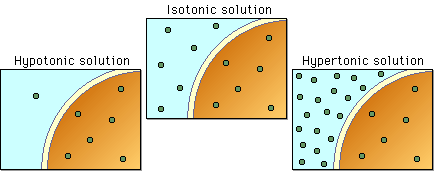
One of the challenges inherent in a marine lifestyle is in maintaining an internal balance against external osmotic pressures. Cell membranes are permeable to water, and water tends to flow from areas of low ion concentration to areas of high ion concentration (which is called ‘osmosis’). Though the cell is incredibly complex, from an osmotic perspective it is basically a small sack of water with some ions in it. If cells aren’t isosmotic (i.e. containing the same concentrations of ions) to the surrounding environment, then water will flow across a cell membrane. Depending on the relative ionic concentration of the cell to the environment, water may flow either into or out of a cell. Either way, this water flow is bad for the organism and may result in cells shriveling up or bursting.

CNN’s reporting of science issues is admittedly not the best around, but a story on their website this morning looks like it was written by a fifth grader. First of all, the headline is absurd. “Science figures out”? Really? How about something like “researchers determine”? “cats display a mastery of physical dynamics that leaves their … Read More “Another science journalism fail from CNN” »
Recently, Andrew shared a video of me Skyping into a sixth grade class to talk about sharks. Long time readers and Twitter followers know that I regularly speak to local schools, community groups, conservation organizations, and even churches. I really enjoy speaking to the public about sharks, and since most of my speaking requests come from people who have previously seen one of my talks, it seems that people enjoy hearing about them from me.
Read More “Wanted: An audience to learn about shark conservation” »
Congratulations on your party’s recent election victories. Your speech at the end of the night was particularly touching, and your personal story is inspirational. The election results do seem to signify that many Americans are not happy with how the Democratic party has been running Washington, and some change will likely be good for the country. As a scientist, however, I am deeply troubled by some of what I’m hearing about the new Republican House majority, particularly about global climate change policy.
Read More “An open letter about climate change to soon-to-be Speaker John Boehner” »