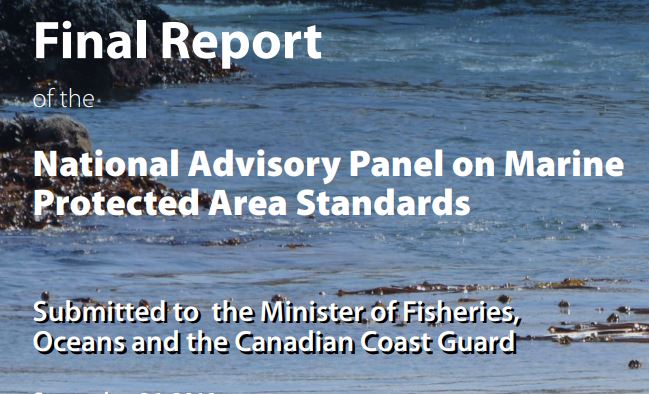
Recently, the Canadian government released the Final Report of the National Advisory Panel on Marine Protected Area Standards. This report is a set of guidelines and goals for the creation of new marine protected areas in Canada, and comes as Canada is hoping to greatly increase the number and quality of MPAs. I reached out to MPA experts and environmental nonprofits to ask what they think.
“Oil and gas development is not compatible with conservation, so we’re really pleased that the National Advisory Panel gave such a strong recommendation to keep these kinds of activities out of marine protected areas in Canada. This is an issue we’ve worked on for decades, and putting into place minimum standards in MPAs would strengthen Canada’s marine protection, and provide clarity for ocean stakeholders. We’re hoping these recommendations become law quickly – not just the ban on harmful activities in MPAs, but equally the legal mechanism for Indigenous Protected Areas, and great transparency in the ocean-planning process.There’s still some ambiguity on what kind of activities will be permitted in marine refuges, also known as other effective conservation measures (OECMs). We’re concerned that there’s still too much flexibility in terms of allowing harmful activities into these conservation areas. If these areas are to be counted towards conservation targets, they must protect the marine environment in a meaningful way.”
-Sigrid Kuehnemund, Vice President, Oceans, WWF-Canada. See the WWF Canada Press Release on this issue.
“We see this as a positive step toward achieving Canada’s goal of protecting 10% of coastal and marine habitats by 2020. We are particularly pleased that the panel clearly stated that harmful industrial activities like oil and gas have no place in MPAs. However, we are concerned about the discretionary approach recommended for other effective conservation measures (e.g. fishery closures), which could undermine their ability to generate ecosystem-level conservation benefits. The Panel’s focus on improving Crown-Indigenous relations (e.g. developing co-management strategies for MPAs) and supporting Indigenous communities in establishing their own protected areas was another positive. We now urge the federal government to take bold action to implement and build on the Panel’s recommendations to deliver high-quality MPAs across Canada.”
-Jordy Thomson, Marine Science and Conservation Coordinator, Ecology Action Centre. See the EAC press release.
“We’re pleased that this expert panel agrees with us that the federal government needs to tighten up regulations and improve consistency in the application of protection standards within the different types of marine protected area they designate. We’re very encouraged by their recommendation that we shouldn’t have oil rigs, mining and other heavy industry where we’re hoping to provide refuge for whales, fish, seabirds and other marine life. Effective protection that truly maintains marine life for the long term is what’s needed.”
-Bill Wareham, Science Projects Manager – Western Region, The David Suzuki Foundation. See the DSF press release here.
“I found the panel’s report a positive step forward in many ways, but wish it had been stronger in defining minimum protection standards. The recognition of Indigenous knowledge, Indigenous peoples’ roles as partners in MPA planning, and Indigenous Protected Areas are particularly promising. Recommended adoption of the IUCN’s standards and guidelines for MPAs, including prohibiting industrial activities in MPAs, is great news. Less encouraging is that Other Effective Area-Based Conservation Measures could still allow industrial activities, although with caveats. Ultimately, though, the big question is what the Minister will do with these recommendation. I hope this does not end up as just another report sitting on a shelf.”
-Dr. Natalie Ban, Associate Professor of Environmental Studies, University of Victoria.
“The recommendations are significant in that they address some major gaps in protected areas in Canada, including indigenous protected areas and certainty around prohibitions on industrial activities. We remain concerned that activities in 4.48% of the areas considered under the Fisheries Act, as “marine refuges” remain under ministerial discretion – as currently these areas only prohibit fishing activities.Canada can lead on a good process for protection, provisions for Indigenous Protected Areas and strong protection measures – we look forward to the government response to these recommendations.”
-Louie Porta, VP Operations & Projects, Oceans North
Other links:
Report silent on whether lobster fishing should be allowed in marine protected areas. CBC News.
Ban oil, gas, bottom trawling in marine protected areas, panel urges. iPolitics.