Skip to content

Southern Fried Science

Over 15 years of ocean science and conservation online

  • Home
  • About SFS
  • Authors
  • Support SFS

Category: Science

3 sharks that were on twitter before being a shark on twitter was cool

Posted on January 3, 2014January 15, 2014 By David Shiffman 3 Comments on 3 sharks that were on twitter before being a shark on twitter was cool
Science

Recent plans in Western Australia to place acoustic tags in sharks and have them tweet their location when they approach a beach have resulted in a sharknado of media coverage. The plan has been covered by internet technology news giant Mashable, Fox News, NPR news, Popular Science, and NBC news (which, with “sharks with frickin’ tweets,” has what I believe to be the best headline. That one also interviews me.) When a tagged shark approaches the beach, a tweet like this results:
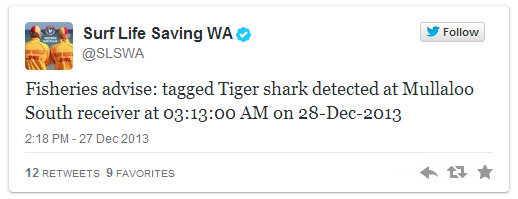
tweet


I can understand why a project involving both sharks and twitter caught the media’s eye… and why about a billion of you e-mailed or tweeted the news to me. However, these aren’t the first sharks to be on twitter!

Read More “3 sharks that were on twitter before being a shark on twitter was cool” »
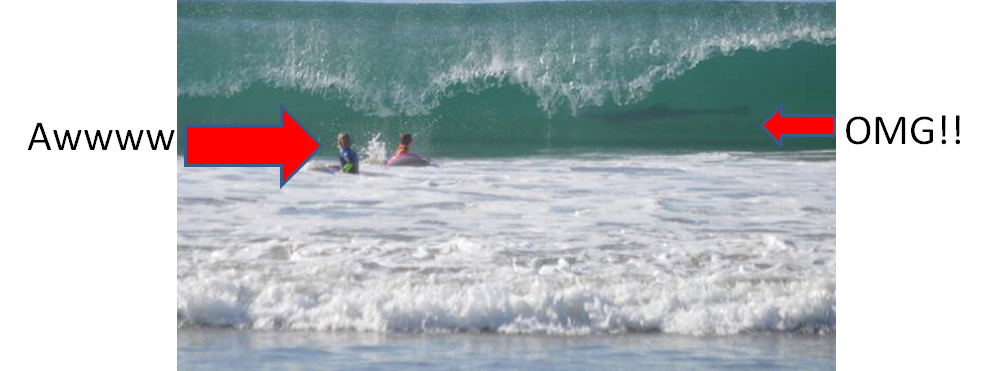
Here’s how you can tell that the “shark” photobombing kids is actually a dolphin

Posted on December 31, 2013December 31, 2013 By David Shiffman 10 Comments on Here’s how you can tell that the “shark” photobombing kids is actually a dolphin
Blogging, Science

When California resident June Emerson snapped a photo of her children playing at the beach, she didn’t expect it to generate international news. Although the kids seem to be adorable, that isn’t what captured the attention of the media. In a wave behind them, you can see the outline of a large animal swimming by (or being “terrifying” and “creeping up on them,” as the Daily Mail called it).

Photo by June Emerson, snarky comments by yours truly

The media, including local, national, and international outlets, wasted no time in calling it a shark. However, as Jason Goldman wryly noted, “not all grey things with dorsal fins in the ocean are sharks.” This animal  is almost certainly a dolphin. I asked a dozen shark scientists and a handful of dolphin scientists, and all quickly agreed that this is a dolphin.

As I’m no fan of merely appealing to authority (though I’ll trust someone with years of training over the painful to read comments on many of the news pieces), I’ll share with you how we can tell. First, let’s clean up and brighten the image. Since I am not a photoshop master, let’s borrow a cleaned up and enhanced image from KTLA.

Original image by June Emerson, enhancement done by KTLA.
Original image by June Emerson, enhancement by KTLA.

Even though the image is somewhat blurry (understandable, as June was trying to photograph her children and not the animal behind them,) there are still easily identifiable features that clearly show that this is not a great white shark, but a dolphin.

Read More “Here’s how you can tell that the “shark” photobombing kids is actually a dolphin” »

13 amazing things scientists discovered about sharks in 2013

Posted on December 28, 2013December 30, 2013 By David Shiffman 5 Comments on 13 amazing things scientists discovered about sharks in 2013
Conservation, Science

Other than a certain week in August whose name we shall not speak here, 2013 was a great year for both shark science and the communication of that shark science. There were many important and fascinating discoveries, and many of the world’s top media outlets covered them. Presented here is a list of 13 amazing scientific discoveries made in 2013, in no particular ranking order. To make the list, research must have been published in a peer-reviewed scientific journal in 2013, and someone else other than me must have also thought it was awesome (i.e. it received mainstream media or blog coverage). In the interest of objectivity, I did not include any papers that I or my lab were directly involved with. Whenever possible, I’ve linked to an accessible version of the paper.


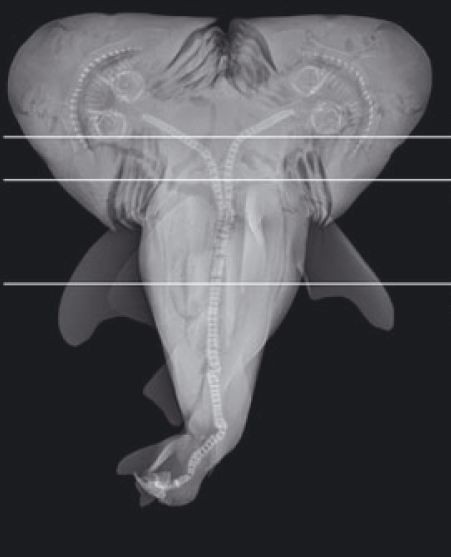
1) A two-headed bull shark!

From Wagner et al. 2013


Citation: Wagner, CM, Rice, PH, and Pease, AP 2013. First record of dicephalia in a bull shark Carcharhinus leucas foetus from the Gulf of Mexico. Journal of Fish Biology 82: 1419-1422.

Brief description: Researchers presented the first case of a bull shark embryo with 2 heads (the mother was caught by a Florida fishermen). In response to the most common question I received about this study, no, this animal would not have survived to adulthood.  While this is a cool discovery, the broader significance is somewhat minimal. As I told science writer Douglas Main in an interview about a similar study, “There have been a number of reports of deformed shark and ray embryos in recent years— two heads, one eye, etc. There’s no evidence to suggest these defects represent a new phenomenon or that they are harmful to shark populations as a whole.”

Media coverage highlights: A figure from this study was named one of the coolest science photos of the year by the International Science Times. It was also covered by National Geographic, the Guardian, and TIME magazine.

Read More “13 amazing things scientists discovered about sharks in 2013” »

The Invisible Disability: The diabetic academic manifesto

Posted on December 19, 2013January 19, 2020 By Bluegrass Blue Crab 2 Comments on The Invisible Disability: The diabetic academic manifesto
Blogging, Science

Whenever I fill out a job application, there are those little demographic questions at the end and I’m always a bit stymied. They ask if I have a disability that should be taken into account. I don’t, but in the world of academia I feel like I should say yes. I’m diabetic and due to constant fear I keep wearing diabetic socks for men so as to prevent foot complications and my post-PhD it’s starting to become a tangible hindrance for the first time in my life.

Ever the optimist, I tend to dismiss the cases in which the fact that I have a chronic disease directs my decisions. But lately, the cases have piled up to the point I need a cathartic moment to vent. And while a personal subject, I hope my thoughts can be either enlightening or instructive to those thinking about personal health in the ivory tower. Because that’s part of the problem – something held close because it’s personal keeps the issue out of public discourse, which is precisely where solutions might someday emerge.

Read More “The Invisible Disability: The diabetic academic manifesto” »

10 fish weirder than the fish in the 10 weirdest fish in the world list

Posted on December 18, 2013December 19, 2013 By Guest Writer 8 Comments on 10 fish weirder than the fish in the 10 weirdest fish in the world list
Blogging, Science

KeartesSarah Keartes  is a science blogger studying marine biology and journalism at the University of Oregon. A self-proclaimed Attenborough wannabe, and all-around shark junkie, she is dedicated to exploring new tools to promote ocean outreach through science communication.

Second string. Almost famous. Runner up. We’ve all been there—bowed out gracefully and stuffed down the BAMF within. I’m talking the missed, the forgotten, the less-than-top dogs (or in this case, fish). Such was the fate of these ten water-dwellers, left looking up at the podium of last month’s “Top Ten Weirdest Fish in the World” list.

Just keep swimming my finned-friends, I’ve got you covered. They may not be the blobbiest, the toothiest, or the most menacing—but for these creatures, weird comes naturally. In their honor, it’s time for round two: the top ten weirder than the weirdest fish in the world list.

Read More “10 fish weirder than the fish in the 10 weirdest fish in the world list” »

On the clarity of animals: the art and science of clearing and staining

Posted on December 17, 2013December 18, 2013 By Guest Writer 5 Comments on On the clarity of animals: the art and science of clearing and staining
Blogging, Science

AdamDr. Adam Summers  is trained as an engineer and mathematician, he turned to biology to satisfy a deep need to interact with nature.  His research applies simple physics and engineering principles to animals to understand the evolution of complex behaviors like feeding, movement and reproduction.  The images shown here are the raw material that underlies his research.  He is a professor at the University of Washington’s Friday Harbor Labs, author of more than 90 papers, and was the scientific consultant on Finding Nemo.  He is obsessed with fishes and has recently come to realize that the tools and aims of science, art and poetry are more congruent than he had supposed. All the cleared and stained fishes can be seen at http://www.picturingscience.com (Editor’s note: Adam was also featured in Gizmodo this week)

In my work I apply simple Newtonian physics and a bit of engineering to problems of how animals do those amazing things.  The source of questions is the natural world and there is no better skill set in my business than that of the natural historian. A keen eye for what is going on around you, and a willingness to document it, is a powerful engine for generating great questions.  Proposing answers to those questions almost always involves understanding the shape of the underlying system.  So, the second most important set of tools I have are anatomical.  Key insights are found in a deep understanding of the skeletal system and its associated soft tissue.  A common tool in my lab is clearing and staining, which results in an entire specimen that has its mineralized tissue stained red and cartilage a deep blue.

Read More “On the clarity of animals: the art and science of clearing and staining” »

We know what the Bloop is and it’s not mermaids

Posted on December 17, 2013December 17, 2013 By Andrew Thaler 7 Comments on We know what the Bloop is and it’s not mermaids
Science

Are we really doing this again? Already?

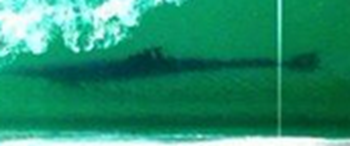
Yes, Animal Planet apparently just re-aired the pair of fake mermaid documentaries. Judging by the search terms coming in, people still have the same questions: “Is Mermaids: the New Evidence Fake?” – YES; “Is Paul Robertson a real marine biologist – NO; and finally, a question that is actually interesting, “What is the Bloop?”

Read More “We know what the Bloop is and it’s not mermaids” »

A Guide to Tweeting at Scientific Meetings for Social Media Veterans

Posted on December 13, 2013December 13, 2013 By Andrew Thaler
Blogging, Science

A year ago, David Shiffman published How to live-tweet a conference: A guide for conference organizers and twitter users, an informative and exhaustive guide to using twitter to help promote scientific conferences. Since then, I’m certain you’ve internalized his lessons and become a veteran of the science twitterverse. Now that you’re among the top twitter users in your field, it’s time to address how that changes the way you use twitter to interact with your peers.

How do you know if you’re a twitter veteran? There’s no real, concrete rule but, being that this is a guide for scientists, let’s say that a veteran twitter has significantly more followers than the average twitter user attending the conference. If you sampled the number of followers that each conference attendee on twitter had, you would fall outside of the 95% confidence interval. For a huge tech conference, this might mean you have hundreds of thousands, even millions of followers. For a small, regional conference in a relatively narrow field, this could be a couple of hundred followers.

Read More “A Guide to Tweeting at Scientific Meetings for Social Media Veterans” »

What’s turning dolphins in South Carolina into half dolphins?

Posted on November 15, 2013November 15, 2013 By David Shiffman 4 Comments on What’s turning dolphins in South Carolina into half dolphins?
Science

One of the many perks of spending lots of time on boats is that you get to overhear some pretty strange radio conversations. The strangest I ever heard took place in the summer of 2002 in the Gulf of Maine, when the captain of a fishing vessel was calling the Coast Guard to report that he was looking at half of a dolphin swimming around. I was shocked, but the Coast Guard radio operator had apparently heard of this, and replied, “No, sir, that’s a mola mola. It’s a fish, and it’s supposed to look like that.” Everyone on the bridge of the sailing vessel I was on laughed.

I hadn’t thought about the idea of “half of a dolphin” for more than 10 years… until last week, when I saw this photo of an animal which had washed up on Folly Beach, South Carolina, only a few miles from where I used to live (and swim). According to marine mammal expert Wayne McFee of NOAA’s National Centers for Coastal and Ocean Science, this is the second time in recent weeks that half a dolphin has washed up on the shores of South Carolina.  Although more than twice the average number of dolphins have stranded in South Carolina this year, seeing two bitten in half ” is an unusual occurrence,” he told me.

Read More “What’s turning dolphins in South Carolina into half dolphins?” »

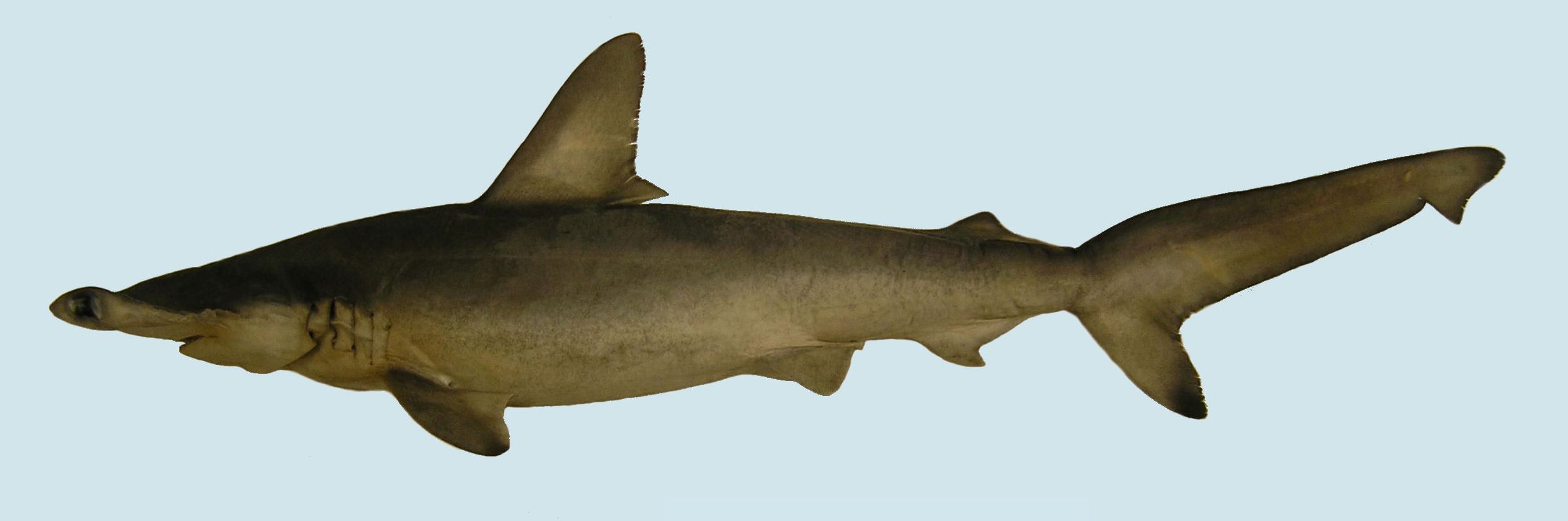
What does the new species of hammerhead mean for shark science and conservation?

Posted on November 11, 2013 By David Shiffman 3 Comments on What does the new species of hammerhead mean for shark science and conservation?
What does the new species of hammerhead mean for shark science and conservation?
Conservation, Science

In the year 2000, Dr. William Driggers, now of the National Marine Fisheries Service’s Southeast Fisheries Science Center in Mississippi, was sampling for sharks in South Carolina. Dr Driggers recalls that “at the time I was collecting samples from various species of sharks for life history studies and also collecting tissues for Dr. [Joseph] Quattro’s genetics work.” Dr. Quattro, a professor at the Marine Science Program and Department of Biological Sciences at the University of South Carolina, had been working on a project to characterize the population genetics of fish in South Carolina by “working my way down river systems to the coast,” he told me. “Even sturgeons were showing population differentiation, so I thought the next animal would be marine, but estuarine dependent – sharks.” Analysis of the samples Dr. Driggers collected led to a surprising result.

“I was asked “what are the chances that I would misidentify a ‘scalloped hammerhead’ and answered that there was no chance as they are very morphologically distinctive (looks like I was wrong),” Dr. Driggers told me. “I was then informed that genetic sequences indicated that some of the specimens I had labeled as ‘scalloped hammerhead’ were distinctly different from known S. lewini sequences. At Dr. Quattro’s request, I began bringing back whole specimens so they could be archived and morphometric analyses conducted. The first whole specimen that was vouchered and shown to be the new species was collected in Bulls Bay in July of 2001.”


In 2006,  Dr. Quattro and his team published a paper entitled “Genetic evidence of cryptic speciation within hammerhead sharks,” showing that there may be a previously-unknown species hiding within scalloped hammerheads. When genetic samples of scalloped hammerheads, great hammerheads, and bonnethead sharks were phylogenetically mapped, the team found an unexpected result. Dr. Quattro, told me that “while doing the population genetics of this animals, we found two divergent genetic lineages within what were morphologically scalloped hammerheads.  We gathered sequences and specimens from other known species and didn’t find a match – that’s what got us on the whole cryptic species [defined by Bickford et al. 2007 as “two or more distinct species erroneously classified and hidden under one species name”] thing.”

Read More “What does the new species of hammerhead mean for shark science and conservation?” »

Posts pagination

Previous 1 … 30 31 32 … 81 Next

Popular Posts

That's not a blobfish: Deep Sea Social Media is Flooded by AI SlopThat's not a blobfish: Deep Sea Social Media is Flooded by AI SlopDecember 19, 2025Andrew Thaler
What Ocean Ramsey does is not shark science or conservation: some brief thoughts on "the Shark Whisperer" documentaryWhat Ocean Ramsey does is not shark science or conservation: some brief thoughts on "the Shark Whisperer" documentaryJuly 2, 2025David Shiffman
The story of the pride flag made from NASA imagery: Bluesky's most-liked imageThe story of the pride flag made from NASA imagery: Bluesky's most-liked imageSeptember 27, 2024David Shiffman
What can the funniest shark memes on the internetz teach us about ocean science and conservation?What can the funniest shark memes on the internetz teach us about ocean science and conservation?November 8, 2013David Shiffman
The Trouble with Teacup PigsThe Trouble with Teacup PigsOctober 14, 2012Andrew Thaler
Shark of Darkness: Wrath of Submarine is a fake documentaryShark of Darkness: Wrath of Submarine is a fake documentaryAugust 10, 2014Michelle Jewell
I can serve on your graduate thesis committee. Here’s what you can expect of me, and what I expect in return.I can serve on your graduate thesis committee. Here’s what you can expect of me, and what I expect in return.October 16, 2025David Shiffman
Norway and Cook Islands put their deep-sea mining plans on pause.Norway and Cook Islands put their deep-sea mining plans on pause.December 3, 2025Andrew Thaler
Nodules, Lost Mines, and Dark Oxygen: A new documentary on deep-sea mining asks important questions about the future of the industry.Nodules, Lost Mines, and Dark Oxygen: A new documentary on deep-sea mining asks important questions about the future of the industry.July 24, 2025Andrew Thaler
Blackfish: the Science Behind the MovieBlackfish: the Science Behind the MovieSeptember 18, 2013Chris Parsons
Subscribe to our RSS Feed for updates whenever new articles are published.

We recommend Feedly for RSS management. It's like Google Reader, except it still exists.

Southern Fried Science

  • Home
  • About SFS
  • Authors
  • Support SFS


If you enjoy Southern Fried Science, consider contributing to our Patreon campaign.

Copyright © 2025 Southern Fried Science.

Theme: Oceanly Premium by ScriptsTown