 Welcome to Dear Shark Man, an advice column inspired by a ridiculous e-mail I received. You can send your questions to me via twitter (@WhySharksMatter) or e-mail (WhySharksMatter at gmail).
Dear Shark Man,
Someone I follow on Instagram posted this earlier this week. In this post, she claims that a shark became blind in one eye because SCUBA divers were regularly rubbing it’s snout. Is that a thing? It doesn’t seem like a thing.
Sincerely,
Frustrated in Fort Lauderdale
Dear Frustrated,
No, a shark cannot go blind because people rub it’s snout. That is not a thing. However, a shark can possibly suffer severe eye irritation, and even permanent damage, if people repeatedly poke the shark’s eyes while rubbing it’s snout, or engaging in other stupid and pointless behavior while they interact with sharks. The eyes are not that far away from the mouth, which is why many shark species have an eyelid-like nictitating membrane that protects their eyes from prey that thrashes while caught in the shark’s mouth (here’s a great picture of a nictitating membrane.) It’s also totally possible that these are natural injuries as a result of bumping into something eye first, such injuries aren’t uncommon.
Some of the other information in this instagram post is also wrong. As we’ve discussed in past Dear Shark Man posts, maybe you shouldn’t get shark facts from non-experts, and maybe non-experts should consult with people who know what they’re talking about before sharing wrong information to a wide audience? There are lots of ways that passionate non-experts can aid in ongoing shark conservation efforts without reinventing the wheel poorly and/or spreading wrong information.
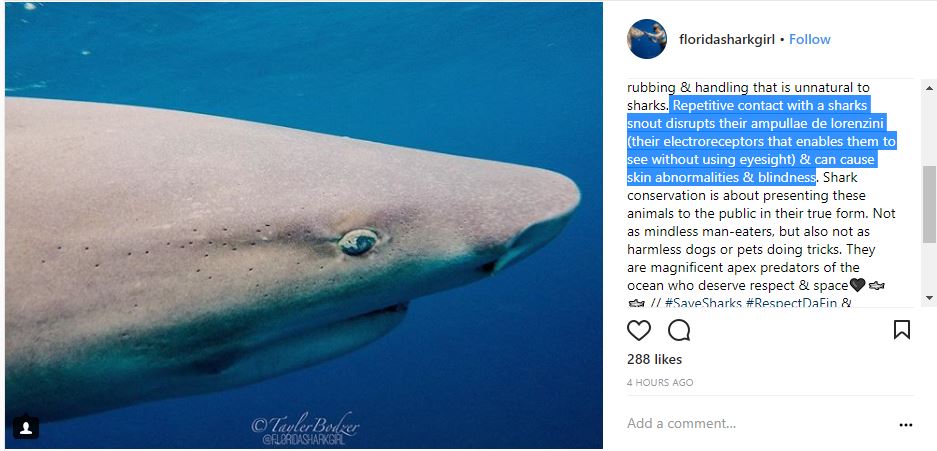
The section of this Instagram post that you asked about, Frustrated, notes that “repetitive contact with a shark’s snout disrupts their ampullae de lorenzini (their electroreceptors that enables them to see without using eyesight) and can cause skin abnormalities and blindness.” That is not what the ampullae of lorenzini do. The ampullae of lorenzini, which are the electrosensory organs inside the pores visible on a shark’s snout (not the visible pores themselves), are used to detect bioelectric and electromagnetic fields. These organs have nothing to do with vision. The phrasing “see without eyesight” is not a jargon-free simplification, it’s just incorrect. There’s no evidence that I can find (and I asked several experts in shark sensory physiology and wound healing) that poking the snout causes skin abnormalities or blindness. Sharks bump into stuff snout first all the time.
This does not mean that grabbing and rubbing a shark’s snout is harmless, or that doing so is a good idea. It is neither. This behavior is wildlife harassment. In some cases it is against the law, and it is always against ethical wildlife tourism guidelines. Also, why the hell would anyone rub a shark’s snout in the first place? These are wild, predatory animals, and while they aren’t mindless killing machines as they are sometimes portrayed, they’re also not cute harmless puppies and kittens. Do people try to scratch lion chins when they go on safari?
This kind of behavior is part of a troubling trend of people who think they’re helping sharks by engaging in behavior that risks the safety of both human and shark, like poking or riding the shark. This is a bad strategy, though under some circumstances, responsible wildlife tourism can absolutely help to protect sharks, and to educate the public about them (see this review about this that I was a coauthor on last year). Certain macho cowboy idiots who publicly state that rubbing a shark’s snout with a metal glove creates a pleasant tingly sensation for a shark are also known to intentionally trigger the physiologically stressful state of tonic immobility in a shark, because they think it is funny to see a shark sink to the bottom upside down. Don’t do this, and don’t promote those who do. (This person’s Instagram feed is full of her engaging in this kind of wildlife harassment behavior, FWIW, so it’s interesting to see her criticize others for doing it).
So, in short: no, poking a shark’s snout did not make this shark go blind. It’s entirely possible that other reckless behavior by SCUBA divers did negatively impact this shark’s eyes, though there’s no way to be sure. Even if it didn’t cause these injuries, poking or riding sharks is a bad idea. Finally, get your shark facts from people who know what they’re talking about and don’t share wrong information from non-experts.
If you appreciate my shark research and conservation outreach, please consider supporting me on Patreon! Any amount is appreciated, and supporters get exclusive rewards!