

Most marine conservationists and environmentally conscious citizens believe that fisheries bycatch is a major problem that needs to be solved soon. In most cases, they are correct, but an
interesting paper from Nature shows that bycatch can sometimes be good for certain species. Consider the case of the Great Skua.
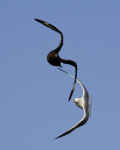
The Great Skua is a large predatory seabird that lives in northern Europe. In the past, it has been known to feed on many smaller local seabird species, including the Leach’s Storm Petrel, the Northern Fulmar, the Northern Gannet, the Lesser Black-Backed Gull, and the Herring Gull. In the last few decades, Great Skua populations have increased tremendously.
Ordinarily, when the population of a predator increases, the populations of its prey decrease. This doesn’t seem to be the case among populations of the seabird species in northern Europe. How can this be?
The answer to this apparent ecological enigma has to do with fisheries bycatch. The oceans around northern Europe support many large-scale fisheries, such as the sandeel fishery. Like most large-scale fisheries, the sandeel fishery has a significant amount of bycatch (fish that were caught merely because they were swimming near the sandeel) associated with it. Since the fishermen only have a permit to sell sandeel, the bycatch species are dumped overboard…where they are devoured by Great Skua.
In other words, Great Skua have found a new steady source of food. Great Skua populations have increased without a decrease in the populations smaller seabirds that they ate in the past.
Modern sentiments, however, have turned against bycatch. Efforts to reduce bycatch in commercial fisheries are underway in many countries worldwide. What will this mean for the seabird communities of northern Europe?
Well, it’s possible (and for the purposes of this discussion, we’ll assume it will definitely happen) that without their new source of food (bycatch dumped over the side of fishing vessels), Great Skua will return to eating their previous prey- the smaller seabirds of northern Europe. Since there are many more Great Skua than there used to be, this would be very bad news for the smaller seabirds in the area, and could easily make several seabird species endangered.
The question for this week’s ethical debate is simple: Do you think that we should continue with efforts to reduce bycatch in Northern Europe even if it means that local seabird species will become endangered?
I should note that the authors of this paper stated that “it would not be appropriate to maintain current rates of discarding for the sake of seabirds”.
Votier SC, Furness RW, Bearhop S, Crane JE, Caldow RW, Catry P, Ensor K, Hamer KC, Hudson AV, Kalmbach E, Klomp NI, Pfeiffer S, Phillips RA, Prieto I, & Thompson DR (2004). Changes in fisheries discard rates and seabird communities. Nature, 427 (6976), 727-30 PMID: 14973483
~WhySharksMatter
Interesting idea. However, what effect does the increased prey seabird population have on the populations of fish that those birds prey on?
It’s an interesting thought, and more information is needed to form a real idea of what should or shouldn’t happen, depending on the population dynamics.
Also, if seabird species are managed intelligently and efficiently, it’s conceivable that the populations would (maybe) go through a period of being endangered and recover if bycatch is reduced globally. I don’t see any reason to assume that any return to preying on seabirds by great skua would make a single species of seabird go extinct based on the information presented here. Endangered, maybe, but extinct? No.
If bycatch were suddenly and drastically reduced (both are unlikely) I would expect to see an initial decline in great skua, followed by a decline in seabird populations. No reason to assume that they wouldn’t level each other out.
In any case, any reduction in bycatch (anywhere on the globe, really) would likely be more gradual that the effects on the great skua populations might be buffered a little.
But it’s really hard to say without knowing the ecosystem and dynamics of the populations.
I agree with Sam that more information about the population dynamics needs to be known before an intelligent answer can be formed. But from the way it sounds I think we do not need to implement any policies that will drastically reduce bycatch. Obviously its not going to waste if it is sustaining the Great Skua. However it is regretful that we as humans (who are taking too many fish that is health for the environment as it is) would waste marine life anymore then we have too.
Maybe the best policy would be to reduce the bycatch by some but not drastically. It does seem plausible that the newly amped up Great Skua population, without the bycatch to supplement there diet, could excessively reduce the seabird prey. It appears that the author’s comment (“…for the sake of seabirds”) is contradictory. If he would rather decrease the rate of bycatch for the sake of extra fish, why would he not care about the birds?
Again, more information about the population dynamics needs to be collected before a definite answer can be concluded, however my opinion is that a policy of moderation seems best. And hopefully in the near future (with more info) the degree of that moderation can be ascertained.
My opinion lies sort of along the lines of what Jeremy said. After reading this post, I can definitely see how bycatch, like many things, can provide positive and negative results. Because my entire academic life has focused around the idea that bycatch is bad, I do feel that some type of policy should be made to decrease the likelihood of this happening. I do, however, like Jeremy, feel that if it is serving as a positive result in another area, that it should not be decreased to the point that it would risk the extinction of the seabird species. With this in mind, I do also realize that many of the effects of bycatch have contributed to “bigger” problems, than that which they seem to be solving right now; so my opinion must stand that while bycatch is, in this case, serving as a positive, I do feel that it must be reduced or at least attempts must be made to reduce it in a way where both, harmful bycatch can be reduced, but perhaps this new positive result can stick around.
according to the article the bycatch is going to be reduced but no indication as to by what %ages…. the management of the situation will be determined by that. If the reduction is radical and quick then this will severely impact the smaller bird populations as opposed to a more controlled and monitored reduction.
I believe that the bycatch would be good to reduce is some terms. In the case of Great Skua the bycatch should not be reduce. I don’t know what fish that the fishermen are catching that are bycatch but as long as the bycatch fish are not going into endangerment I believe it is fine to let the fisherman do that. I know it would be hard to enforce this but it would be helpful to the fish, to the birds and to humans.
I do not believe that Great Skua can account for the use of all bycatch. The reduction of bycatch may be highly advantageous in countries outside of Northern Europe. If bycatch cannot be avoidable, then it should be released back into the water (if the fish are still in a survivable condition) or used resourcefully, like selling it for use in food (if edible) or other products. In order to prevent the extinction of smaller sea birds, scientist should try to slowly reduce the amount of bycatch in Northern Europe and record the changes after a small reduction before reducing the amount of bycathc any further. After continuing to repeat this reduction and recording, maybe one can find a point at which both bycatch can be reduced and the smaller sea birds avoid extinction via the Great Skua.
I have seen a few sources reveal that bycatch is a large cause of pushing several species to the brink of extinction. Other sources say millions of metric tonnes of marine life is wasted every year due to bycatch. Is that the main debate over whether or not bycatch should continue parse? If that is not the underlying issue, I see no problem with continuing to allow it in order to act as another food source for the Great Skua.
We should reduce bycatch if it starts to become a huge problem and the species become endangered. Otherwise, I don’t see anything wrong with it because it isn’t hurting anything. It was stated that, bycatch could sometimes be beneficial for the environment. And, if there is more Great Skua then they need to feed on the bycatch. It’s a win-win situation until the bycatch become endangered and that is when things should stop.
Easy. You don’t want the bycatch? Just start poisoning the stuff you dump, kill the appropriate numbers of Skua to achieve balance, and get on with life. This won’t work because I don’t know what I’m talking about (as usual) but I threw it out there.
“This won’t work because I don’t know what I’m talking about (as usual)”
I think you may have missed the point of this assignment…
I believe that the bycatch is beneficial contribution. With the overwhelming outcome of populated Great Skua the best thing to do is to continue with the commercial fishing which will contain the Great Skua from becoming a threat to other species. This is a no brainer, and the rightful thing to do is to allow things to evolve the way it has been.
We should not be encouraging bycatch because although in this one instance it is beneficial for seabirds, on a larger scale it is incredibly wasteful. It would be impossible to say that in this one region they can continue with bycatch but in others they cannot. I think this is another example of people trying to get over involved in natural processes. Why would we continue to unnecessarily kill fish (which could in turn make some of those fish species endangered) in order to try and prevent sea bird species from becoming endangered?
I think we should let nature play out as it will without, who is to say that the sea bird population will not eventually even out without human intervention?
I think any efforts to be less wasteful with the environment and its organisms can hardly ever be negative, so any efforts to reduce the amount of bycatching should be continued. But if the extra fish species being caught and handed over to Great Skua are not yet endangered, I don’t think bycatching right now is a significant problem. If they do become endangered, then we should take appropriate action. If we’re worried about the prey bird populations becoming endangered by the increase of Great Skua, then can’t we keep them in isolation and help to repopulate them to greater numbers? If it’s been a while since the Great Skua have fed on these prey bird species, how quickly would the Great Skua be able to remember these old prey species and readapt to feeding on them? Perhaps the Great Skua would suffer greater reduction in population size by cutting down on bycatch, because it may take time for them to figure out how to react to this change, resulting in increased competition among the Great Skua. As long as efforts to reduce bycatch are gradual and not drastic, the Great Skua should be able to react accordingly.
I believe that an attempt to reduce bycatch should be continued whether or not it has become the main source of the Great Suka’s prey. I also agree with Talbtron that any efforts to be less wasteful with our environment and its organisms, especially in this situation, could hardly be negative. The Great Suka populations have risen because of this source of food, and if it is reduced, then their numbers should go with it. Having the fishermen reduce bycatch immediately is very unlikely, so the fact that this would be done at a slowly decreasing rate, will help the Great Suku and its population numbers transition back to their original state before the availability of all the bycatch existed.
It is true that the Great Suku might then resort to eating the smaller seabirds, but have the small seabirds populations risen too as a result of not being hunted as heavily? And if they may be in danger of being endangered, we should make the effort to keep them in isolation and help to keep their population level at a stable level.