Skip to content

Southern Fried Science

Over 15 years of ocean science and conservation online

  • Home
  • About SFS
  • Authors
  • Support SFS

Finding Megalodon at the bottom of the sea

Posted on January 2, 2024January 5, 2024 By Andrew Thaler
Featured, Science

Since the first Challenger Expedition, deep-sea explorers have recovered shark teeth from the bottom of the ocean. Sharks shed their teeth almost as much as Twitter sheds users after changing its name to the symbol synonymous with closing your browser. Shark teeth crop up in deepwater trawls, geologic samples, and even embedded in the core of polymetallic nodules. One famous polymetallic nodule collected during a 1978 expedition to the Clipperton-Clarion Zone featured a fossil great white shark tooth prominently protruding from the manganese-rich ore. 

Finding shark teeth in samples dredged from the seafloor is a trivial matter, but spotting one in situ, sitting on the seabed, through the eyes of a robot hanging below you on a tether 3 kilometers long, is an entirely different experience. 

That’s exactly what happened to the crew of the E/V Nautilus in June, 2022.

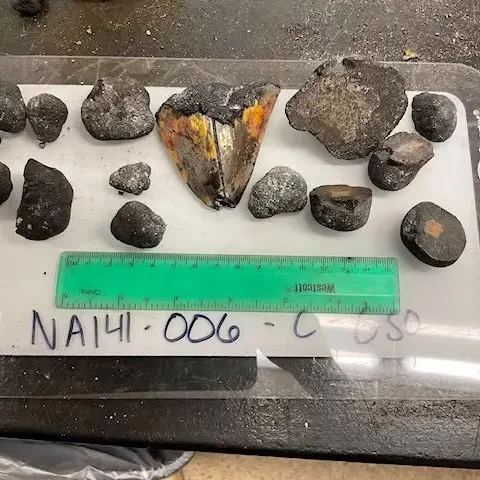
During an exploration of seamounts around Johnson Atoll in the Pacific Remote Islands Marine National Monument, researchers on the Nautilus live expedition spotted something exciting amidst the cobalt-rich crusts that comprise the hard bottom around these seamounts: an ancient megalodon tooth, partially wrapped in a blanket of manganese, sticking out of the bottom. 
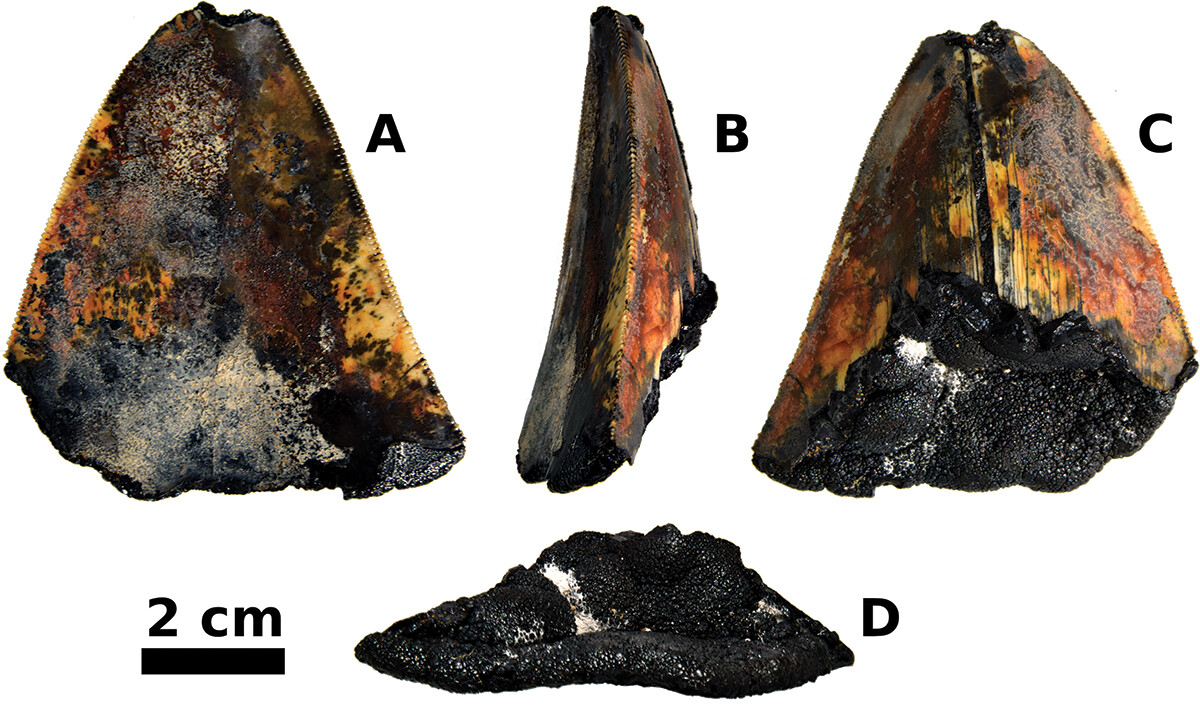
Otodus megalodon tooth, from Pollerspöck et al. 2023.

Manganese crusts grow slowly on the deep seafloor as metals from seawater accrete on the surface of hard structures: exposed rocks, ancient shells, and even the teeth of long extinct sharks. These crusts take millions of years to form, which means that this tooth was likely found where it fell, ejected from the mouth of a shark that went extinct 2.6 million years ago.

The ferromanganese crusts found on the Johnson Atoll and throughout seamounts in the Pacific Remote Islands Marine National Monument are rich in manganese, cobalt, and nickel (though not as rich as polymetallic nodule deposits to the north in the Clarion Clipperton Zone). These crusts accumulate over millennia, providing hard structure for the diverse and delightful animals that call seamounts home. Though other countries are currently looking into opening up their seabed to deep-sea mining, the ecosystems that fall within the marine national monument, is, for the moment, protected from mineral exploitation.
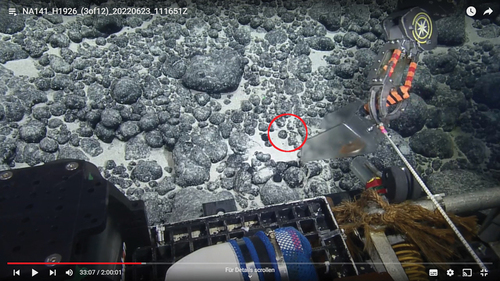
I’ve been staring at this picture all morning and I still can’t comprehend how they were able to spot a tooth in all that. From Pollerspöck et al. 2023.

We still know precious little about the ecosystems of the deep-sea, particularly those that lie far from the charismatic habitats of hydrothermal vents, methane seeps, whale falls, and coral reefs. A new species of the bone-eating Osedax worm was recently discovered feeding on the pulpy insides of thresher shark teeth. Did Osedax once do the same to the discarded teeth of ancient megalodons swimming through Pliocene seas?

The open access paper First in situ documentation of a fossil tooth of the megatooth shark Otodus (Megaselachus) megalodon from the deep sea in the Pacific Ocean is available in the journal Historical Biology.

This wasn’t the only fossil the E/V Nautilus team found in the Pacific Remote Islands Marine National Monument. They also recovered an ancient beaked whale skull encrusted in manganese:


Southern Fried Science is free and ad-free. Southern Fried Science and the OpenCTD project are supported by funding from our Patreon Subscribers. If you value these resources, please consider contributing a few dollars to help keep the servers running and the coffee flowing. We have stickers.

Feature photo via Ocean Exploration Trust/Katherine Kelley
Share this:

  • Click to share on Bluesky (Opens in new window) Bluesky
  • Click to share on Facebook (Opens in new window) Facebook
  • Click to share on Reddit (Opens in new window) Reddit
  • Click to share on Threads (Opens in new window) Threads
  • Click to share on WhatsApp (Opens in new window) WhatsApp
  • Click to share on Mastodon (Opens in new window) Mastodon

Related

Tags: deep-sea mining EV Nautilus megalodon Pacific Remote Islands sharks

Post navigation

❮ Previous Post: The OpenCTD: Open-source Oceanography for Everyone
Next Post: Conservation, Technology, and the Future of the Seafloor: My 2023 science year in review. ❯

You may also like

Weekly Salvage
A new Gulf oil spill, opposition to deep-sea mining, DIY drop cameras, and more! Massive Monday Morning Salvage: October 30, 2017
October 30, 2017
Weekly Salvage
Twitter Ocean Chess, lessons from the Vaquita, awe of the deep, and more! Monday Morning Salvage: November 13, 2017
November 13, 2017
Education
Taking Initiative: My 2023 year in environmental education, outreach, and activism
January 19, 2024
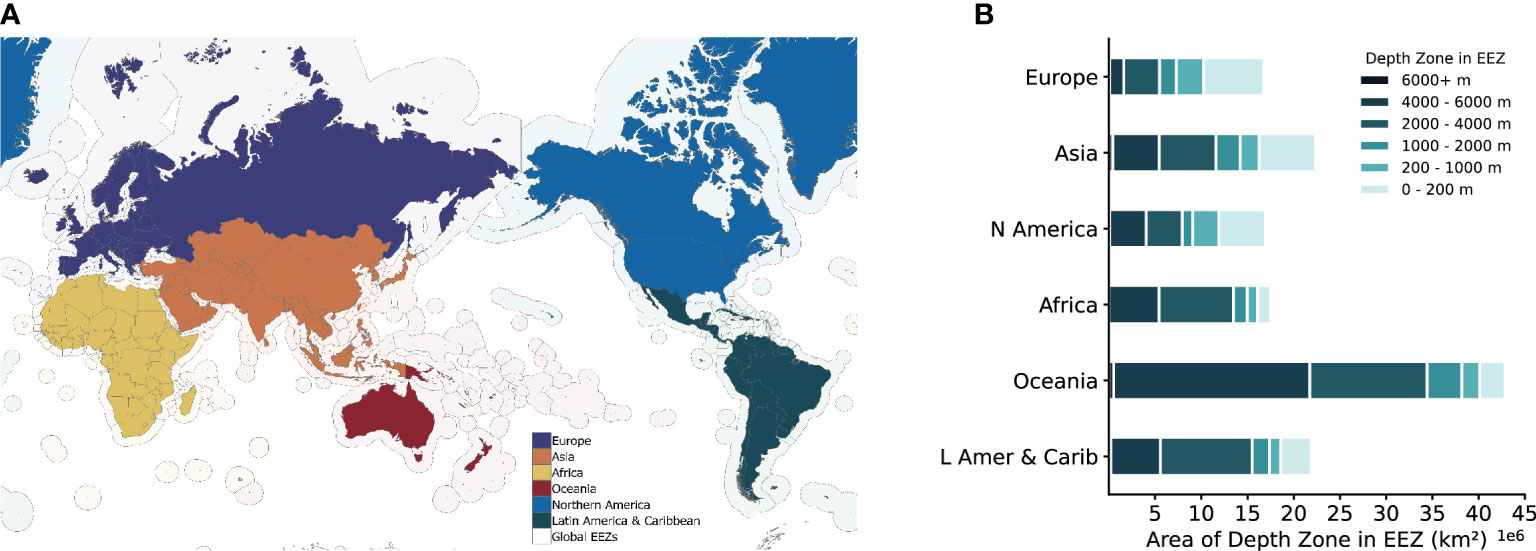
Figure 1 Where is the deep sea globally? (A) A global map illustrates of the regions included in the assessment: Europe, Northern America, Africa, Asia, Oceania, and Latin America & the Caribbean; (B) Area of each depth zone for all EEZs claimed in each region of the world (Bell et al., 2022b).
Exploration
Deep Ocean Exploration needs to move beyond Imported Magic
January 16, 2024

Popular Posts

Shark scientists want their research to help save threatened species, but don’t know how. Our new paper can help.Shark scientists want their research to help save threatened species, but don’t know how. Our new paper can help.December 1, 2025David Shiffman
Norway and Cook Islands put their deep-sea mining plans on pause.Norway and Cook Islands put their deep-sea mining plans on pause.December 3, 2025Andrew Thaler
What Ocean Ramsey does is not shark science or conservation: some brief thoughts on "the Shark Whisperer" documentaryWhat Ocean Ramsey does is not shark science or conservation: some brief thoughts on "the Shark Whisperer" documentaryJuly 2, 2025David Shiffman
What we know we don't know: impacts of deep-sea mining on whales, dolphins, sharks, turtles, and other migratory species.What we know we don't know: impacts of deep-sea mining on whales, dolphins, sharks, turtles, and other migratory species.November 20, 2025Andrew Thaler
2025: My year in writing, public speaking, and media interviews2025: My year in writing, public speaking, and media interviewsDecember 3, 2025David Shiffman
The Trouble with Teacup PigsThe Trouble with Teacup PigsOctober 14, 2012Andrew Thaler
Urea and Shark OsmoregulationUrea and Shark OsmoregulationNovember 15, 2010David Shiffman
How tiny satellites are tracking marine wildlifeDecember 1, 2025Andrew Thaler
Shark of Darkness: Wrath of Submarine is a fake documentaryShark of Darkness: Wrath of Submarine is a fake documentaryAugust 10, 2014Michelle Jewell
Quick Tips for Graduate Student Life - Write a Book ReviewJanuary 23, 2014Andrew Thaler
Subscribe to our RSS Feed for updates whenever new articles are published.

We recommend Feedly for RSS management. It's like Google Reader, except it still exists.

Southern Fried Science

  • Home
  • About SFS
  • Authors
  • Support SFS


If you enjoy Southern Fried Science, consider contributing to our Patreon campaign.

Copyright © 2025 Southern Fried Science.

Theme: Oceanly Premium by ScriptsTown