 Nested within the story of Ishmael, Queequeg, Herman Melville, and Moby Dick are four Coffins. The first two are within the story itself – Peter Coffin, the innkeeper who unites Ishmael with Queequeg, and Queequeg’s Coffin, built on premonition of death, that carries Ishmael to safety after the Pequod is destroyed. These two coffins bookend the epic voyage of the Pequod and it’s crew, but their occurrence parallels two other Coffins, and the fate of the whaleship Essex.
Moby Dick was largely based on two historic events, as well as Herman Melville’s travels aboard whaling ships. The first was the legend of Mocha Dick – a real “fighting sperm” common sighted of the coast of Chile. Mocha Dick had a reputation for attacking whale boats, and though he never sank one, his legend was such that when whaleships met fr a gam, sailors would often ask “What news of Mocha Dick?” Allegedly, when Mocha Dick was finally killed, 20 rusty harpoon tips were found in his carcass. True or not, those legends no doubt were the inspiration for the great white whale.
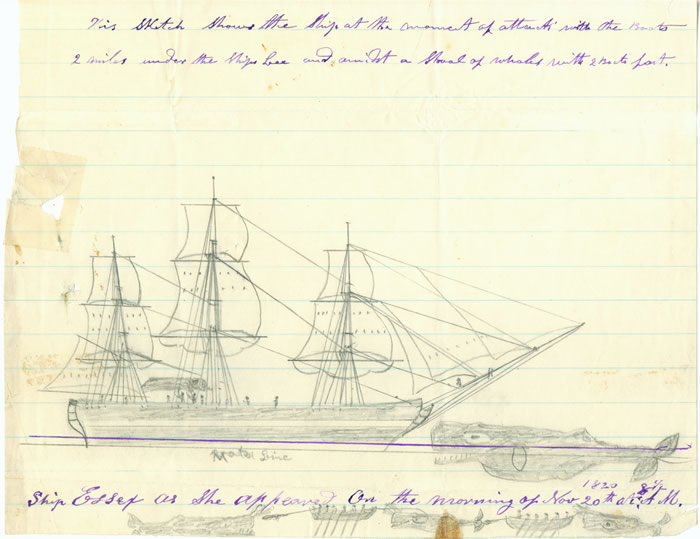
The second, and much more significant historic event was the sinking of the whaleship Essex. Charged by a bull sperm whale, the Essex capsized and sunk near where the fictional Pequod is said to have met it’s end. Unlike the Pequod, most of the crew of the Essex survived the sinking aboard three small whale boats. It was during the Journey that came after the sinking where we meet the other two Coffins.
Remember – Peter Coffin introduces Ishmael to the Cannibal, Queequeg. Later, Queequeg’s Coffin saves Ishmael’s life.
For ninety-six days the men of the Essex drifted across the vast Pacific. Of the three whale boats, one was lost with seven men aboard, never to be found. One was rescued by the Indian, but not before the crew had been forced through starvation to cannibalize their fallen shipmate. The third boat, lead by Captain Pollard – the captain of the lost Essex – had to face a grimmer decision.
Confronted with starvation, dehydration, and no prospect for rescue, they twice drew straws – once for the murderer, and once for the murdered. Charles Ramsdell was chosen by fate to pull the trigger, his victim, the poor cabin boy who drew the short straw – Owen Coffin.
Then, on the ninety-sixth day, the two survivors were rescued by another whaleship, Dauphin, Captained by Zimri Coffin, Owen Coffin’s cousin.
Both Ishmael and Melville’s Coffin’s are connected. In the first, both Ishmael and Mellville’s Coffins are tied up in nobility and cannibalism – Owen Coffin is said to have bravely accepted his fate, even after another crewman, who would surely die in the coming days, volunteered to take his place; Queequeg is, of course, the savage more noble than any western man. In the last, both Coffin’s bring salvation and are somehow inextricably bound to the first – Melville’s by blood and Ishmael’s by Queequeg’s life.
It’s hard to imagine that these parallels weren’t intentional on Melville’s part. The story of the Essex and its aftermath was fresh in his mind. What’s truly remarkable is how Melville wove this narrative of survival and destruction into a much larger work of fiction that ends where the real story begins.
~Southern Fried Scientist
Added: Stuff you missed in history: Real Life Moby Dick
There is a very good recounting of the Essex in recent podcast by Stuff You Missed in History Class – probably my favorite of the How Stuff Works podcasts.
I tracked down the podcast and linked it at the bottom. Thanks!
Late to the party, I know, but have you read “Leviathan: The History of Whaling in America” by Eric Jay Dolin? I’m 2/3 of the way through (I keep putting it down and picking it up) but it’s a great review of whaling through the modern (i.e. colonial era on) US history, including the importance of the whaling industry to the establishment of the US as a nation. It also discusses the Essex, the Ann Alexander, and dozens of other whaling boats highlighted throughout. He also couches Moby Dick in the context of the Golden Age of American whaling. I’m not much of a marine mammal person, but I definitely found it a worth while read.
Leviathan is in my queue. I just finished with “In the Heart of the Sea” and “Searching for Moby Dick”, both excellent reads.