Skip to content

Southern Fried Science

Over 15 years of ocean science and conservation online

  • Home
  • About SFS
  • Authors
  • Support SFS

Fun Science FRIEDay – All About the Benjamins Baby!

Posted on July 25, 2014July 24, 2014 By Kersey Sturdivant
Uncategorized

To quote the Notorious BIG, “It’s all about the Benjamins, BABY!”

That quote unfortunately holds true in many walks of life, and is especially applicable to this weeks FSF where Dr. Costanza, from Australian National University, and a number of colleagues puts a price tag on the world’s natural environment. Some of you are probably thinking, “Dude, that’s old news!”  In summary, yes, this is old news.. sorta.

(Photo credit: dreamstime.com)

Back in 1997, Costanza and friends wrote an influential paper valuing the worlds ecosystem services. It was met with varied reception. Some economist lamented the paper for bad economics and some conservation biologist argued it was a bad way to approach conservation. However, many people applauded Costanza et. al for their approach and it led to changes in the way many governments viewed and valued their natural resources. A number of governments, from Costa Rica to the United Kingdom, started to take the value of ecosystem services into account when they planned environmental policies.

Earth… you expensive!

Photo credit: http://heavensjourneytolife.blogspot.com


So why am I bringing up a paper from 1997? Well that group has revisited their assessment of the value of global resources and updated their estimate based on new findings about ecosystem value. In 1997 Constanza and his team estimated the value of ecosystems worldwide was ~33 trillion dollars. To put that in perspective, that was more than double the GNP of every country on the Earth back in 1997. Seventeen years later, Constanza and his team estimate that the original value was far too low, and that the true estimate of global ecosystem value is likely 3 times as much as what they previously thought.
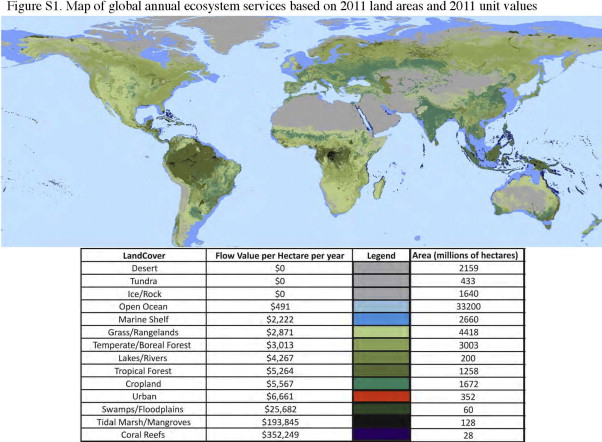
 

Map of global annual ecosystem services. (Photo credit: Costanza et al. 2014)


To be honest, that is a mind boggling and humbling assessment about the value of the environment. While people may have their criticisms of this approach, converting ecosystems services into a tangible value (despite the imprecision) is a good starting point to help people conceptualize the importance of these systems. As an example, to put into some perspective the value of a single ecosystem. After Hurricane Katrina, the Army Core embarked on a 14.5 billion dollar project on a massive network of flood walls and levees to protect New Orleans from coastal damage. The cost for this project does not account for maintenance and upkeep, indicating the true cost will be far higher than the initial expenditure. You know what else protects coast from storm damage? Coastal marshes! Coastal marshes absorb the wind energy and waves of storms, weakening their impact farther inland. And oddly enough, these systems rebuild and maintain themselves.

Dr. Costanza’s method is a powerful approach that provides us with an avenue to see just how much we depend on nature — and just how much of it we’re destroying.

 

Photo credit: Shawn Regan @ grist.org


You can see the original research article published in the journal Global Environmental Change.

Share this:

  • Click to share on Bluesky (Opens in new window) Bluesky
  • Click to share on Facebook (Opens in new window) Facebook
  • Click to share on Reddit (Opens in new window) Reddit
  • Click to share on Threads (Opens in new window) Threads
  • Click to share on WhatsApp (Opens in new window) WhatsApp
  • Click to share on Mastodon (Opens in new window) Mastodon

Related

Post navigation

❮ Previous Post: Education and Experience are Not Mutually Exclusive: Job Market Pet Peeves
Next Post: Busting Ocean Myths: How many containers are really lost at sea? ❯

Popular Posts

Shark scientists want their research to help save threatened species, but don’t know how. Our new paper can help.Shark scientists want their research to help save threatened species, but don’t know how. Our new paper can help.December 1, 2025David Shiffman
Norway and Cook Islands put their deep-sea mining plans on pause.Norway and Cook Islands put their deep-sea mining plans on pause.December 3, 2025Andrew Thaler
What Ocean Ramsey does is not shark science or conservation: some brief thoughts on "the Shark Whisperer" documentaryWhat Ocean Ramsey does is not shark science or conservation: some brief thoughts on "the Shark Whisperer" documentaryJuly 2, 2025David Shiffman
The Trouble with Teacup PigsThe Trouble with Teacup PigsOctober 14, 2012Andrew Thaler
What we know we don't know: impacts of deep-sea mining on whales, dolphins, sharks, turtles, and other migratory species.What we know we don't know: impacts of deep-sea mining on whales, dolphins, sharks, turtles, and other migratory species.November 20, 2025Andrew Thaler
2025: My year in writing, public speaking, and media interviews2025: My year in writing, public speaking, and media interviewsDecember 3, 2025David Shiffman
Urea and Shark OsmoregulationUrea and Shark OsmoregulationNovember 15, 2010David Shiffman
Shark of Darkness: Wrath of Submarine is a fake documentaryShark of Darkness: Wrath of Submarine is a fake documentaryAugust 10, 2014Michelle Jewell
How tiny satellites are tracking marine wildlifeDecember 1, 2025Andrew Thaler
Build a dirt cheap, tough-as-nails field computer in a Pelican caseBuild a dirt cheap, tough-as-nails field computer in a Pelican caseJuly 21, 2015Andrew Thaler
Subscribe to our RSS Feed for updates whenever new articles are published.

We recommend Feedly for RSS management. It's like Google Reader, except it still exists.

Southern Fried Science

  • Home
  • About SFS
  • Authors
  • Support SFS


If you enjoy Southern Fried Science, consider contributing to our Patreon campaign.

Copyright © 2025 Southern Fried Science.

Theme: Oceanly Premium by ScriptsTown