Skip to content

Southern Fried Science

Over 15 years of ocean science and conservation online

  • Home
  • About SFS
  • Authors
  • Support SFS

Fun Science FRIEDay – Life is Inevitable

Posted on February 8, 2019February 8, 2019 By Kersey Sturdivant
Uncategorized

Why does life exist? Its an age old question that has been debated for centuries with popular hypotheses crediting celestial interference, a primordial soup, or a colossal stroke of luck. However, a relatively recent and provocative hypothesis suggests luck has nothing to do with it, and that instead, life is an inevitable consequence of physics.

The author of the concept, Jeremy England – professor of biophysics at MIT, suggests, “the origin and subsequent evolution of life follow from the fundamental laws of nature and should be as unsurprising as rocks rolling downhill.”
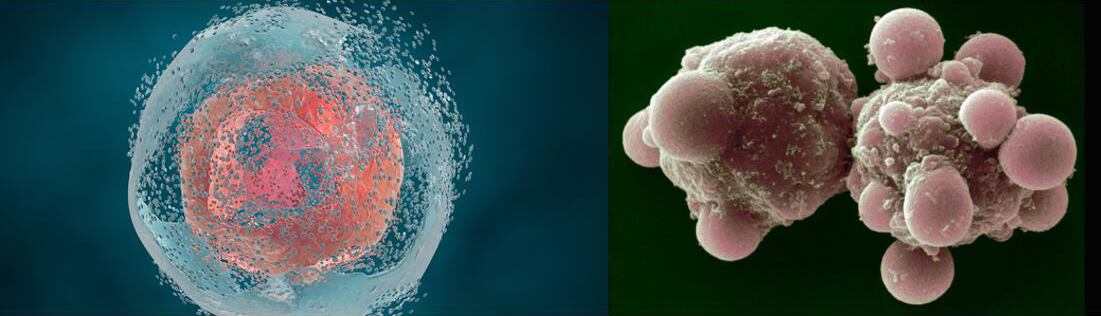
 

(Photo credit: creative-bioarray)

England asserts that the one key difference between living things and inanimate clumps of carbon atoms is that the former tends to be much more efficient at capturing energy from the environment and dissipating that energy as heat. England derived a formula he believes explains this capacity. When a group of atoms is driven by an external source of energy (like the sun or chemical fuel) and surrounded by a heat bath (like the ocean or atmosphere), it will often gradually restructure itself in order to dissipate increasingly more energy. This could mean that under certain conditions, matter inexorably acquires the key physical attribute associated with life.

England’s hypothesis bridges physics and biology and is rooted in the second law of thermodynamics known as the law of increasing entropy. Hot things cool down, gas diffuses through air, eggs scramble but never spontaneously unscramble; in short, energy tends to disperse or spread out as time progresses. The best explanation I’ve heard of this is to think of a pool of water with three color dyes dropped in it. Initially, they remain as separate dots far apart, but over time, the colors spread out, mix, and in the end, there’s just one single color. That’s the universe; the dots, in this case, can be pockets of biological life.

Essentially England is proposing that biology arises because, in certain environments – like on planets – where the energy balance is so out of whack, physics guarantees that atoms rearrange themselves to be able to deal with the chaotic flow of energy. These atomic structures just happen to resemble what we refer to as “life”.

As England famously said: “You start with a random clump of atoms, and if you shine light on it for long enough, it should not be so surprising that you get a plant.”

You can read his seminal manuscript describing this hypothesis in the Journal of Chemical Physics.

Share this:

  • Click to share on Bluesky (Opens in new window) Bluesky
  • Click to share on Facebook (Opens in new window) Facebook
  • Click to share on Reddit (Opens in new window) Reddit
  • Click to share on Threads (Opens in new window) Threads
  • Click to share on WhatsApp (Opens in new window) WhatsApp
  • Click to share on Mastodon (Opens in new window) Mastodon

Related

Tags: atoms inception Life physics thermodynamics

Post navigation

❮ Previous Post: Logs from a majestic pit of acid: Diving Belize’s Blue Hole with Erika Bergman.
Next Post: Remembering Walter Munk, a photo on a flash drive in a pile of poo from a seal at the bottom of the sea, lucky vikings, and more! Monday Morning Salvage: February 11, 2019 ❯

You may also like

Science
Cosmic Quandaries with Dr. Neil deGrasse Tyson
July 18, 2010
Popular Culture
Biodiversity Wednesday – Plants are badass
June 16, 2010
Uncategorized
Fun Science FRIEDay – Inception
October 4, 2019
Weekly Salvage
Mining historic shipwrecks for lead and other old things from the bottom of the sea. Also, Robots! Weekly Salvage: November 4, 2019
November 4, 2019

Popular Posts

Shark scientists want their research to help save threatened species, but don’t know how. Our new paper can help.Shark scientists want their research to help save threatened species, but don’t know how. Our new paper can help.December 1, 2025David Shiffman
Norway and Cook Islands put their deep-sea mining plans on pause.Norway and Cook Islands put their deep-sea mining plans on pause.December 3, 2025Andrew Thaler
What Ocean Ramsey does is not shark science or conservation: some brief thoughts on "the Shark Whisperer" documentaryWhat Ocean Ramsey does is not shark science or conservation: some brief thoughts on "the Shark Whisperer" documentaryJuly 2, 2025David Shiffman
What we know we don't know: impacts of deep-sea mining on whales, dolphins, sharks, turtles, and other migratory species.What we know we don't know: impacts of deep-sea mining on whales, dolphins, sharks, turtles, and other migratory species.November 20, 2025Andrew Thaler
2025: My year in writing, public speaking, and media interviews2025: My year in writing, public speaking, and media interviewsDecember 3, 2025David Shiffman
The Trouble with Teacup PigsThe Trouble with Teacup PigsOctober 14, 2012Andrew Thaler
Urea and Shark OsmoregulationUrea and Shark OsmoregulationNovember 15, 2010David Shiffman
How tiny satellites are tracking marine wildlifeDecember 1, 2025Andrew Thaler
Shark of Darkness: Wrath of Submarine is a fake documentaryShark of Darkness: Wrath of Submarine is a fake documentaryAugust 10, 2014Michelle Jewell
Quick Tips for Graduate Student Life - Write a Book ReviewJanuary 23, 2014Andrew Thaler
Subscribe to our RSS Feed for updates whenever new articles are published.

We recommend Feedly for RSS management. It's like Google Reader, except it still exists.

Southern Fried Science

  • Home
  • About SFS
  • Authors
  • Support SFS


If you enjoy Southern Fried Science, consider contributing to our Patreon campaign.

Copyright © 2025 Southern Fried Science.

Theme: Oceanly Premium by ScriptsTown