Skip to content

Southern Fried Science

Over 15 years of ocean science and conservation online

  • Home
  • About SFS
  • Authors
  • Support SFS

Fun Science FRIEDay – Death Star

Posted on November 21, 2014November 21, 2014 By Kersey Sturdivant
Blogging

Happy Fun Science FRIEDay!

While Ebola wreaks havoc on Homo sapiens in the terrestrial world, there has been an even more virulent disease causing the destruction of a marine animal, the sea star. Today we talk about this deadly condition impacting sea star populations and the recent discovery of just what is causing this affliction.
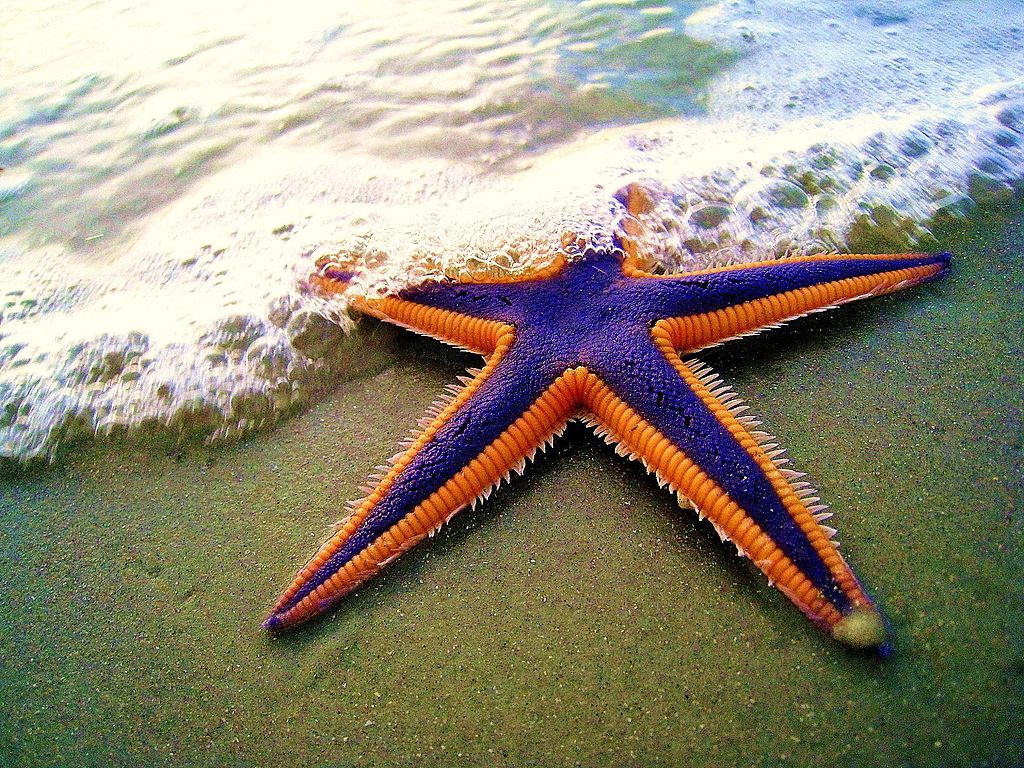
 

Royal starfish (Astropecten articulatus) on the beach. (Photo credit: TheMargue - http://www.fotopedia.com/items/flickr-2884079538)
Royal starfish (Astropecten articulatus) on the beach.
(Photo credit: TheMargue – http://www.fotopedia.com/items/flickr-2884079538)

Sea stars, also commonly known as starfish, are star-shaped echinoderms that typically have a central disc and five arms. Sea stars are generally considered to be keystone species in their respective habitats given their unique life history traits (size, diets, adaptability). In fact, Robert Paine first used the term “keystone species” in 1966 to describe the sea star, Pisaster ochraceus.
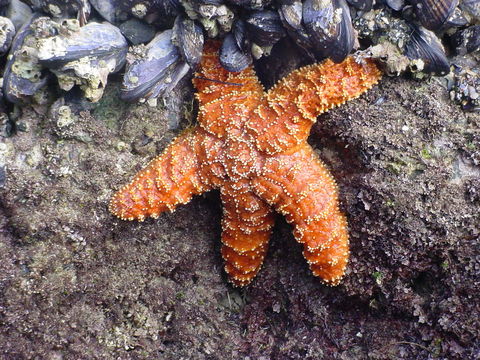
 

Pisaster ochraceus (Photo credit: Rosario Beach Marine Laboratory)
Pisaster ochraceus
(Photo credit: Rosario Beach Marine Laboratory)

Last year, a mysterious disease began appearing in sea stars in the Pacific. From Alaska to Mexico, sea stars from 20 different species were contracting an unknown disease, and the death toll was in the millions. This mystery disease was extremely deadly, condemning nearly 100% of sea stars that contracted the disease to a horrific death. Known as sea star wasting disease, an infected sea star would undergo rapid degradation (fancy science speak for melting). In the end, all that would be left of the infected sea star would be a pile of slime and a few pieces of invertebrate skeleton.
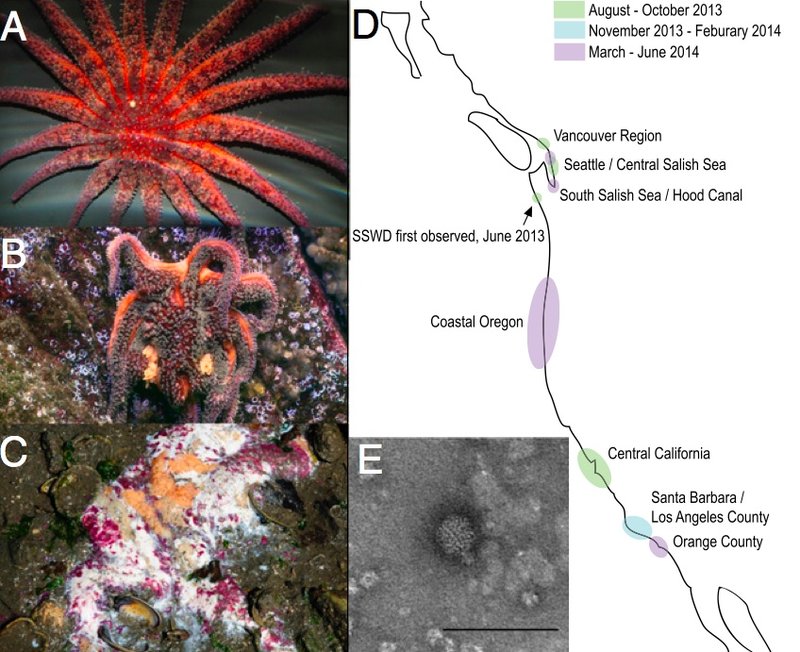
 

The sea star death march: A) A healthy sunflower sea star B) An infected sea star C) A sea star goo pile D) Disease occurrence E) The viral culprit  (Photo Credit: Hewson et al., PNAS)
The sea star death march: A) A healthy sunflower sea star B) An infected sea star C) A sea star goo pile D) Disease occurrence E) The viral culprit
(Photo Credit: Hewson et al., PNAS)

Despite the magnitude of the calamity scientist were perplexed at what was causing the disease, that is until a team of American and Canadian scientists, led by Ian Hewson of Cornell University, recently revealed the culprit to be a virus.  Ian and his team were unsure if a bacteria, virus, or parasite caused sea star wasting disease, but after examining hundreds of slides of infected sea star tissue, they surmised the disease was likely caused by a virus. They then devised an experiment to affirm their suspicions. They injected healthy sea stars with the liquefied tissue of infected sea stars, and also injected a control group of sea stars with the same liquefied tissue, except they sterilized the tissue to kill any pathogens. Sure enough, a week after being injected with the non-sterilized tissue, healthy sea stars began exhibiting sea star wasting disease and eventually experienced mortality.

Going a step further to identify the virus, Ian and his team then genetically sequenced and sorted the infected sea stars’ tissue. Those analyses yielded a genome of a previously unknown virus, which the researchers named sea star-associated densovirus. This virus is similar to diseases known to infect insects and also has genetic similarities to a disease that occasionally infects Hawaiian sea urchins.

Now that the virus impacting these sea stars has been identified, questions still remain about the origin, and what is next for sea stars in the wild still battling this pathogen.

You can read more about this interesting study that Ian et al. published in the Proceedings of the National Academy of Sciences.

Share this:

  • Click to share on Bluesky (Opens in new window) Bluesky
  • Click to share on Facebook (Opens in new window) Facebook
  • Click to share on Reddit (Opens in new window) Reddit
  • Click to share on Threads (Opens in new window) Threads
  • Click to share on WhatsApp (Opens in new window) WhatsApp
  • Click to share on Mastodon (Opens in new window) Mastodon

Related

Tags: Asteroidea disease echinoderm pathogen sea star wasting disease starfish

Post navigation

❮ Previous Post: Agents of seal: stealthy seals use subsurface structures to sneak by sharks
Next Post: Ocean things we’re thankful for, West Coast Edition ❯

You may also like

Weekly Salvage
The real deep reefs of South Carolina, dolphin chatter, autonomous starfish killing robots, an exciting submarine discovery, and more! Monday Morning Salvage: September 3, 2018
September 3, 2018
Weekly Salvage
Deep-sea gator falls covered in isopods, more struggles for the Ocean Cleanup, a robot lost in the cold (but not the one you’re thinking of), and more! Monday Morning Salvage: February 18, 2019
February 18, 2019
Weekly Salvage
Hurricane Irma, the Manatee Sheriff, climate change, and more! Monday Morning Salvage: September 11, 2017
September 11, 2017
Uncategorized
Fun Science FRIEDay – Cure for HIV?
May 19, 2017

Popular Posts

Shark scientists want their research to help save threatened species, but don’t know how. Our new paper can help.Shark scientists want their research to help save threatened species, but don’t know how. Our new paper can help.December 1, 2025David Shiffman
Norway and Cook Islands put their deep-sea mining plans on pause.Norway and Cook Islands put their deep-sea mining plans on pause.December 3, 2025Andrew Thaler
What Ocean Ramsey does is not shark science or conservation: some brief thoughts on "the Shark Whisperer" documentaryWhat Ocean Ramsey does is not shark science or conservation: some brief thoughts on "the Shark Whisperer" documentaryJuly 2, 2025David Shiffman
What we know we don't know: impacts of deep-sea mining on whales, dolphins, sharks, turtles, and other migratory species.What we know we don't know: impacts of deep-sea mining on whales, dolphins, sharks, turtles, and other migratory species.November 20, 2025Andrew Thaler
2025: My year in writing, public speaking, and media interviews2025: My year in writing, public speaking, and media interviewsDecember 3, 2025David Shiffman
The Trouble with Teacup PigsThe Trouble with Teacup PigsOctober 14, 2012Andrew Thaler
Urea and Shark OsmoregulationUrea and Shark OsmoregulationNovember 15, 2010David Shiffman
How tiny satellites are tracking marine wildlifeDecember 1, 2025Andrew Thaler
Shark of Darkness: Wrath of Submarine is a fake documentaryShark of Darkness: Wrath of Submarine is a fake documentaryAugust 10, 2014Michelle Jewell
Quick Tips for Graduate Student Life - Write a Book ReviewJanuary 23, 2014Andrew Thaler
Subscribe to our RSS Feed for updates whenever new articles are published.

We recommend Feedly for RSS management. It's like Google Reader, except it still exists.

Southern Fried Science

  • Home
  • About SFS
  • Authors
  • Support SFS


If you enjoy Southern Fried Science, consider contributing to our Patreon campaign.

Copyright © 2025 Southern Fried Science.

Theme: Oceanly Premium by ScriptsTown