Skip to content

Southern Fried Science

Over 15 years of ocean science and conservation online

  • Home
  • About SFS
  • Authors
  • Support SFS

Fun Science FRIEDay – Snap, Crack, Pop

Posted on April 24, 2015April 17, 2015 By Kersey Sturdivant
Uncategorized

You’ve been there before. You are sitting or standing around and get a mental sensation that you need to “pop your knuckles”.  A swift squeeze of your fingers and the tension is relieved. Crisis averted. But why do knuckles make that popping sound when you crack them? If questions like this keep you up at night… maybe you need to reevaluate your priorities. But, if the start of this article has piqued your interest, you will be pleased to know that a a team of researchers, led by the University of Alberta Faculty of Rehabilitation Medicine, have confirmed the reasons for knuckle popping.
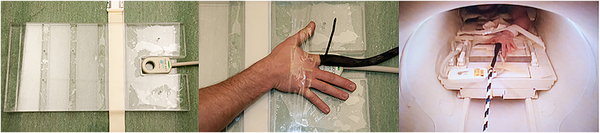
Pull My Finger experiment.  The radiofrequency coil inside the clear housing (left). The metocarpophaangeal (MCP) joint of interest centred over the bore of the radiofrequency coil (middle). The participant’s hand within the imaging magnet (right).  (Photo credit: Kawchuck et al. 2015, PLoS ONE)
Pull My Finger experiment. The radiofrequency coil inside the clear housing (left).
The metocarpophaangeal (MCP) joint of interest centred over the bore of the radiofrequency coil (middle). The participant’s hand within the imaging magnet (right). (Photo credit: Kawchuck et al. 2015, PLoS ONE)

How? SCIENCE!  But more specifically, in a “pull my finger study,” by placing a test subject’s hands inside an MRI machine, pulling the test subject’s fingers, and recording the results. What they found was that vacuum cavities (aka bubbles) formed in the synovial fluid of the joint, and the formation of these bubbles caused the popping noise we associated with cracking our knuckles. Cool!
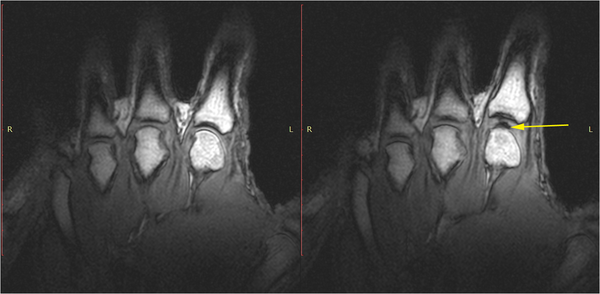
Pull My Finger experiment. Static images of the hand in the resting phase before cracking (left). The same hand following cracking with the addition of a post-cracking distraction force (right). Note the dark, interarticular void (Photo credit: Kawchuck et al. 2015, PLoS ONE)
Pull My Finger experiment. Static images of the hand in the resting phase before cracking (left).
The same hand following cracking with the addition of a post-cracking distraction force (right). Note the dark, interarticular void (Photo credit: Kawchuck et al. 2015, PLoS ONE)

The theory of bubbles in the joints of a knuckles was first developed in the late 1940s by researchers in the U.K. who hypothesized that cracking the knuckles caused bubbles to form in the synovial fluid causing a popping noise. However, a few decades later another study suggested that it was not the formation of the bubbles but their collapse (i.e. bubble bursting) that produced the audible popping noise. Ugh Science, you can be so ambiguous sometimes?

Lucky for us Kawchuck and his team have definitively proven that it is the formation of the bubbles that produces the noise, and not their collapse. So the next time you see someone cracking their knuckles, instead of scaring them with tells of arthritis, you can wow them with anatomical descriptions of why they make that noise. #nerdout

A really cool video of this work can be viewed here. And you can read the full study published in the journal PLoS ONE.


Happy FSF!

Share this:

  • Click to share on Bluesky (Opens in new window) Bluesky
  • Click to share on Facebook (Opens in new window) Facebook
  • Click to share on Reddit (Opens in new window) Reddit
  • Click to share on Threads (Opens in new window) Threads
  • Click to share on WhatsApp (Opens in new window) WhatsApp
  • Click to share on Mastodon (Opens in new window) Mastodon

Related

Tags: knuckle cracking synovial fluid

Post navigation

❮ Previous Post: What happens when we punch a hole in the seafloor?
Next Post: From Sea and Sky: Hacking the Chesapeake with #BayBots ❯

Popular Posts

What Ocean Ramsey does is not shark science or conservation: some brief thoughts on "the Shark Whisperer" documentaryWhat Ocean Ramsey does is not shark science or conservation: some brief thoughts on "the Shark Whisperer" documentaryJuly 2, 2025David Shiffman
I can serve on your graduate thesis committee. Here’s what you can expect of me, and what I expect in return.I can serve on your graduate thesis committee. Here’s what you can expect of me, and what I expect in return.October 16, 2025David Shiffman
The story of the pride flag made from NASA imagery: Bluesky's most-liked imageThe story of the pride flag made from NASA imagery: Bluesky's most-liked imageSeptember 27, 2024David Shiffman
Shark of Darkness: Wrath of Submarine is a fake documentaryShark of Darkness: Wrath of Submarine is a fake documentaryAugust 10, 2014Michelle Jewell
What can the funniest shark memes on the internetz teach us about ocean science and conservation?What can the funniest shark memes on the internetz teach us about ocean science and conservation?November 8, 2013David Shiffman
The Trouble with Teacup PigsThe Trouble with Teacup PigsOctober 14, 2012Andrew Thaler
Nodules, Lost Mines, and Dark Oxygen: A new documentary on deep-sea mining asks important questions about the future of the industry.Nodules, Lost Mines, and Dark Oxygen: A new documentary on deep-sea mining asks important questions about the future of the industry.July 24, 2025Andrew Thaler
"Twitter sucks now and all the cool kids are moving to Bluesky:" Our new survey shows that scientists no longer find Twitter professionally useful or pleasant"Twitter sucks now and all the cool kids are moving to Bluesky:" Our new survey shows that scientists no longer find Twitter professionally useful or pleasantAugust 19, 2025David Shiffman
I turned my woodshop into a personal solar farm.I turned my woodshop into a personal solar farm.June 21, 2021Andrew Thaler
Build a dirt cheap, tough-as-nails field computer in a Pelican caseBuild a dirt cheap, tough-as-nails field computer in a Pelican caseJuly 21, 2015Andrew Thaler
Subscribe to our RSS Feed for updates whenever new articles are published.

We recommend Feedly for RSS management. It's like Google Reader, except it still exists.

Southern Fried Science

  • Home
  • About SFS
  • Authors
  • Support SFS


If you enjoy Southern Fried Science, consider contributing to our Patreon campaign.

Copyright © 2025 Southern Fried Science.

Theme: Oceanly Premium by ScriptsTown