 Michelle Wcisel is a Zoologist specialized in predator/prey behaivour and the Scientific Communicator for EDNA Interactive. She has spent the past 4 years studying the behaviour of white sharks and Cape fur seals at Geyser Rock, ‘Shark Alley’, South Africa.
Animal movement is often shaped by natural barriers; a fish can’t leave the river it swims in, a tortoise is going to struggle to climb a cliff face, and a pangolin can’t swim across the sea. These barriers come quite naturally to the animals, yet researchers have often struggled to account for these constraints in movement analysis, particularly when it comes to estimating home range (or ‘Utilization Distributions’, UDs). Unfortunately, the few solutions that have attempted to account for barriers are often incredibly complicated without providing much improvement overall, so previous studies have been forced to simply ‘clip out’ the parts of the estimate that extend over these inconceivable areas (i.e. Heupel et al. 2004; Hammerschlag et al. 2012; Jewell et al. 2012).
White sharks movements are particularly interesting when it comes to this conundrum, as they are not only shaped by boundaries; the species is attracted to barriers every year when they seek out seal colonies to forage or move inshore to beaches (Kock et al. 2013; Towner et al. 2013). Our study area proved to be particularly challenging due to structures such as Shark Alley – a roughly 250m wide channel of water between Dyer Island and Geyser Rock (the seal colony). The white sharks we manually tracked (VIDEO) spent the majority of their time in the alley, therefore if we used the traditional method of clipping the UD, we would have lost the majority of the data we fought long and hard to collect! Traditional methods are also unable to account for movement (as in Jewell et al. 2012), which results in UDs clumping in areas of high use (or high tag activity) and neglecting important migration corridors between them. This is when we began to look for suitable alternatives to accurately project what the white sharks at Dyer Island and Geyser Rock were up to without sacrificing the data.
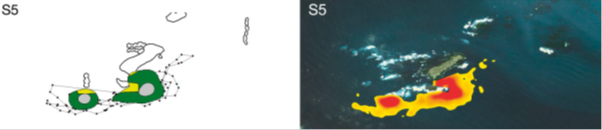
Simon Benhamou’s work on Movement Based Kernel Density Estimates (MKDEs) was our starting point (Benhamou & Cornélis 2010). MKDEs create UD estimates that make use of positions collected in succession within an animal’s track and consider the time taken between positions to build the spatial density of the range. Additionally, this method can account for boundaries defined within the range before the analysis and will shape the UD around them. Here’s an example of traditional method vs. MKDE that we used on Shark5’s track. You can see that the MKDE does a great job of projecting the movement of Shark5’s UD around the seal colony (right), whereas in the traditional method, we would have lost the data that the kernel places over the island’s east side (left).
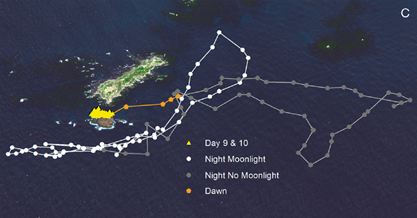
We also had a great opportunity to examine how the sharks move around seal colonies by comparing our results to those ~300km to the east in Mossel Bay. Johnson et al. (2009) found that white sharks would visit the seal colony during the restricted time periods of dawn and dusk hours, and spend all other times patrolling near shore reef systems far from the colony. At Geyser Rock, we found sharks remained close to the seal colony during all daylight hours, often right inside Shark Alley. The only time we actively tracked sharks away from the seal colony was during the night, when they would patrol deep offshore reefs. The only exceptions to this were the few occasions we tracked at night under a clear sky with a bright moon. During these conditions, sharks once again stayed close to Geyser Rock, patrolling to the south of the island rather than move to the offshore reefs. This provides evidence towards the hypothesis that white sharks detect seals primarily through vision, and made for some very interesting tracking nights!
We were surprised to find that sharks behaved so differently here, especially considering that Mossel Bay and Geyser Rock share some of the same individual white sharks! What could be driving these differences? Well, we’ll have to leave you in suspense for now, but our infographic below contains a clue…
As for the future, we will now attempt to apply MKDE analyses to SPOT data collected from the South African OCEARCH expedition to identify important hotspots and migration corridors for white sharks throughout the southern Africa/Indian Ocean areas. With any luck, this future work will serve as a backbone for white shark management in the region and as an important test of the method for trans-oceanic species.
Research Conducted by Marine Dynamics a Shark Cage Diving Operator in Gansbaai South Africa
References:
Heupel, M. R., Simpfendorfer, C. A., & Hueter, R. E. (2004). Estimation of shark home ranges using passive monitoring techniques. Environmental Biology of Fishes, 71(2), 135-142.
Hammerschlag, N., Gallagher, A. J., Wester, J., Luo, J., & Ault, J. S. (2012). Don’t bite the hand that feeds: assessing ecological impacts of provisioning ecotourism on an apex marine predator. Functional Ecology, 26(3), 567-576.
Jewell, O. J., Johnson, R. L., Gennari, E., & Bester, M. N. (2013). Fine scale movements and activity areas of white sharks (Carcharodon carcharias) in Mossel Bay, South Africa. Environmental biology of fishes, 96(7), 881-894.
Kock, A., O’Riain, M. J., Mauff, K., Meÿer, M., Kotze, D., & Griffiths, C. (2013). Residency, habitat use and sexual segregation of white sharks, Carcharodon carcharias in False Bay, South Africa. PloS one, 8(1), e55048.
Towner, A. V., Underhill, L. G., Jewell, O. J., & Smale, M. J. (2013). Environmental influences on the abundance and sexual composition of white sharks Carcharodon carcharias in Gansbaai, South Africa. PloS one, 8(8), e71197.
Benhamou, S., & Cornélis, D. (2010). Incorporating movement behavior and barriers to improve kernel home range space use estimates. The Journal of Wildlife Management, 74(6), 1353-1360.
Johnson, R., Bester, M. N., Dudley, S. F., Oosthuizen, W. H., Meÿer, M., Hancke, L., & Gennari, E. (2009). Coastal swimming patterns of white sharks (Carcharodon carcharias) at Mossel Bay, South Africa. Environmental biology of fishes, 85(3), 189-200.