This article originally appeared in the August/September 2020 issue of the Deep-sea Mining Observer. It is reprinted here with permission. For the latest news and analysis about the development of the deep-sea mining industry, subscribe to DSM Observer here: http://dsmobserver.com/subscribe/
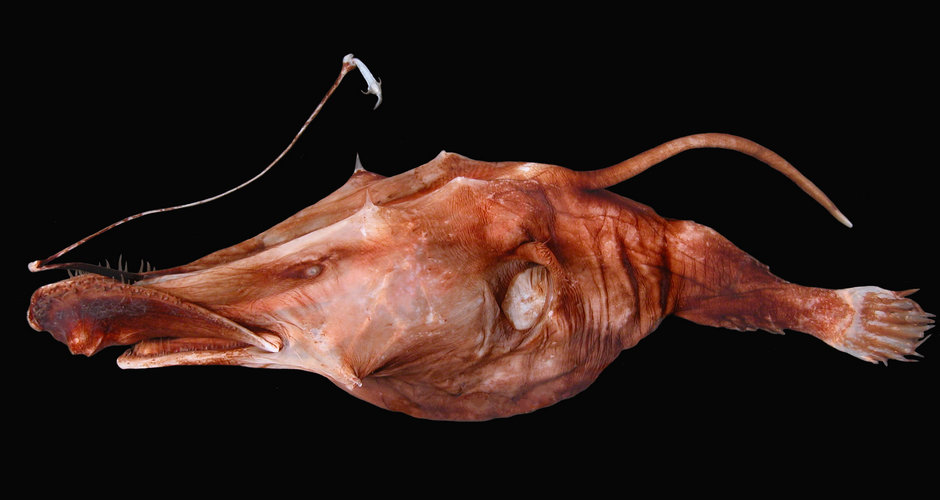
When you live in the darkness of the abyss, finding a partner is hard and keeping a partner is even harder. Deep-sea anglerfish, one of the iconic ambassador species of the deep ocean, have found a novel solution to this problem–dwarf males are sexual parasites that latch onto the body of the much larger female anglerfish and then physically fuse to their partner, becoming permanently attached to the point where they share a circulatory and digestive system.
Parasitic dwarf males are uncommon, but not unheard of, throughout the animal kingdom. Osedax, the deep sea bone eating worm, also maintains a harem of dwarf males in a specialized chamber in their trunk. But few species, and no other vertebrates, go to quite the extremes of the anglerfish. And with good reason.
Vertebrate immune systems have a long shared history. The Major Histocompatibility Complex (MHC) is a suite of genes shared among all gnathostomes–the taxonomic group that contains all jawed vertebrates, from fish to fishermen. It creates the proteins which provide the foundation for the adaptive immune system, the core complex which allows bodies to tell self from no-self, detect pathogens, and reject non-self invaders. Suppressing the MHC seriously inhibits a vertebrate’s ability to fight off infection.
Incidentally, not all deep-sea anglerfish have parasitic dwarf males, and the species most often presented as a type specimen in the popular press, the humpback anglerfish Melanocetus johnsonii, is one of several that do not have permanently attached parasitic dwarf males. M. johnsonii males are free-swimming throughout their life, they’re just small and clingy.
The existence of closely related anglerfish that have fully parasitic dwarf males, dwarf males that temporarily attach during mating, and males that do not attach, creates an opportunity to explore the evolution of the vertebrate immune system in these strange fish. A recent study conducted by researchers at the Max Planck Institute of Immunobiology and Epigenetics and the University of Washington attempted to unravel this mystery of anglerfish mating.
Among anglerfish that didn’t, or only temporarily attached during mating, there were no major differences between anglerfish MHC genes and those of other fish species. The adaptive immune system appears to present no barrier to temporary attachment. In contrast, there were massive changes among those anglerfish with parasitic dwarf males, including deletions of entire sections of the major histocompatibility complex and a significant reduction in MHC diversity. These changes were even more pronounced among anglerfish that host multiple male parasites simultaneously.
Major changes were found associated with other components of the immune system, as well, including several genes which regulate the function of cytotoxic T cells that were missing from the genomes of anglerfish that host permanently attached males. Among all investigated species that have either permanent or temporarily attached males, several antibody producing genes were absent. Other antibody-forming genes had accumulated significant deleterious mutations, but only within the genomes of anglerfish who host multiple male parasites simultaneously.
In order to secure long-term partnerships in the vast and biomass limited deep oceans, anglerfish have rewritten their immune systems to cope with the demands of this lifelong commitment.
While there are important lessons on immune system suppression that can be adapted towards human organ transplantation and treating autoimmune diseases, there is likely not a direct line between anglerfish genetics and pharmaceutical treatment. This research, however, does raise a new question–although anglerfish have suppressed significant components of their immune system at a genetic level to allow for the attachment of parasitic mates, their immune system continues to fight off other infections. The more interesting line of inquiry may not be “why don’t female anglerfish reject their mates?” but rather “how do anglerfish immune systems continue to function for other pathogens while suppressed to prevent the rejection of permanently attached males?”
The more we explore the deep oceans, the more surprising discoveries we make about the adaptability of life on earth. As one of the few global stakeholders that has both an enduring interest in establishing baselines for biodiversity in the deep sea as well as the financial and technological capacity to maintain a presence in areas beyond national jurisdiction, the deep-sea mining industry has the potential to serve as an engine of discovery that benefits humankind in often unexpected ways.
Featured image: Wolftrap Anglerfish. Photo by Theodore W. Pietsch.