Skip to content

Southern Fried Science

Over 15 years of ocean science and conservation online

  • Home
  • About SFS
  • Authors
  • Support SFS

Measuring the Cultural Value of Oysters

Posted on July 14, 2017July 14, 2017 By Bluegrass Blue Crab
Open Science, Uncategorized

Most people from oyster-producing regions like the Chesapeake can attest to the fact that oysters are important the the social fabric of the community. In many towns that date back to the colonial era, oyster shells literally line Main Street and form the foundation of the town. In others, they form the basis of a modern-day bar scene boasting of “merroir” of the oysters alongside terroir of the wine. When the ecosystem around these kinds of places changes (think warming waters, acidified waters, introduced species who also love oysters), the resource underpinning this aspect of culture and heritage can be threatened. What does that mean for the humans so connected to the briny bivalve?
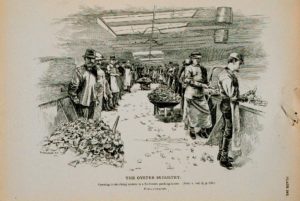
Historic Baltimore Shucking House. Courtesy of the NOAA Photo Library

A new paper by myself, Bruce Vogt, and Troy Hartley proposes we monitor that connection to oysters alongside the more standard indicators like water quality, benthic community, and oyster population. This kind of monitoring is important in efforts to expand fisheries management to an ecosystem perspective and also potentially gives community members yet another reason to care when their local water body receive a grade of “C”. Given monitoring of this kind is often completed on a shoestring budget and must integrate well with existing monitoring data, there’s some serious restrictions about what kind of information can fill this void. But the paper gives us an elegant solution: business names taken from state tax records.

Turns out, there’s a cadre of people who aren’t trying to sell actual oysters who name their auto repair shops, wineries, and antique shops after oysters to pay homage to the historical creature. According to business owners, there’s a desire to directly credit the region’s identity in part to oysters.

Of course, there’s other kinds of value associated with oysters – namely, they’re delicious and people are willing to support a fishing industry (both wild and mariculture, in the Chesapeake) in order to eat them. Small towns and neighborhoods are also named after historical oyster industry areas or large oyster bars in credit to the prominence they carry in the community. So the bottom line is that oysters represent many kinds of cultural value to the people of the Chesapeake, and this is something worth monitoring and preserving.

But don’t just take my word for it – read the paper! It’s open access for the first 50 days of publication on Ecological Complexity’s website, and after that, don’t hesitate to ask me for a copy!

Share this:

  • Share on Bluesky (Opens in new window) Bluesky
  • Share on Facebook (Opens in new window) Facebook
  • Share on Reddit (Opens in new window) Reddit
  • Share on Threads (Opens in new window) Threads
  • Share on WhatsApp (Opens in new window) WhatsApp
  • Share on Mastodon (Opens in new window) Mastodon

Related

Tags: business names Chesapeake oysters

Post navigation

❮ Previous Post: Your car has just been crushed by hagfish: Frequently Asked Questions
Next Post: HAGFISH! Also deep-sea mining, climate change, The Ocean Cleanup, and more! Monday Morning Salvage: July 17, 2017 ❯

You may also like

Weekly Salvage
Frisky Anglerfish, Persistent Aquatic Living Sensors, Make for the Planet Borneo, Sea Cucumber Mafia, and more! Monday Morning Salvage: March 26, 2018
March 26, 2018
Weekly Salvage
Valuing the deep sea, send @mcmsharksxx to Antarctica, deep-sea mining takes a dive, explore Kiribati, and more! Monday Morning Salvage: July 9, 2018
July 9, 2018
Weekly Salvage
Farting oysters, bombing sea lions, and a new trash island? It must be the Monday Morning Salvage! November 20, 2017
November 20, 2017
Uncategorized
Weekly dose of TED: Reviving New York’s rivers with oysters!
March 4, 2011

Popular Posts

How close did the world's first deep-sea mining come to the dredging the world's largest cold-water coral reef?How close did the world's first deep-sea mining come to the dredging the world's largest cold-water coral reef?March 17, 2026Andrew Thaler
What Ocean Ramsey does is not shark science or conservation: some brief thoughts on "the Shark Whisperer" documentaryWhat Ocean Ramsey does is not shark science or conservation: some brief thoughts on "the Shark Whisperer" documentaryJuly 2, 2025David Shiffman
That's not a blobfish: Deep Sea Social Media is Flooded by AI SlopThat's not a blobfish: Deep Sea Social Media is Flooded by AI SlopDecember 19, 2025Andrew Thaler
Urea and Shark OsmoregulationUrea and Shark OsmoregulationNovember 15, 2010David Shiffman
Tangier, an Island out of Time.Tangier, an Island out of Time.July 3, 2017Andrew Thaler
Here's what I teach my students about finding jobs in marine biology and conservationHere's what I teach my students about finding jobs in marine biology and conservationApril 10, 2024David Shiffman
Shark of Darkness: Wrath of Submarine is a fake documentaryShark of Darkness: Wrath of Submarine is a fake documentaryAugust 10, 2014Michelle Jewell
America's Second-Largest Estuary is a Lagoon Full of SharksAmerica's Second-Largest Estuary is a Lagoon Full of SharksApril 12, 2018Chuck Bangley
The story of the pride flag made from NASA imagery: Bluesky's most-liked imageThe story of the pride flag made from NASA imagery: Bluesky's most-liked imageSeptember 27, 2024David Shiffman
Alberta, Canada is the proud owner of the largest man-made pyramid on the planetAlberta, Canada is the proud owner of the largest man-made pyramid on the planetOctober 16, 2012Andrew Thaler
Subscribe to our RSS Feed for updates whenever new articles are published.

We recommend Feedly for RSS management. It's like Google Reader, except it still exists.

Southern Fried Science

  • Home
  • About SFS
  • Authors
  • Support SFS


If you enjoy Southern Fried Science, consider contributing to our Patreon campaign.

Copyright © 2026 Southern Fried Science.

Theme: Oceanly Premium by ScriptsTown