Skip to content

Southern Fried Science

Over 15 years of ocean science and conservation online

  • Home
  • About SFS
  • Authors
  • Support SFS

MISHAP in Antarctica

Posted on May 7, 2010May 7, 2010 By Guest Writer
Science

Southern Fried Notice: Reny Tyson is a graduate student at the Duke University Marine Lab currently on location in Antarctica tracking Humpback Whales. The main expedition blog is Tagging Whales in the Antarctic Seas hosted at the Nicholas School of the Environment. Follow their adventure as they track Humpbacks through Antarctic Seas.


Today we begin a journey south towards the Western Antarctic Peninsula to begin year 2 of our program, Multi-scale Interdisciplinary Study of Humpback Whales and their Prey, aptly referred to as MISHAP.  We are a team of scientists representing 8 institutions and organizations attempting to understand more fully humpback whale foraging ecology in Antarctic waters – how much are they eating, what are their behaviors associated with eating, and how does the behavior of their primary prey, Antarctic krill, affect their foraging behavior. During last years cruise we encountered some of the highest densities of whales ever recorded and many superswarms of krill (over 3 million tons) in several coves and bays along the Peninsula that the whales were happily foraging on.  We are using the DTag (Digital acoustic recording tag) to observe the underwater behaviors of whales while  concurrently measuring the behavior and density of krill with several acoustic samplers. This year we are adding a few dimensions to our study including putting a crittercam on the whales and obtaining biopsy samples of the animals.  We are excited to see how the conditions will be this year – will we encounter such high densities of krill and whales this year?  Will the coves be full of ice by the time we get there?  We shall find out in a few short days..
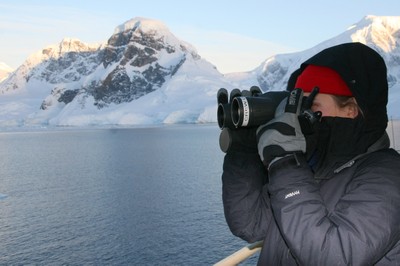
Image courtesy Tagging Whales in the Antarctic Seas

From a personal note – I can’t express how grateful I am to be part of such an adventure.  To be able to work with these scientists with these animals in this environment is indescribable.

If you want to follow along with us on our journey check out our blog Tagging Whales in the Antarctic Seas.

We will be posting as often as we can (with our very limited bandwith) and we will check back in with our friends here at Southern Fried Science a few times during our journey.

We’d love to hear from you!

~Reny

If you have questions for Reny or the Antarctic team, please leave them in the comments section and we will forward them on.

Share this:

  • Share on Bluesky (Opens in new window) Bluesky
  • Share on Facebook (Opens in new window) Facebook
  • Share on Reddit (Opens in new window) Reddit
  • Share on Threads (Opens in new window) Threads
  • Share on WhatsApp (Opens in new window) WhatsApp
  • Share on Mastodon (Opens in new window) Mastodon

Related

Tags: Antarctica humpback whales MISHAP

Post navigation

❮ Previous Post: Weekly dose of TED – James Cameron: Before Avatar … a curious boy
Next Post: 365 days of Darwin: May 8, 2010 ❯

You may also like

Science
Update from Antarctica – What is MISHAP?
May 20, 2010
Uncategorized
Snot Bots for whale health, critical dolphins, lobster considerations, and more! Monday Morning Salvage: January 15, 2018.
January 15, 2018
Weekly Salvage
What does your sandwich cost, rare species in the deep, dong worms, and more! Monday Morning Salvage: June 26, 2017
June 26, 2017
Science
Monday morning blogaerobics: shark news roundup and a message from Antarctica
May 24, 2010

Popular Posts

How close did the world's first deep-sea mining come to the dredging the world's largest cold-water coral reef?How close did the world's first deep-sea mining come to the dredging the world's largest cold-water coral reef?March 17, 2026Andrew Thaler
What Ocean Ramsey does is not shark science or conservation: some brief thoughts on "the Shark Whisperer" documentaryWhat Ocean Ramsey does is not shark science or conservation: some brief thoughts on "the Shark Whisperer" documentaryJuly 2, 2025David Shiffman
That's not a blobfish: Deep Sea Social Media is Flooded by AI SlopThat's not a blobfish: Deep Sea Social Media is Flooded by AI SlopDecember 19, 2025Andrew Thaler
Urea and Shark OsmoregulationUrea and Shark OsmoregulationNovember 15, 2010David Shiffman
Here's what I teach my students about finding jobs in marine biology and conservationHere's what I teach my students about finding jobs in marine biology and conservationApril 10, 2024David Shiffman
The story of the pride flag made from NASA imagery: Bluesky's most-liked imageThe story of the pride flag made from NASA imagery: Bluesky's most-liked imageSeptember 27, 2024David Shiffman
Alberta, Canada is the proud owner of the largest man-made pyramid on the planetAlberta, Canada is the proud owner of the largest man-made pyramid on the planetOctober 16, 2012Andrew Thaler
America's Second-Largest Estuary is a Lagoon Full of SharksAmerica's Second-Largest Estuary is a Lagoon Full of SharksApril 12, 2018Chuck Bangley
Here are some ocean conservation technologies that I'm excited aboutHere are some ocean conservation technologies that I'm excited aboutFebruary 19, 2026David Shiffman
I turned my woodshop into a personal solar farm.I turned my woodshop into a personal solar farm.June 21, 2021Andrew Thaler
Subscribe to our RSS Feed for updates whenever new articles are published.

We recommend Feedly for RSS management. It's like Google Reader, except it still exists.

Southern Fried Science

  • Home
  • About SFS
  • Authors
  • Support SFS


If you enjoy Southern Fried Science, consider contributing to our Patreon campaign.

Copyright © 2026 Southern Fried Science.

Theme: Oceanly Premium by ScriptsTown