

Skip to content

Southern Fried Science

Over 15 years of ocean science and conservation online

  • Home
  • About SFS
  • Authors
  • Support SFS

Recent Posts

We Asked IMCC7 Attendees What Ocean Conservation Needs. Here’s What They Said.
November 5, 2026
Researching Historical Erasure on Public Lands
July 31, 2026
5 things I learned helping to reassess the global conservation status of every species of tuna and billfish
September 15, 2026
Key takeaways from my Convention on Migratory Species report on fish aggregating devices in the Mediterranean Sea
September 3, 2026
Jabberwocks and Snallygasters: teaching environmental education with monsters, mayhem, and dice.
August 31, 2026
The conservation impacts of recreational fishing
August 25, 2026

Dolphin intelligence researcher did not say that dolphins aren’t intelligent as Daily Mail, Sunday Times claim

Posted on September 12, 2013October 27, 2013 By David Shiffman 11 Comments on Dolphin intelligence researcher did not say that dolphins aren’t intelligent as Daily Mail, Sunday Times claim
Science

davesquare

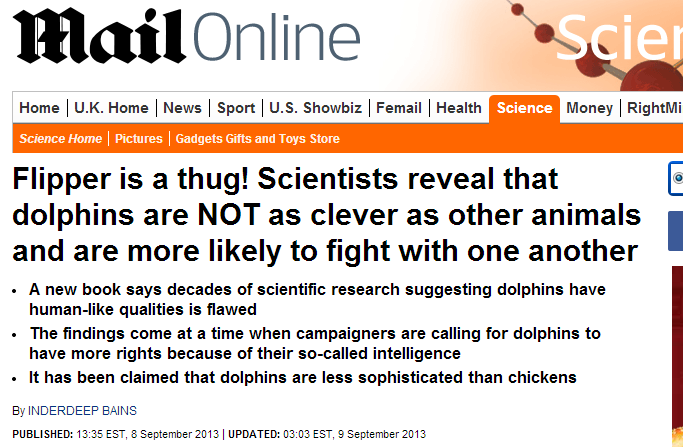
A screen capture of the Daily Mail's headline for this article
A screen capture of the Daily Mail’s article headline

Earlier this week, the Daily Mail ran an article which claimed that dolphins are not as intelligent as is commonly believed. The crux of this provocative argument comes from an interview with Dr. Justin Gregg, a research associate with the dolphin communication project who studies social cognition.

According to the Daily Mail article, Justin Gregg said, “Dolphins are fascinating in their own right, but in terms of intelligence they are nowhere near as special as they have been portrayed…they are less sophisticated than chickens.” In an editorial that was likely the source of the Daily Mail article, the Sunday Times claims that he said “Not only are dolphins dimmer than the average chicken, says Justin Gregg, a zoologist, but they are also capable of gang rape and acts of violence. So don’t be taken in by those winning smiles.”

Unsurprisingly, this article has ruffled some feathers in the marine mammal researcher community.


Read More “Dolphin intelligence researcher did not say that dolphins aren’t intelligent as Daily Mail, Sunday Times claim” »

Cocktail Week Reboot: How to brew beer in a coffee maker, using only materials commonly found on a modestly sized oceanographic research vessel.

Posted on September 11, 2013October 27, 2013 By Andrew Thaler 1 Comment on Cocktail Week Reboot: How to brew beer in a coffee maker, using only materials commonly found on a modestly sized oceanographic research vessel.
Science

It’s Cocktail Week over at Deep Sea News. In honor of this most auspicious event we’ve dredged up the post that put Southern Fried Science on the chart, nearly five years ago. Enjoy this blast from our southern fried past.


The Flip - One research vessel you may a drink on
The Flip – one research vessel that mandates a drink

Introduction

Beer brewing is the delicate and dedicated blending of art and science.  Finding the perfect balance of grains, hops, malt, adding just the right flavoring agents, boiling for exactly enough time to release the tannins, starches, humic acids from you wort, activating enzymes to break down those starches, forging the perfect mash from the ether of sobriety to give birth to that most glorious pint, these are skills that take a lifetime to master. Perfect beer is meticulously planned and carefully crafted.

Screw that.

You’re six days into a 2 month expedition, and if you were lucky enough to not be on a dry ship, it’s de facto dry by now anyway. You’re eying the ethanol stores, the crew is eying each other, and all hell will break loose if y’all don’t get some sweet water soon. This is no time for artistry.

This is not, as a rule, a terribly good beer (though, with a good brewmaster on board, it can be). This is a beer to pass the time and ease the pain of life at sea. I can guarantee that if you are careful, it will be at least as good as the cheapest commercial alternative.

Read More “Cocktail Week Reboot: How to brew beer in a coffee maker, using only materials commonly found on a modestly sized oceanographic research vessel.” »

One month until ScienceOnline Oceans: Here’s what you need to know!

Posted on September 11, 2013October 27, 2013 By David Shiffman

davesquare sciooceansScienceOnline Oceans starts on October 11th, one month from today! Here’s what you need to know in order to make the most of the meeting.

1) There are still spots available! If you’ve been considering attending (or if you are already planning attending and know others who might be interested), there are still spots available! The conference registration fee remains $150 for students and $200 for others. Register here.

2) Make your hotel reservation this week!  If you haven’t yet made your hotel reservation, you need to do it THIS WEEK! We strongly recommend staying at the conference hotel, as bus transportation to conference events and field trips is to and from the hotel. Additionally, the hotel bar is the evening social gathering place for the conference. We consider time at the hotel as part of the conference! You don’t need to pay at the time you make the reservation, you pay when you check out.

Information about hotel reservations can be found here: http://oceans.scienceonline.com/hotel-information/
If you do not reserve before the weekend, then
  • you may not be able to get a room at the conference rate
  • you may not be able to get a room at all, and, most importantly
  • ScienceOnline is financially responsible for paying for the rooms we contracted for (if we don’t get enough reservations)!
There is also a roomshare Wiki: http://sciooceans.wikispaces.com/Roomshare

**Please note that if you are planning on participating in a Friday afternoon workshop, it may be easier to fly in Thursday night, and if you are participating in a Sunday field trip, it may be easier to fly home Monday morning. A limited number of hotel rooms are available at the conference rate on both Thursday and Sunday evening.**

Read More “One month until ScienceOnline Oceans: Here’s what you need to know!” »

Six sea monsters that make their horror movie counterparts look tame

Posted on September 8, 2013January 3, 2017 By Andrew Thaler
Popular Culture, Science

Evolution is infinitely creative. Sometimes, amid the beauty and wonder, the awe that emanates from the shear power of natural selection, and the poetry of descent with modification, evolution produces something that terrifies. I am not talking about our natural predators, for whom fear is part of our evolutionary heritage, but rather creatures that appear as though they emerged from our darkest nightmares. But even our nightmares are limited by our finite minds.

Evolution has no such limits and the immense size and incomprehensible diversity of the oceans has produce animals that make us yearn for the comforting familiarity of the common Pumpkinhead. Submitted for the approval of the Midnight Society, I present six sea monsters that make their horror movie counterparts look tame:

1. These mind-bending tapeworms crawled straight out of Slither.

Here is a classic horror movie scenario for you: alien/parasite/mutant invaders enter your body, latch on to you brain, and take control, forcing you to do their bidding as they multiply and infect those around you. From Body Snatchers to Slither, mind-controlling parasites are a mainstay of the genre. But you’re a reader of Southern Fried Science. You already know all about barnacles that take over crab brains and induce sex-changes when necessary or fungi that invade ants and force them to climb to their doom. Mind control parasites aren’t really all that uncommon, but they mostly infect invertebrates. There aren’t any deadly mind-melting monsters that can take over us higher organisms, right? Right?!

Wrong.

Read More “Six sea monsters that make their horror movie counterparts look tame” »

Conserving the Endangered African Wild Dogs of Zimbabwe

Posted on September 6, 2013September 6, 2013 By Guest Writer
Conserving the Endangered African Wild Dogs of Zimbabwe
Conservation

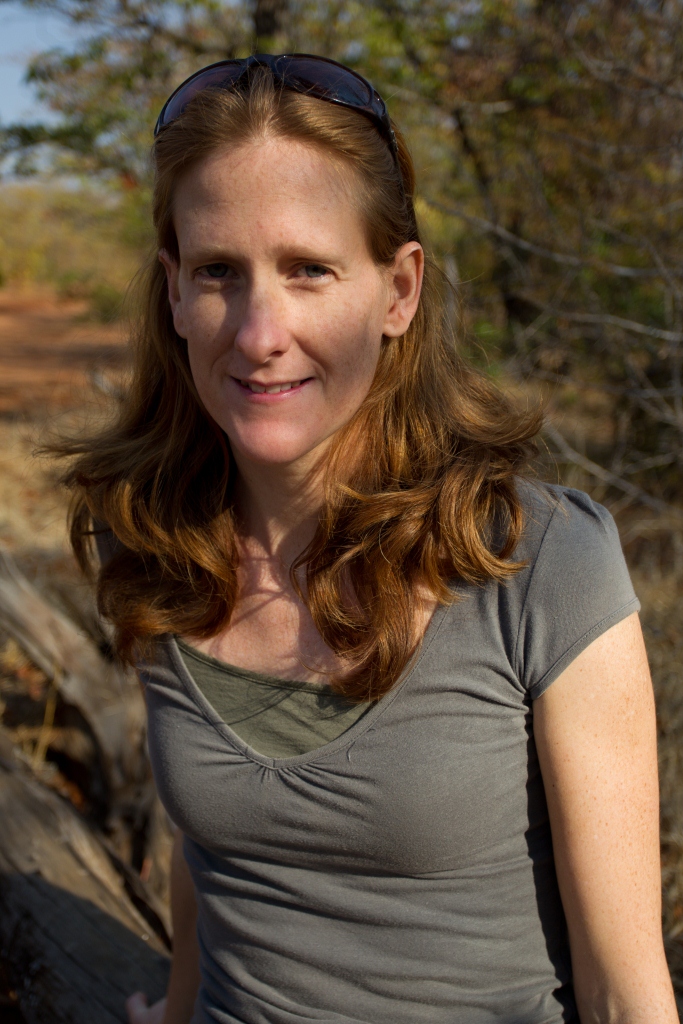
Rosemary GroomDr. Rosemary Groom  grew up in Zimbabwe and has spent the last 12 years working in wildlife conservation in East and southern Africa. She is a dedicated conservation biologist, with a strong belief in the importance of large scale multidisciplinary conservation programs. Rosemary has worked on various different projects, from reptiles to large African herbivores, but for the past five years she has been working on large carnivore conservation in Zimbabwe, for the small, home-grown, hands-on charity The African Wildlife Conservation Fund.  The endangered African wild dog is the focal species for the program, but Rosemary also runs the Gonarezhou Predator Project, focussing on African lions. Rosemary is a member of the IUCN canid specialist group and is currently acting as the southern African coordinator for the Rangewide Conservation Program for Cheetah and Wild Dogs.  She has published several papers in peer reviewed scientific journals and currently holds a post-doctoral fellowship at the University of Johannesburg.

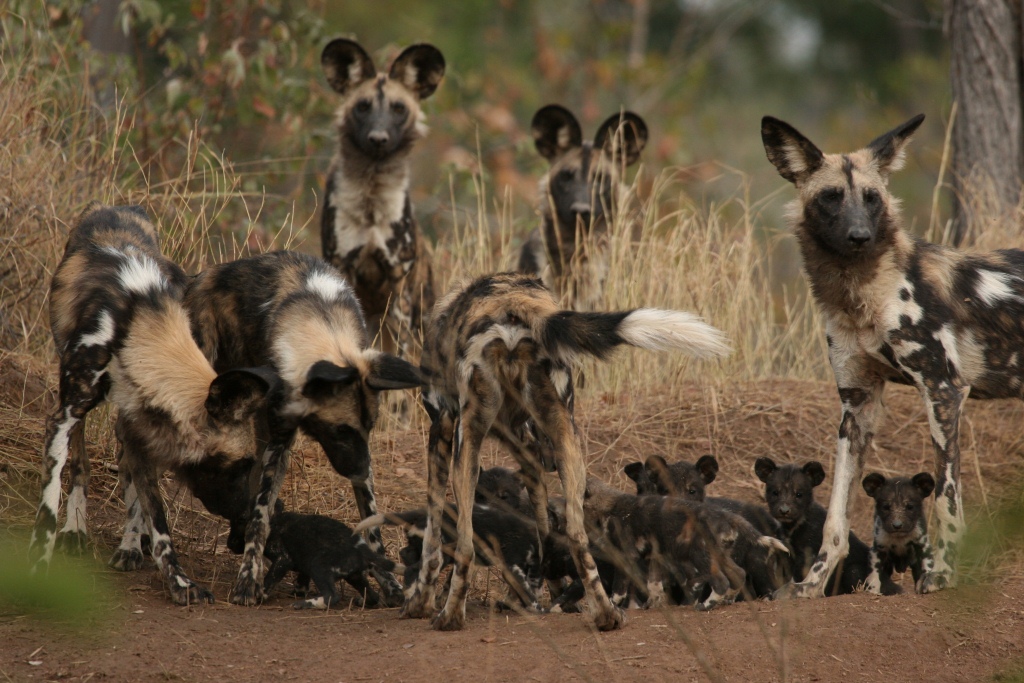
African Wild Dogs. Photo courtesy Rosemary Groom


African wild dogs are the most endangered large carnivore in southern Africa.  There may be as few as 660 packs left in the wild – that’s only 660 breeding females!  African wild dogs are beautiful, amiable and charismatic animals with very endearing pups – not the feral domestic dogs that some people believe them to be.

In fact, African wild dogs have their own evolutionary lineage and are more closely related to wolves than they are to domestic dogs.

But unfortunately they are highly endangered and their global population is declining…  Threats include habitat loss and fragmentation, wire snaring, disease, human persecution and even predation by lions.

Read More “Conserving the Endangered African Wild Dogs of Zimbabwe” »

Sick of fictional mermaid documentaries? Try some dystopian maritime science fiction, instead!

Posted on September 2, 2013October 27, 2013 By Andrew Thaler 4 Comments on Sick of fictional mermaid documentaries? Try some dystopian maritime science fiction, instead!
Popular Culture

Welcome to the Fleet! It’s the near future, the rising tides have swallowed much of the world’s coastlines, and the last survivors of a deadly plague are scattered across a new and vastly different ocean. But all is not well in the Reach. The fish are dwindling, the currents are shifting, and secrets long thought … Read More “Sick of fictional mermaid documentaries? Try some dystopian maritime science fiction, instead!” »

And now for something completely different: An experiment in Science Fiction and Kindle Direct Publishing

Posted on August 29, 2013October 27, 2013 By Andrew Thaler 3 Comments on And now for something completely different: An experiment in Science Fiction and Kindle Direct Publishing
Popular Culture

Longtime readers have occasionally humored my attempts at short science fiction stories, the like of which can be found in Eno Magazine and Nature. Writing these short pieces is fun, but there’s a longer story that’s been festering in my head for the better part of a year and it’s finally time to come out.

Welcome to the Fleet.

Fleet is set in the near future, in a world of maximum sea level rise where the human population has been reduced to a few small enclaves and disease outbreaks are rampant and devastating. Amid the hardships, a trio of fishers slowly begin to unlock a long buried mystery that will challenge their loyalty to the fleet and each other.

Read More “And now for something completely different: An experiment in Science Fiction and Kindle Direct Publishing” »

#Ocean2Ocean: The final entry.

Posted on August 28, 2013October 27, 2013 By Andrew Thaler
Blogging

We arrived in sunny California last Thursday evening after 6 days of driving and more than 3000 miles covered. The goats were delivered to their new yard, where they have settled back down to an enviable routine of eating, sleeping, and headbutting each other. Our little neighborhood in Vallejo is delightful, it not a touch … Read More “#Ocean2Ocean: The final entry.” »

The Pizza of Privilege: My Experiences with Anti-Semitism in Academia

Posted on August 22, 2013October 27, 2013 By David Shiffman 45 Comments on The Pizza of Privilege: My Experiences with Anti-Semitism in Academia
Science

davesquare

Anti-Semitic graffiti similar to this has been found on U.S. universities. This comes from a private residence in New York. Photo credit: Alex Silverman/WCBS 880.

Since I joined Southern Fried Science in 2009, I’ve written almost 1,000 blog posts. This post has unquestionably been the most difficult one for me to write. Although I’ve always enjoyed sharing and debating my opinions (even when they’re unpopular in certain circles,) I’ve never been comfortable discussing negative personal experiences. And yet, I feel that the topic of anti-Semitism in academia , something that is in fact much more pervasive than most non-Jews believe, is too important for me to remain silent any longer. More than 40% of Jewish students reported being the victim of some degree of anti-Semitism at their college or university. This can range from mockery to exclusion to  the Michigan State student who was beaten while his attackers made the Nazi salute last summer.

I want to state upfront that it is not my intention in writing this post to start a “which minority group is the most oppressed” competition, nor am I naive enough to believe that my post will be the proverbial straw that breaks the camel’s back and fixes these issues once and for all. I also want to state that while I could write a whole book about my experiences with anti-Semitism in the context of my personal pro-Israel advocacy, this post is not about that, other than to say that while not all criticism of Israel and Israel’s policies and actions can be considered anti-Semitic in nature, some of it certainly can.  Finally, it’s important to note that while not all of these examples are necessarily anti-Jewish specifically, all are anti-someone-different-from-me and contrary to a culture of diversity and inclusiveness. My goal is simply to continue an important and ongoing conversation about academic culture by sharing my personal experiences, and perhaps to bring another group into that conversation.  Please feel free to share your own experiences in the comments section.

Read More “The Pizza of Privilege: My Experiences with Anti-Semitism in Academia” »

10 Tips for grad students to make the most of a scientific conference

Posted on August 21, 2013October 27, 2013 By David Shiffman 22 Comments on 10 Tips for grad students to make the most of a scientific conference
Science

davesquare

Presenting research at the International Marine Conservation Congress in Victoria, BC.
Presenting research at the International Marine Conservation Congress in Victoria, BC (2011).

I just returned from the Society for Conservation Biology’s International Congress for Conservation Biology. It was a great meeting, and I learned a lot. It also marked a milestone for me, as although I am just starting the 3rd year of my Ph.D.,  the ICCB was the 20th scientific conference I’ve attended. Inspired by this milestone, by Josh Drew’s recent post on the subject, and by the excellent graduate student networking workshop held at the ICCB, I wanted to share my tips and tricks for graduate students to get the most out of a conference

Please note that while these tips have served me well and are generally applicable to professional meetings in the sciences, they may not be appropriate for every field or every person’s goals for a conference.  Additionally, some may be considered quite basic, but I assure you that I’ve met people (particularly graduate students attending a conference for a first time) who don’t know them. I welcome a discussion in the comments.

Read More “10 Tips for grad students to make the most of a scientific conference” »

Posts pagination

Previous 1 … 126 127 128 … 277 Next

Popular Posts

Getting a sense of porpoiseJanuary 20, 2009Andrew Thaler
This is the worst academic presentation in the world ... tributeApril 23, 2015Chris Parsons
That's not a blobfish: Deep Sea Social Media is Flooded by AI SlopThat's not a blobfish: Deep Sea Social Media is Flooded by AI SlopDecember 19, 2025Andrew Thaler
Have we found the city of Atlantis?Have we found the city of Atlantis?September 1, 2026Chris Parsons
Shark of Darkness: Wrath of Submarine is a fake documentaryShark of Darkness: Wrath of Submarine is a fake documentaryAugust 10, 2014Michelle Jewell
What Ocean Ramsey does is not shark science or conservation: some brief thoughts on "the Shark Whisperer" documentaryWhat Ocean Ramsey does is not shark science or conservation: some brief thoughts on "the Shark Whisperer" documentaryJuly 2, 2025David Shiffman
The 45 most influential female ecologists alive today according to twitterThe 45 most influential female ecologists alive today according to twitterFebruary 10, 2014Guest Writer
Soon may the explainer come: Everything you’ve always wanted to know about sea shanties but were afraid to askSoon may the explainer come: Everything you’ve always wanted to know about sea shanties but were afraid to askNovember 22, 2022David Shiffman
Our favorite sea monsters – Ningen (#4)Our favorite sea monsters – Ningen (#4)September 7, 2010Andrew Thaler
No, harassing a shark for fun is not ethically equivalent to scientific research that helps conserve a speciesNo, harassing a shark for fun is not ethically equivalent to scientific research that helps conserve a speciesMarch 26, 2014David Shiffman

squishy

Subscribe to our RSS Feed for updates whenever new articles are published.

We recommend Feedly for RSS management. It's like Google Reader, except it still exists.

Southern Fried Science

  • Home
  • About SFS
  • Authors
  • Support SFS


If you enjoy Southern Fried Science, consider contributing to our Patreon campaign.

Copyright © 2026 Southern Fried Science.

Theme: Oceanly Premium by ScriptsTown