
Skip to content

Southern Fried Science

Over 15 years of ocean science and conservation online

  • Home
  • About SFS
  • Authors
  • Support SFS

Recent Posts

5 things I learned helping to reassess the global conservation status of every species of tuna and billfish
September 15, 2026
Key takeaways from my Convention on Migratory Species report on fish aggregating devices in the Mediterranean Sea
September 3, 2026
Jabberwocks and Snallygasters: teaching environmental education with monsters, mayhem, and dice.
August 31, 2026
The conservation impacts of recreational fishing
August 25, 2026
How to help protect the deep sea in the Marianas and American Samoa today
August 20, 2026
Trump Administration Advances Mariana Trench Offshore Mineral Leasing Process
August 19, 2026

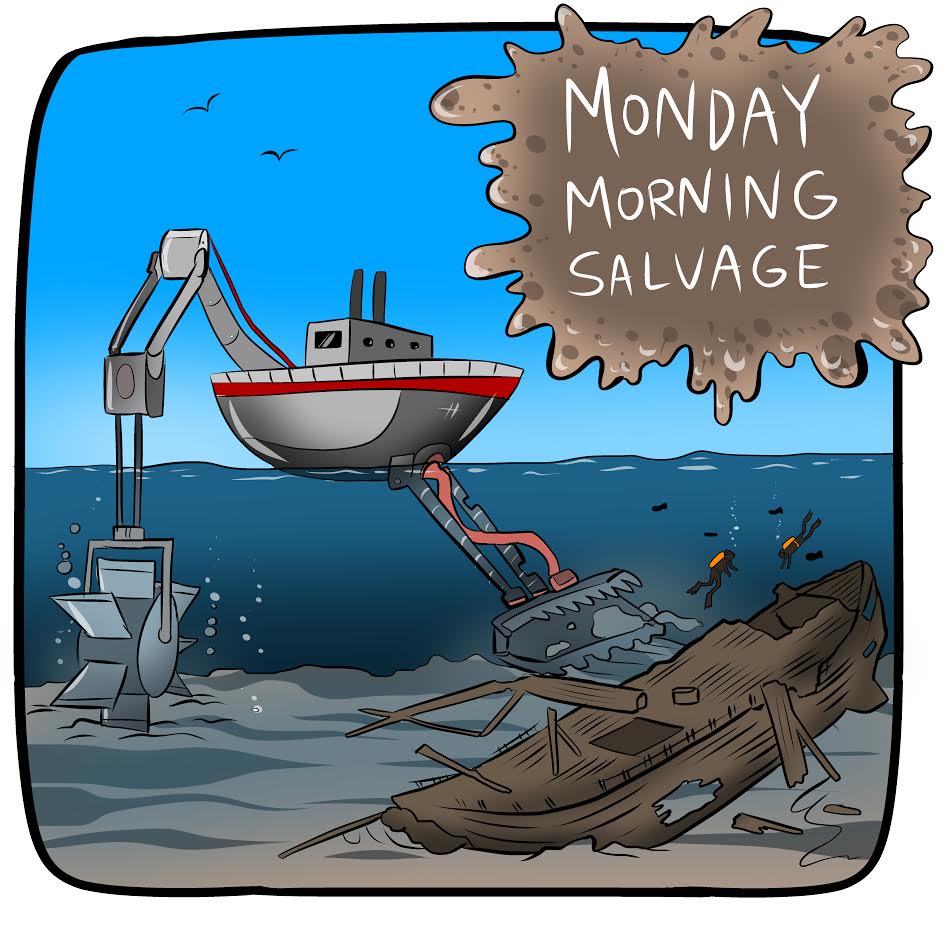
Titanic tourists, nodule mining, right whales, and more! The Monday Morning Salvage: April 17, 2017

Posted on April 17, 2017April 16, 2017 By Andrew Thaler
Weekly Salvage

Fog Horn (A Call to Action)

  • The EPA is seeking public input on the new administrations approach to environmental regulations. They are required to seek public input. They are required to respond to public input. Go tell them how you feel. Public comments close May 15. Here’s the docket with instructions on how to comment: Evaluation of Existing Regulations.

Flotsam (what we’re obsessed with right now)
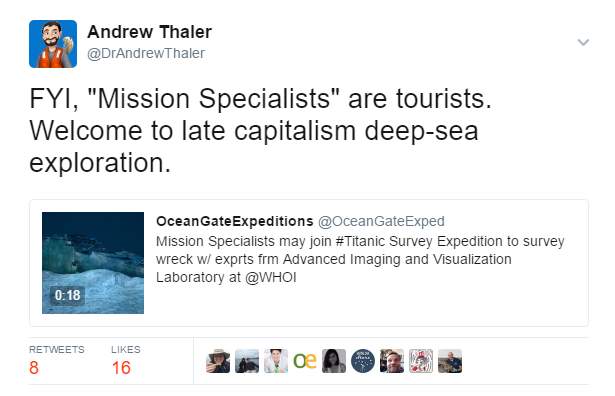
  • Titanic Tourism. Like this article: To Visit Titanic Firsthand, New York Banker Dives Deep Into Wallet. I have thoughts. Oh so many thoughts.

Jetsam (what we’re enjoying from around the web)

  • Deep-sea mining meets alternative energy: Renewables’ deep-sea mining conundrum. I once calculated that all the copper in Solwara 1 could make 800 1-megawatt wind turbines [note: I am not good at math].
  • Two really cool expeditions coming out of Louisiana this year: Exploring Changes on the Gulf Coast and Ecology of Shallow Wood Falls.  Neat!
  • Begun, the crab wars have. Svalbard’s Snow Crabs: a Pincered Proxy for Arctic Oil.
  • A wonderful piece on field notes and what they mean to past a future fisheries biologists from our friends at the Fisheries Blog.
  • A tiny Iowa paper just won a Pulitzer Prize for tackling farm pollution. This mouse roars.
  • Farm-raised superbugs find their way into kids’ noses somehow. This is fine. Every thing is fine.
Read More “Titanic tourists, nodule mining, right whales, and more! The Monday Morning Salvage: April 17, 2017” »

Hone your social media #SciComm skills with ocean science pros.

Posted on April 14, 2017 By Andrew Thaler
Blogging

Looking to boost your ocean outreach skills in a more formal setting? We’ve got two opportunities for social media training with ocean science and ocean communications experts from Southern Fried Science: LUMCON Summer Course: Join me at the Louisiana Universities Marine Consortium on the Gulf Coast for a week-long workshop on Science Communication Using Social Media led by … Read More “Hone your social media #SciComm skills with ocean science pros.” »

Make for the Planet with Conservation X Labs and the Earth Optimism Summit!

Posted on April 11, 2017 By Andrew Thaler 2 Comments on Make for the Planet with Conservation X Labs and the Earth Optimism Summit!
Conservation

Invasive species, overfishing, ocean plastics, wildlife tracking, and measuring ecosystem services, are some of the most daunting challenges in conservation.While these challenges require a combination of social, commercial, and regulatory cooperation to address, they can also be tackled through technological innovation, which can bypass some of the largest hurdles to implementing practical, timely solutions.

On April 21, 2017, 18 teams of conservationists, technologists, makers, and hardware hackers will gather in Washington DC and tackle five conservation challenges selected by a panel of experts at the Make for the Planet, part of the Smithsonian’s Earth Optimism Summit. Over three days, teams will work to develop prototypes, strategic frameworks, and model systems that address specific issues within the broader challenge prompt of terrestrial species invasion, overfishing, ocean plastics, wildlife tracking, and ecosystem services.

Read More “Make for the Planet with Conservation X Labs and the Earth Optimism Summit!” »

Octopus Genes, Decolonization, and a mega-dose of Citizen Science! Monday Morning Salvage: April 10, 2017

Posted on April 10, 2017April 10, 2017 By Andrew Thaler
Weekly Salvage

Flotsam (what we’re obsessed with right now)

  • Octopuses are weird. Really, really weird. Ed Yong covers yet another weird octopus thing in the Atlantic: Octopuses Do Something Really Strange to Their Genes. And check out the original paper, below.

Jetsam (what we’re enjoying from around the web)

  • This interview with Shay Akil McLean is one of the best introductions to the concept of decolonizing science: Hood Biologist Explains How to Decolonize All The Science. See also: We Need Decolonial Scientists.
  • Free Radicals is one of the best new(ish) science blogs on the net: Zapatistas Reimagine Science as Tool of Resistance.
  • Incidentally, the March for Science does not have a diversity problem.

Instead, I believe that this march needs to be completely apolitical and nonpartisan. I think that we should protest the current administration, which wants to repeal laws guaranteeing clean air and water, claim that climate change is a hoax, and remove scientists’ access to quality healthcare, but in a way that doesn’t alienate members of the current administration. We should demand change, but vaguely, and from no one in particular.

Source.

  • If you love geophysical fluid dynamics, then you will love these foamy streaks in a lagoon. Deep Sea News, natch.
  • With the legendary Erika Bergman at the helm, the Aquatica Submarine crew put eyes on a new glass sponge bioherm off the coast of Vancouver.

https://www.youtube.com/watch?v=V6stLjJ5lAo

  • Another article about the GOSH meeting where I rep-ed OpenROV and Oceanography for Everyone: Santiago de Chile, capital of the Global network for Open Science Hardware.
  • As a card-carrying population geneticist, I second this piece: Getting your genetic disease risks from 23andme is probably a terrible idea.

Read More “Octopus Genes, Decolonization, and a mega-dose of Citizen Science! Monday Morning Salvage: April 10, 2017” »

Meteor hunters, deep divers, and ocean action! Monday Morning Salvage: April 3, 2017

Posted on April 3, 2017 By Andrew Thaler
Weekly Salvage

Flotsam (what we’re obsessed with right now)

  • Have you ever wanted to hunt for meteorites in the Great Lakes using underwater robots? Yes? Well, guess what? Now you can! Join along with the ROV Meteorite Hunt on OpenExplorer!
  • If the Great Lakes are a little too chilly for you, maybe consider joining SFS Super Fan Joey Meier and his students at Polk State on their journey to Guadalupe!

Jetsam (what we’re enjoying from around the web)

Read More “Meteor hunters, deep divers, and ocean action! Monday Morning Salvage: April 3, 2017” »

Thursday Afternoon Dredging: March 30th, 2017

Posted on March 30, 2017March 30, 2017 By David Shiffman
Uncategorized

Cuttings (short and sweet):

Logo by Ethan Kocak

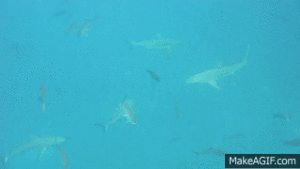
  • Watch the sharks at Palmyra Atoll, and check out my new article for Hakai Magazine about an important new study of this unexploited population.
  • Follow Erin Dillon, a UC Santa Barbara Ph.D. student, on twitter!
  • Derelict Fishing Gear and the Death of Chesapeake Bay Blue Crabs. From the NOAA Response and Restoration blog
  • Growth spurts may determine a lamprey’s sex. By Erin Ross, for Scientific American.

Read More “Thursday Afternoon Dredging: March 30th, 2017” »

Dear John: Farming and technology in the near future.

Posted on March 29, 2017March 29, 2017 By Andrew Thaler
Popular Culture

I wrote this story a couple of years ago and have been trying to find a home for it ever since. As the issue of proprietary software’s relationship to agricultural technology is back in the news, I figure it’s time to stop shopping this short science fiction story around and put it in front of a real audience. For some real-world background reading, see:

  • Why American Farmers Are Hacking Their Tractors With Ukrainian Firmware.
  • Hacking the Tractor: what the future of farming means for open science.
  • New High-Tech Farm Equipment Is a Nightmare for Farmers.
  • We Can’t Let John Deere Destroy the Very Idea of Ownership.

DEAR JOHN.

It started with the tractor. Or, rather, it stopped with the tractor. John Willis climbed down from the cabin of his dead machine and removed the cowling. Everything looked fine. The diesel engine shined, its green accents still brilliant.

After years trading his skill with a wrench and a soldering iron for access to his neighbors’ equipment, he finally owned a tractor of his own. The latest model, too. Not ostentatious, but with just enough comforts to make up for the last ten years. The tractor was new, bought debt-free through the Farm Act and a decade of careful planning and backbreaking labor. Expensive, but built to last.

Except it didn’t last. For the third time in an hour, the engine seized, the wheels locked, the console went dead. Willis sighed. He had acres to till and he wasn’t in the mood to spend a day stripping the engine, hunting for some tiny defect. He could send it to the service yard, but he couldn’t afford to wait for an authorized repair. The quote alone would set him back a week.

He couldn’t afford another late planting. Not this year.

He started the tractor. It roared back to life, the engine purred but the console beeped and flashed with panic, a thousand different alarms. The manual, a massive, multi-gigabyte document, was sitting on his work computer, back in the barn. For whatever reason, he couldn’t get it to download to his field tablet. He put the tractor in gear and continued down the field.

Fifteen minutes later, the tractor was dead again.

Well, he thought to himself, at least there’s a rhythm to it. He limped down the rows in quarter-hour bursts.

Read More “Dear John: Farming and technology in the near future.” »

Building the future with open hardware. Monday Morning Salvage: March 27, 2017

Posted on March 26, 2017 By Andrew Thaler
Weekly Salvage

Flotsam (what we’re obsessed with right now)

I spent the last week at the annual Gathering for Open Science Hardware in Santiago, Chile exploring the future of science and the open-source movement with one of the most impressive hardware developers, hackers, makers, and artists in the world. It’s my travel day, so this will necessarily be a short one.

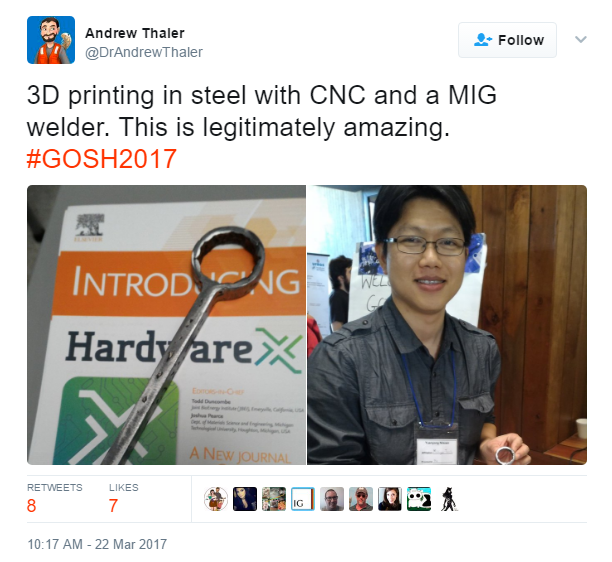
  • Among the many things still blowing my mind? 3D printing in steel using a MIG welder. So simple, so clever, so brilliantly implemented. See the paper below.

Read More “Building the future with open hardware. Monday Morning Salvage: March 27, 2017” »

Thursday Afternoon Dredging: March 23, 2017

Posted on March 23, 2017March 23, 2017 By David Shiffman
Uncategorized

Cuttings (short and sweet):

Logo by Ethan Kocak

  • Watch thousands of blacktip and spinner sharks close to Florida beaches, courtesy FAU Elasmolab.

  • Follow Madeline Cashion, a UBC Marine Conservation Ecology graduate student, on twitter!
  • New research shows that fish may evolve rapidly to take advantage of marine protected areas. By Randy Shore, for the Vancouver Sun.

Read More “Thursday Afternoon Dredging: March 23, 2017” »

Scientists deploy satellite tags on rarely studied sawsharks for the first time

Posted on March 23, 2017March 23, 2017 By David Shiffman
Science

An Australian research expedition has successfully deployed three satellite telemetry tags on sawsharks for the first time! These rarely-seen sharks have a toothy rostrum similar to a sawfish, but are true sharks while sawfish are rays. Sawshark rostrums also have sensory barbels, unlike the rostrums of sawfish. “This is actually a good example of convergent evolution where two distantly related species have adaptations that have converged to be very similar in looks and (purportedly) function,”said professor Jane Williamson, the head of the Marine Ecology Group at Macquarie University and the leader of this expedition. “Sawsharks probably use their rostrum in a similar manner to sawfish: as a tool for sensing and capturing prey, and possibly for self-defense.”

Read More “Scientists deploy satellite tags on rarely studied sawsharks for the first time” »

Posts pagination

Previous 1 … 66 67 68 … 276 Next

Popular Posts

At least 74 practicing shark researchers: How a silly thing I said online raised thousands for conservationAt least 74 practicing shark researchers: How a silly thing I said online raised thousands for conservationFebruary 26, 2025David Shiffman
Why the new Trump order to shoot wolves is both illegal and a dreadful precedent for endangered speciesWhy the new Trump order to shoot wolves is both illegal and a dreadful precedent for endangered speciesSeptember 5, 2026Ali Gaster
Severely injured great white shark found, are scientists responsible?Severely injured great white shark found, are scientists responsible?March 29, 2011David Shiffman
5 things I learned helping to reassess the global conservation status of every species of tuna and billfish5 things I learned helping to reassess the global conservation status of every species of tuna and billfishSeptember 15, 2026David Shiffman
That's not a blobfish: Deep Sea Social Media is Flooded by AI SlopThat's not a blobfish: Deep Sea Social Media is Flooded by AI SlopDecember 19, 2025Andrew Thaler
Getting a sense of porpoiseJanuary 20, 2009Andrew Thaler
How to build a canoe from scratch on a graduate student stipendHow to build a canoe from scratch on a graduate student stipendApril 17, 2010Andrew Thaler
13 wrong things about sharks that conservation advocates should stop saying in 2013 (and what they should say instead)December 27, 2012David Shiffman
What is a Sand Shark?What is a Sand Shark?November 12, 2017Chuck Bangley
The Trump Administration’s latest attack on endangered speciesThe Trump Administration’s latest attack on endangered speciesSeptember 17, 2026Ali Gaster

squishy

Subscribe to our RSS Feed for updates whenever new articles are published.

We recommend Feedly for RSS management. It's like Google Reader, except it still exists.

Southern Fried Science

  • Home
  • About SFS
  • Authors
  • Support SFS


If you enjoy Southern Fried Science, consider contributing to our Patreon campaign.

Copyright © 2026 Southern Fried Science.

Theme: Oceanly Premium by ScriptsTown