Skip to content

Southern Fried Science

Over 15 years of ocean science and conservation online

  • Home
  • About SFS
  • Authors
  • Support SFS

Pirate fishing: far less awesome then it sounds

Posted on January 25, 2011January 25, 2011 By David Shiffman 6 Comments on Pirate fishing: far less awesome then it sounds
Conservation, Science

Earlier this month, NOAA provided a list of “pirate fishing” countries to Congress. This report identifies Portugal, Italy, Venezuela, Colombia, Ecuador, and Panama as nations whose vessels engage in “illegal, unreported, unregulated” fishing.

Russell Smith, NOAA deputy assistant secretary for international fisheries, explains why this so-called pirate fishing is such a big deal:

“Illegal fishing must be stopped as it subjects our fishermen to unfair competition and undermines efforts to sustainably manage the valuable fish stocks around the world that so many communities depend on for food and jobs.”

The Pew Charitable trusts reports that an estimated 20% of all fish removed from the oceans are fished illegally. NOAA claims that this results in an annual loss of $23 billion to legal fisheries worldwide. Specifically, the six violator countries listed here are guilty of having:

“fishing vessels that did not comply with measures agreed to under various international fishery management organizations, such as closed fishing seasons, vessel registry lists, and a ban on the use of driftnets. Other violations included illegal gear modifications, fishing without authorization, and possession of undersized bluefin tuna.”
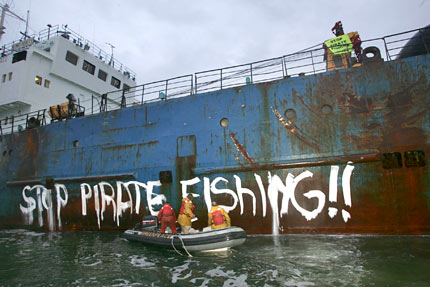
Image courtesy Greenpeace

According to the Magnuson-Stevens act, one of the most important laws addressing U.S. fisheries policy, these nations now have to “consult” with NOAA to end their pirate fishing. If they do not, they could face severe economic sanctions. Vessels flying the flag of the violator country could be denied entry into U.S. ports, or imports from that country could be restricted.

Personally, I don’t think that Hugo Chavez would care very much if we stopped importing Venezuelan fish, and I can’t imagine us implementing sanctions against an important ally like Italy over a fishing disagreement. Still, it’s nice to see illegal fishing being taken seriously by the government.

It’s worth noting that at least some previously-identified violators has changed their ways. France, China, Libya, and Tunisia all either punished the owners of the ships in question or altered national fisheries laws to address pirate fishing.

I’ll follow this story closely, since the outcome will go a long way towards determining whether the United States is a global leader on fisheries and marine conservation issues. Stay tuned.

Share this:

  • Share on Bluesky (Opens in new window) Bluesky
  • Share on Facebook (Opens in new window) Facebook
  • Share on Reddit (Opens in new window) Reddit
  • Share on Threads (Opens in new window) Threads
  • Share on WhatsApp (Opens in new window) WhatsApp
  • Share on Mastodon (Opens in new window) Mastodon

Related

Tags: fisheries policy illegal fishing Magnuson-Stevens act NOAA pirate fishing

Post navigation

❮ Previous Post: Conservation and the Concept of Species in a Biodiversity Crisis (Part 1)
Next Post: State of the Field: Too big, too small, just right – the Goldilocks Conundrum of Conservation ❯

You may also like

Conservation
Media coverage of the Yates Supreme Court case isn’t treating illegal fishing seriously
November 6, 2014
Science
Open thread for NOAA scientists to speak freely about scientific and technical matters based on their official work without approval from the public affairs office or their supervisors.
December 8, 2011
Oceanography for Everyone
Community Oceanography with low-cost, open-source CTDs
September 23, 2022
Science
Canada proposed revisions to the Fisheries Act. Here’s how science and conservation experts reacted.
February 7, 2018

6 thoughts on “Pirate fishing: far less awesome then it sounds”

  1. John Carroll says:
    January 25, 2011 at 12:55 pm

    Agreed, pirate fishing is definitely not as awesome as I imagined – sailing vessels, puffy shirts, funny hats, and fishing rods!

    Definitely a major problem, but I guess one could hope that the current violators change their ways like China and France did.

  2. Mark Gibson says:
    January 25, 2011 at 2:05 pm

    Thanks for this post. I noticed, however, a couple things for correction wrt IUU statistics.

    Pew and NOAA have not conducted their own studies, though they both work actively on IUU fishing. Both of their estimates are taken from Agnew et al. 2009. Estimating the Worldwide Extent of Illegal Fishing. It is an open access article, available here at PLoSONE.

    Yes, the NYT Green Blog also recently attributed this statistic to Pew, which was incorrect.

  3. Alan Dove says:
    January 25, 2011 at 2:07 pm

    Yeah, that’s about as un-awesome as “ghost fishing,” which also sounded pretty cool until I heard the definition.

    We may not have much leverage with Chavez, but I expect the other countries on the list will take notice. Heck, even Venezuela might get with the program if we start slapping their non-fish imports with hefty tariffs. Except for their oil, of course – we’re kind of addicted to that.

  4. WhySharksMatter says:
    January 25, 2011 at 2:08 pm

    Thanks for the information, Mark. I’ll look into it and if you are correct I’ll update the post.

  5. Mark Gibson says:
    January 25, 2011 at 9:57 pm

    I’d be happy to give more detail on this. Shoot me an email if you want. Best.

  6. WhySharksMatter says:
    January 26, 2011 at 8:17 am

    Please do. WhySharksMatter AT Gmail DOT com. Thanks, Mark!

Comments are closed.

Popular Posts

How close did the world's first deep-sea mining come to the dredging the world's largest cold-water coral reef?How close did the world's first deep-sea mining come to the dredging the world's largest cold-water coral reef?March 17, 2026Andrew Thaler
At least 74 practicing shark researchers: How a silly thing I said online raised thousands for conservationAt least 74 practicing shark researchers: How a silly thing I said online raised thousands for conservationFebruary 26, 2025David Shiffman
What Ocean Ramsey does is not shark science or conservation: some brief thoughts on "the Shark Whisperer" documentaryWhat Ocean Ramsey does is not shark science or conservation: some brief thoughts on "the Shark Whisperer" documentaryJuly 2, 2025David Shiffman
That's not a blobfish: Deep Sea Social Media is Flooded by AI SlopThat's not a blobfish: Deep Sea Social Media is Flooded by AI SlopDecember 19, 2025Andrew Thaler
Urea and Shark OsmoregulationUrea and Shark OsmoregulationNovember 15, 2010David Shiffman
Here's what I teach my students about finding jobs in marine biology and conservationHere's what I teach my students about finding jobs in marine biology and conservationApril 10, 2024David Shiffman
Here are some ocean conservation technologies that I'm excited aboutHere are some ocean conservation technologies that I'm excited aboutFebruary 19, 2026David Shiffman
I turned my woodshop into a personal solar farm.I turned my woodshop into a personal solar farm.June 21, 2021Andrew Thaler
Alberta, Canada is the proud owner of the largest man-made pyramid on the planetAlberta, Canada is the proud owner of the largest man-made pyramid on the planetOctober 16, 2012Andrew Thaler
Shark of Darkness: Wrath of Submarine is a fake documentaryShark of Darkness: Wrath of Submarine is a fake documentaryAugust 10, 2014Michelle Jewell
Subscribe to our RSS Feed for updates whenever new articles are published.

We recommend Feedly for RSS management. It's like Google Reader, except it still exists.

Southern Fried Science

  • Home
  • About SFS
  • Authors
  • Support SFS


If you enjoy Southern Fried Science, consider contributing to our Patreon campaign.

Copyright © 2026 Southern Fried Science.

Theme: Oceanly Premium by ScriptsTown