Skip to content

Southern Fried Science

Over 15 years of ocean science and conservation online

  • Home
  • About SFS
  • Authors
  • Support SFS

Tag: great white shark

3 sharks that were on twitter before being a shark on twitter was cool

Posted on January 3, 2014January 15, 2014 By David Shiffman 3 Comments on 3 sharks that were on twitter before being a shark on twitter was cool
Science

Recent plans in Western Australia to place acoustic tags in sharks and have them tweet their location when they approach a beach have resulted in a sharknado of media coverage. The plan has been covered by internet technology news giant Mashable, Fox News, NPR news, Popular Science, and NBC news (which, with “sharks with frickin’ tweets,” has what I believe to be the best headline. That one also interviews me.) When a tagged shark approaches the beach, a tweet like this results:
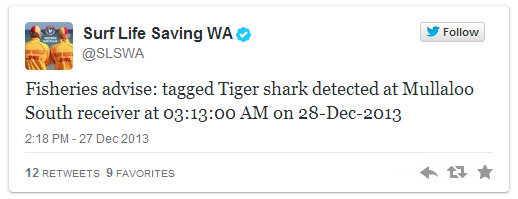
tweet


I can understand why a project involving both sharks and twitter caught the media’s eye… and why about a billion of you e-mailed or tweeted the news to me. However, these aren’t the first sharks to be on twitter!

Read More “3 sharks that were on twitter before being a shark on twitter was cool” »
Here’s how you can tell that the “shark” photobombing kids is actually a dolphin

Posted on December 31, 2013December 31, 2013 By David Shiffman 10 Comments on Here’s how you can tell that the “shark” photobombing kids is actually a dolphin
Blogging, Science

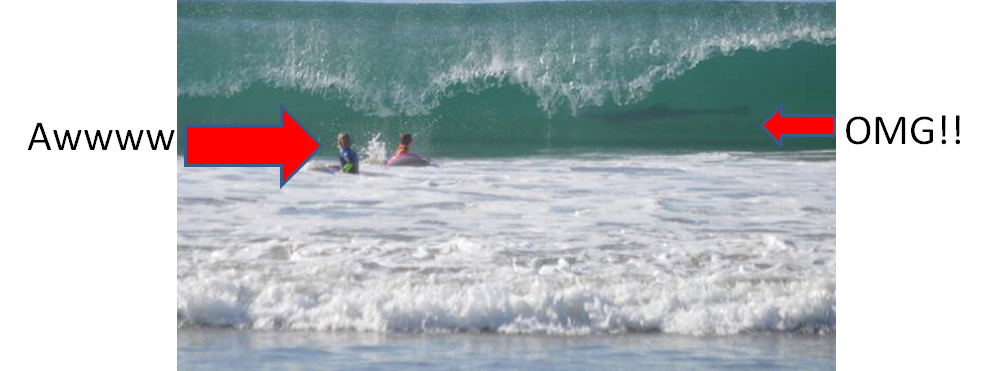
When California resident June Emerson snapped a photo of her children playing at the beach, she didn’t expect it to generate international news. Although the kids seem to be adorable, that isn’t what captured the attention of the media. In a wave behind them, you can see the outline of a large animal swimming by (or being “terrifying” and “creeping up on them,” as the Daily Mail called it).

Photo by June Emerson, snarky comments by yours truly

The media, including local, national, and international outlets, wasted no time in calling it a shark. However, as Jason Goldman wryly noted, “not all grey things with dorsal fins in the ocean are sharks.” This animal  is almost certainly a dolphin. I asked a dozen shark scientists and a handful of dolphin scientists, and all quickly agreed that this is a dolphin.

As I’m no fan of merely appealing to authority (though I’ll trust someone with years of training over the painful to read comments on many of the news pieces), I’ll share with you how we can tell. First, let’s clean up and brighten the image. Since I am not a photoshop master, let’s borrow a cleaned up and enhanced image from KTLA.

Original image by June Emerson, enhancement done by KTLA.
Original image by June Emerson, enhancement by KTLA.

Even though the image is somewhat blurry (understandable, as June was trying to photograph her children and not the animal behind them,) there are still easily identifiable features that clearly show that this is not a great white shark, but a dolphin.

Read More “Here’s how you can tell that the “shark” photobombing kids is actually a dolphin” »

13 wrong things about sharks that conservation advocates should stop saying in 2013 (and what they should say instead)

Posted on December 27, 2012December 27, 2012 By David Shiffman 64 Comments on 13 wrong things about sharks that conservation advocates should stop saying in 2013 (and what they should say instead)
Conservation, Science

davesquare

While the rest of the scientific and management community and I are grateful for the passionate support of many shark conservation advocates, passion is no substitute for knowledge and accuracy.  Some conservation issues are a matter of opinion and can (and should) be reasonably be discussed by people with different views, but many others are a matter of fact. Presented here, in no particular order, are 13  incorrect statements and arguments commonly made by well-intentioned but uninformed shark conservation advocates, along with the reality of the situation.

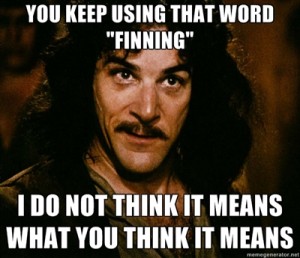
From MemeGenerator.net

1) “Shark finning” is synonymous and interchangeable with “the global shark fin trade.” Shark finning is a specific fishing method. It is not the only way to catch sharks, and it is not the only way to provide shark fins for the global fin trade. Stopping shark finning is a worthy goal (that has largely been accomplished already *) because it is a wasteful and brutal fishing method that complicates management, but stopping shark finning does not stop the global shark fin trade. Many people calling for a ban on finning really seem to want no shark fishing and no fin trade of any kind (a viewpoint I disagree with, but regardless, proper terminology matters). For more on the difference between shark fishing and shark finning, see this post from June 2012.

2) 100 million sharks a year are killed for their fins. The origin of this number is still debated, but it was popularized by Sharkwater. While we will likely never know exactly how many sharks are “killed for their fins”, the best scientific estimate of the scope of the fin trade we have comes from a 2006 paper by Dr. Shelley Clarke. She found that the fins of between 26 and 73 million sharks end up in the fin trade each year, with a simulation average of 38 million.  Dr. Clarke wrote an essay for SeaWeb on the misuse of her work, which is worth a read.

3) 1 in 3 species of sharks face extinction. This one is actually relatively close to accurate, and can be fixed with the addition of just two words. An IUCN Shark Specialist Group report found that 1 in 3 species of “open ocean” sharks are Threatened with extinction (Threatened means Vulnerable, Endangered or Critically Endangered according to IUCN Red List standards). 1 in 6 species of shark, skate, ray, or chimera are Threatened- while still a troubling number indicative of a very bad situation, it’s half as bad as claimed by many advocates. Also, please note that I included skates and rays, which are similarly threatened but often ignored by conservation advocates (with one notable exception from 2012).

Read More “13 wrong things about sharks that conservation advocates should stop saying in 2013 (and what they should say instead)” »

Cull canceled: victory for the sharks of Western Australia!

Posted on November 15, 2011December 9, 2011 By David Shiffman 1 Comment on Cull canceled: victory for the sharks of Western Australia!
Conservation, Science

A few weeks ago, I wrote about a proposed shark cull in Western Australia and asked for your help to oppose it. By the end of the Support Our Sharks anti-cull campaign, the petition had almost 19,000 signatures from dedicated shark conservationists from around the world, including many of our readers. After some initial anti-shark … Read More “Cull canceled: victory for the sharks of Western Australia!” »

Western Australia’s sharks need your help!

Posted on October 23, 2011 By David Shiffman 14 Comments on Western Australia’s sharks need your help!
Conservation, Science

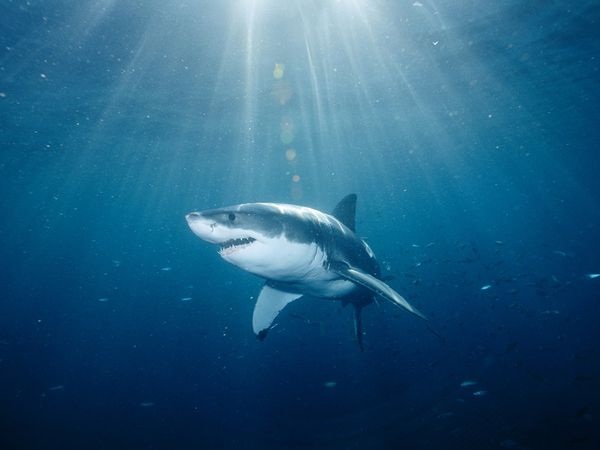
Great White Shark. Image courtesy animals.NationalGeographic.com

Last week, I wrote about three current shark conservation issues, including a proposed shark cull in Western Australia. Barbara Wueringer was able to deliver her letter to Western Australian government officials on Friday, and thanks to your help, it was signed by more than 100 scientists and conservationists from all over the world.

Yesterday, however, another swimmer was killed by a shark in Western Australian waters. George Thomas Wainwright, 32, was a native of Texas who had been working on a boat in Australia. This attack, which is the third in the last two months, has resulted in renewed calls for a “shark cull”. The proposed plan would involve both an attempt to kill the specific shark responsible for killing Mr. Wainwright and a more general killing of all the sharks in the area. It is believed that the shark that killed Mr. Wainwright was a great white shark, also known as a  “white pointer” in Australia.

Read More “Western Australia’s sharks need your help!” »

Just enough about “Certainly More Than You Want to Know About The Fishes of The Pacific Coast” to pique your curiosity

Posted on October 14, 2011October 17, 2011 By Andrew Thaler 2 Comments on Just enough about “Certainly More Than You Want to Know About The Fishes of The Pacific Coast” to pique your curiosity
Science

There is a website floating around the interwebs entitled “So you want to be a marine biologist?” that most future marine biologists who came of age in the early 21st century have encountered. The sage page of advice is followed up with “So you want to be a marine biologist, the revenge“. Reading through these two essays, one might come to the conclusion that their author, Dr. Milton Love of the University of California, Santa Barbara, should compose a voluminous tome to the fishes of the Pacific coast. Which is exactly what he’s done. Welcome to Certainly More Than You Want to Know About The Fishes of The Pacific Coast: a postmodern experience.

Despite it’s self-aware title, this book is far more than just an exhaustive guide to the fishes of the Pacific, though it certainly is that. The highly detailed taxonomic descriptions are rich with humor and insight into the ecology, behavior, and physiology of, if not each species, than each genus or species complex. Interspersed among the taxa are descriptions of prominent Pacific researchers, anecdotes from a lifetime of work on the water, stories by people who lived, worked, and fished these species, and the occasional poem, song, or limerick. Somehow, these disparate units manage to complement each other in a way that makes you want to read what is essential a taxonomy textbook cover-to-cover.

Read More “Just enough about “Certainly More Than You Want to Know About The Fishes of The Pacific Coast” to pique your curiosity” »

Full video of injured shark shows numerous natural injuries

Posted on May 3, 2011May 10, 2011 By David Shiffman 101 Comments on Full video of injured shark shows numerous natural injuries
Science
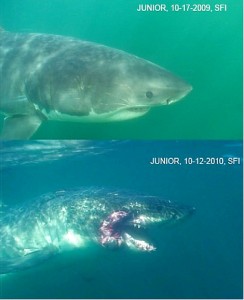
Junior the Great White shark, before and (long) after being caught by Dr. Domeier's team. Image courtesy FijiSharkDiving.Blogspot.com

Several months ago, still photographs showing an injured great white shark surfaced. The shark in question was previously captured by a shark research team lead by Dr. Michael Domeier on the TV show “Shark Men” – and the capture of this shark didn’t go as planned. These still images were taken from a video, and in response to the ensuing controversy, Dr. Domeier’s team claimed that when the full video is viewed, you can see that the injury comes from another shark and not from capture injury. No clear sharkbite injuries are visible in the original still image.

I submitted a Freedom of Information Act request for the full video, which had been in the possession of NOAA’s Office of National Marine Sanctuaries pending an investigation.

Here, for the first time available to the public, is the full video from which the above images were taken.

Read More “Full video of injured shark shows numerous natural injuries” »

Expedition Week premieres tonight, Shark Men next Sunday

Posted on April 3, 2011April 3, 2011 By David Shiffman 1 Comment on Expedition Week premieres tonight, Shark Men next Sunday
Popular Culture

Expedition Week 2011 starts tonight on the National Geographic Channel. This year, there are 13 premieres on seven straight nights, and they promise “extreme treks, new discoveries, and bold investigations” featuring topics as diverse as conservation, exotic human cultures, archaeology, geology, and maritime history. In other words, there’s plenty for science geeks like us to enjoy.

Read More “Expedition Week premieres tonight, Shark Men next Sunday” »

Severely injured great white shark found, are scientists responsible?

Posted on March 29, 2011May 3, 2011 By David Shiffman 125 Comments on Severely injured great white shark found, are scientists responsible?
Conservation, Popular Culture, Science

[Editor’s Notice – Comments have been suspended on this post. Please visit “Full video of injured shark shows numerous natural injuries” for an update on this controversy]

Last summer, I reviewed National Geographic’s “Expedition Great White” and interviewed the lead scientist. Several researchers and conservationists were concerned about the methods that Dr. Michael Domeier uses to study great white sharks, particularly after one shark was “foul hooked” through the gills. These methods (removing captured great white sharks from the water to study them using a forklift-like structure) make for excellent television, but may be harmful to the sharks.  As I reported last year:

Read More “Severely injured great white shark found, are scientists responsible?” »

State of the Field: Satellite tagging sharks

Posted on February 15, 2011 By David Shiffman 2 Comments on State of the Field: Satellite tagging sharks
Science

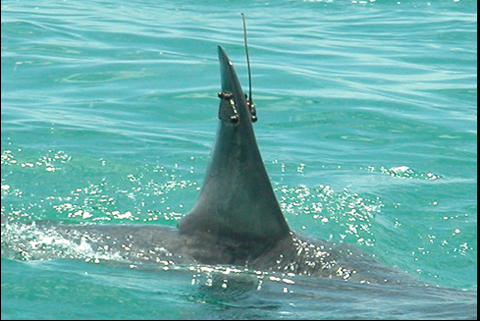
Modern shark researchers have access to a variety of high-tech tools. Acoustic tags with noises specific to each individual shark signal a receiver (or network of receivers) every time the shark passes nearby. Some tags have three-dimensional accelerometers, allowing researchers to study the small scale movement patterns and behaviors of sharks. Others, which are placed in the stomach, measure pH before, during, and after digestion. The most advanced technology on the market, however, is undoubtedly the satellite tag.

Image from SurfThereNow.com

Read More “State of the Field: Satellite tagging sharks” »

Posts pagination

Previous 1 2 3 Next

Popular Posts

What Ocean Ramsey does is not shark science or conservation: some brief thoughts on "the Shark Whisperer" documentaryWhat Ocean Ramsey does is not shark science or conservation: some brief thoughts on "the Shark Whisperer" documentaryJuly 2, 2025David Shiffman
That's not a blobfish: Deep Sea Social Media is Flooded by AI SlopThat's not a blobfish: Deep Sea Social Media is Flooded by AI SlopDecember 19, 2025Andrew Thaler
The story of the pride flag made from NASA imagery: Bluesky's most-liked imageThe story of the pride flag made from NASA imagery: Bluesky's most-liked imageSeptember 27, 2024David Shiffman
What can the funniest shark memes on the internetz teach us about ocean science and conservation?What can the funniest shark memes on the internetz teach us about ocean science and conservation?November 8, 2013David Shiffman
The Trouble with Teacup PigsThe Trouble with Teacup PigsOctober 14, 2012Andrew Thaler
I can serve on your graduate thesis committee. Here’s what you can expect of me, and what I expect in return.I can serve on your graduate thesis committee. Here’s what you can expect of me, and what I expect in return.October 16, 2025David Shiffman
Shark of Darkness: Wrath of Submarine is a fake documentaryShark of Darkness: Wrath of Submarine is a fake documentaryAugust 10, 2014Michelle Jewell
Nodules, Lost Mines, and Dark Oxygen: A new documentary on deep-sea mining asks important questions about the future of the industry.Nodules, Lost Mines, and Dark Oxygen: A new documentary on deep-sea mining asks important questions about the future of the industry.July 24, 2025Andrew Thaler
Norway and Cook Islands put their deep-sea mining plans on pause.Norway and Cook Islands put their deep-sea mining plans on pause.December 3, 2025Andrew Thaler
Blackfish: the Science Behind the MovieBlackfish: the Science Behind the MovieSeptember 18, 2013Chris Parsons
Subscribe to our RSS Feed for updates whenever new articles are published.

We recommend Feedly for RSS management. It's like Google Reader, except it still exists.

Southern Fried Science

  • Home
  • About SFS
  • Authors
  • Support SFS


If you enjoy Southern Fried Science, consider contributing to our Patreon campaign.

Copyright © 2025 Southern Fried Science.

Theme: Oceanly Premium by ScriptsTown