
Skip to content

Southern Fried Science

Over 15 years of ocean science and conservation online

  • Home
  • About SFS
  • Authors
  • Support SFS

Tag: manta ray

Was CITES COP16 a game-changer for online outreach at wildlife management meetings?

Posted on March 18, 2013 By David Shiffman 5 Comments on Was CITES COP16 a game-changer for online outreach at wildlife management meetings?
Conservation, Science

davesquareCITES logo

As 16th Conference of the Parties of the Convention of International Trade in Endangered Species (CITES COP16, pronounced sight-eze) comes to a close, I’d like to reflect on something that made this meeting unlike almost any other wildlife conservation and management meeting in history. Yes, history was made as delegates voted to list commercially exploited shark species for the first time, and history was made when manta rays became the first shark or ray species  to be listed under CITES the first time they were proposed, and that’s all fantastic news. However, what I believe made CITES COP16 a game-changer for wildlife conservation and management was the large-scale inclusion of online outreach by both attendees and organizers. For the first time ever, interested members of the public from all over the world could follow along (and to some degree, participate) in real time.

Read More “Was CITES COP16 a game-changer for online outreach at wildlife management meetings?” »
A guide to following shark conservation proposals at CITES on twitter

Posted on March 5, 2013 By David Shiffman
Conservation, Science

davesquare

CITES logoRight now, delegates from 178 countries are meeting in Bangkok, Thailand to discuss a variety of conservation proposals. At the 16th CITES Conference of the Parties, among many other worthy topics, delegates will be debating a record-number of shark and ray proposals. These include iconic species like hammerhead sharks (3 species) and manta rays (2 species), as well as oceanic whitetip sharks, porbeagle sharks, and three species of freshwater stingray.

In addition to a record-number of shark and ray proposals, this year’s Conference of the Parties also has a record-number of attendees live-tweeting the meeting.Those of you who follow me on twitter know that I’ve been re-tweeting lots of information about CITES and these shark conservation proposals. In case you want to get the information directly from the source, I’ve prepared a guide to following along with the meeting on twitter.

1) Follow #CITES . Though this hashtag isn’t exclusively focused on sharks (and isn’t exclusively in English), there’s a lot of good information being shared.

2) Follow #Cites4Sharks . Also use this hashtag if you’re sharing any relevant links or information.

3) Follow the 13 accounts I’ve highlighted below (and let me know in the comments if you have suggestions for any accounts I should add to the list):

Read More “A guide to following shark conservation proposals at CITES on twitter” »

13 wrong things about sharks that conservation advocates should stop saying in 2013 (and what they should say instead)

Posted on December 27, 2012December 27, 2012 By David Shiffman 64 Comments on 13 wrong things about sharks that conservation advocates should stop saying in 2013 (and what they should say instead)
Conservation, Science

davesquare

While the rest of the scientific and management community and I are grateful for the passionate support of many shark conservation advocates, passion is no substitute for knowledge and accuracy.  Some conservation issues are a matter of opinion and can (and should) be reasonably be discussed by people with different views, but many others are a matter of fact. Presented here, in no particular order, are 13  incorrect statements and arguments commonly made by well-intentioned but uninformed shark conservation advocates, along with the reality of the situation.

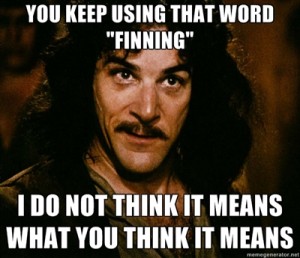
From MemeGenerator.net

1) “Shark finning” is synonymous and interchangeable with “the global shark fin trade.” Shark finning is a specific fishing method. It is not the only way to catch sharks, and it is not the only way to provide shark fins for the global fin trade. Stopping shark finning is a worthy goal (that has largely been accomplished already *) because it is a wasteful and brutal fishing method that complicates management, but stopping shark finning does not stop the global shark fin trade. Many people calling for a ban on finning really seem to want no shark fishing and no fin trade of any kind (a viewpoint I disagree with, but regardless, proper terminology matters). For more on the difference between shark fishing and shark finning, see this post from June 2012.

2) 100 million sharks a year are killed for their fins. The origin of this number is still debated, but it was popularized by Sharkwater. While we will likely never know exactly how many sharks are “killed for their fins”, the best scientific estimate of the scope of the fin trade we have comes from a 2006 paper by Dr. Shelley Clarke. She found that the fins of between 26 and 73 million sharks end up in the fin trade each year, with a simulation average of 38 million.  Dr. Clarke wrote an essay for SeaWeb on the misuse of her work, which is worth a read.

3) 1 in 3 species of sharks face extinction. This one is actually relatively close to accurate, and can be fixed with the addition of just two words. An IUCN Shark Specialist Group report found that 1 in 3 species of “open ocean” sharks are Threatened with extinction (Threatened means Vulnerable, Endangered or Critically Endangered according to IUCN Red List standards). 1 in 6 species of shark, skate, ray, or chimera are Threatened- while still a troubling number indicative of a very bad situation, it’s half as bad as claimed by many advocates. Also, please note that I included skates and rays, which are similarly threatened but often ignored by conservation advocates (with one notable exception from 2012).

Read More “13 wrong things about sharks that conservation advocates should stop saying in 2013 (and what they should say instead)” »

Breaking news: CITES protections for hammerheads, manta rays, and oceanic whitetips proposed

Posted on October 5, 2012October 5, 2012 By David Shiffman
Conservation, Science

A newly-released list of proposed amendments  for the upcoming CITES Conference of the Parties includes proposals to protect ten species of sharks and rays, a record-breaking number. These include three species of hammerheads, oceanic whitetip sharks, porbeagle sharks, three species of freshwater stingray, and both species of manta ray. In total, 37 countries are involved in … Read More “Breaking news: CITES protections for hammerheads, manta rays, and oceanic whitetips proposed” »

Watch Episode 4 of Blue Pints: Sea Grant and Sea Monsters

Posted on July 13, 2012October 27, 2013 By Andrew Thaler 2 Comments on Watch Episode 4 of Blue Pints: Sea Grant and Sea Monsters
Uncategorized

httpv://www.youtube.com/watch?v=RIfiPiQJ3pU

Read More “Watch Episode 4 of Blue Pints: Sea Grant and Sea Monsters” »

Threatened gentle giants: both species of manta ray added to the IUCN Red List

Posted on November 14, 2011December 9, 2011 By David Shiffman 14 Comments on Threatened gentle giants: both species of manta ray added to the IUCN Red List
Conservation, Science

Manta rays are true gentle giants; though they can grow more than 20 feet wide from wingtip to wingtip, they eat only plankton. Swimming with these animals is a rare thrill for SCUBA divers, and manta-viewing ecotourism is worth over $100 million each year. Like many species of sharks, manta rays grow slowly and reproduce … Read More “Threatened gentle giants: both species of manta ray added to the IUCN Red List” »

Shark News Roundup: the ecology of fear, curious whale sharks, and saving the manta rays

Posted on November 16, 2010November 14, 2010 By David Shiffman
Conservation, Science

The shark blog-o-sphere has been busy lately. Here are some of the headlines from the world of shark science and conservation.

Chuck from Ya Like Dags has a fantastic post explaining the ecology of fear and how it relates to sharks. As it turns out, predators can have a major impact on an ecosystem just by being there- prey change their behavior in ecologically significant ways because they want to avoid being eaten. If you’re looking for scientific reasons why sharks are important to the ocean or if you’re just looking for a cool ecology story, check it out!

Al Dove of the Georgia Aquarium explains that whale sharks are curious animals that will  sometimes swim over to check out humans. I’ve found that most sharks tend to avoid people, but he has a pretty convincing video.

Read More “Shark News Roundup: the ecology of fear, curious whale sharks, and saving the manta rays” »

Popular Posts

Shark scientists want their research to help save threatened species, but don’t know how. Our new paper can help.Shark scientists want their research to help save threatened species, but don’t know how. Our new paper can help.December 1, 2025David Shiffman
Norway and Cook Islands put their deep-sea mining plans on pause.Norway and Cook Islands put their deep-sea mining plans on pause.December 3, 2025Andrew Thaler
What Ocean Ramsey does is not shark science or conservation: some brief thoughts on "the Shark Whisperer" documentaryWhat Ocean Ramsey does is not shark science or conservation: some brief thoughts on "the Shark Whisperer" documentaryJuly 2, 2025David Shiffman
The Trouble with Teacup PigsThe Trouble with Teacup PigsOctober 14, 2012Andrew Thaler
What we know we don't know: impacts of deep-sea mining on whales, dolphins, sharks, turtles, and other migratory species.What we know we don't know: impacts of deep-sea mining on whales, dolphins, sharks, turtles, and other migratory species.November 20, 2025Andrew Thaler
2025: My year in writing, public speaking, and media interviews2025: My year in writing, public speaking, and media interviewsDecember 3, 2025David Shiffman
Urea and Shark OsmoregulationUrea and Shark OsmoregulationNovember 15, 2010David Shiffman
Shark of Darkness: Wrath of Submarine is a fake documentaryShark of Darkness: Wrath of Submarine is a fake documentaryAugust 10, 2014Michelle Jewell
How tiny satellites are tracking marine wildlifeDecember 1, 2025Andrew Thaler
Build a dirt cheap, tough-as-nails field computer in a Pelican caseBuild a dirt cheap, tough-as-nails field computer in a Pelican caseJuly 21, 2015Andrew Thaler
Subscribe to our RSS Feed for updates whenever new articles are published.

We recommend Feedly for RSS management. It's like Google Reader, except it still exists.

Southern Fried Science

  • Home
  • About SFS
  • Authors
  • Support SFS


If you enjoy Southern Fried Science, consider contributing to our Patreon campaign.

Copyright © 2025 Southern Fried Science.

Theme: Oceanly Premium by ScriptsTown