Skip to content

Southern Fried Science

Over 15 years of ocean science and conservation online

  • Home
  • About SFS
  • Authors
  • Support SFS

Tag: Munidopsis

Beyond the Edge of the Plume: understanding environmental impacts of deep-sea mining

Posted on July 21, 2014July 21, 2014 By Andrew Thaler 1 Comment on Beyond the Edge of the Plume: understanding environmental impacts of deep-sea mining
Conservation, Science
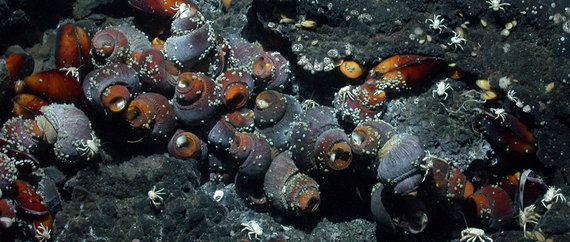
Ifremeria nautilei from the Manus Basin. Source: MARUM

The mining of deep-sea hydrothermal vents for gold, copper, and other precious metals, is imminent. Over the last seven years I’ve worked with industry, academia, and international regulatory agencies to help craft guidelines for conducting environmental impact studies and assess the connectivity and resilience of deep-sea ecosystems. Deep-sea mining, particularly at hydrothermal vents, is a complicated endeavor. As an ecologist and environmentalist, I’d like to see all deep-sea ecosystems receive extraordinary levels of protection. As a pragmatist and someone who recognizes that access to technology is a human right, I realize that demand for essential resources like copper, cobalt, and rare earth elements is only going to increase.

Mining a deep-sea hydrothermal vent presents a conundrum. Across the world, vents vary in their longevity and proximity to each other. A fast spreading center like those found in western Pacific back-arc basins, can have numerous, densely packed vents that persist for tens of years. In contrast, ultra-slow spreading centers, like the central Indian Ridge, may have a few, sparsely distributed vents that remain active for centuries. The sustainability of deep-sea mining is completely dependent on the type of vents being mined. Vents in slow spreading centers may never recover from any anthropogenic impact, while those in fast spreading centers could be extremely resilient to the disturbance caused by mining.

Read More “Beyond the Edge of the Plume: understanding environmental impacts of deep-sea mining” »

This Week in the Deep

Posted on January 12, 2013January 25, 2013 By Andrew Thaler
Science

New and noteworthy publications in deep-sea science for the week of January 7, 2013.

Deep Sea Research Part 1: Oceanographic Research Papers: Discovery of a new hydrothermal vent based on an underwater, high-resolution geophysical survey


A new hydrothermal vent site in the Southern Mariana Trough has been discovered using acoustic and magnetic surveys conducted by the Japan Agency for Marine–Earth Science and Technology’s (JAMSTEC) autonomous underwater vehicle (AUV) Urashima. The high-resolution magnetic survey, part of near-bottom geophysical mapping around a previously known hydrothermal vent site, the Pika site, during YK09-08 cruise in June-July 2009, found that a clear magnetization low extends ~500 m north from the Pika site. Acoustic signals, suggesting hydrothermal plumes, and 10 m-scale chimney-like topographic highs were detected within this low magnetization zone by a 120 kHz side-scan sonar and a 400 kHz multibeam echo sounder. In order to confirm the seafloor sources of the geophysical signals, seafloor observations were carried out using the deep-sea manned submersible Shinkai 6500 during the YK 10-10 cruise in August 2010. These discovered a new hydrothermal vent site (12°55.30′N, 143°38.89′E; at a depth of 2922 m), which we have named the Urashima site. This hydrothermal vent site covers an area of approximately 300 m x 300 m and consists of black and clear smoker chimneys, brownish-colored shimmering chimneys, and inactive chimneys. All of the fluids sampled from the Urashima and Pika sites have chlorinity greater than local ambient seawater, suggesting subseafloor phase separation or leaching from rocks in the hydrothermal reaction zone. End-member compositions of the Urashima and Pika fluids suggest that fluids from two different sources feed the two sites, even though are located on the same knoll and separated by only ~500 m. We demonstrate that investigations on hydrothermal vent sites located in close proximity to one another can provide important insights into subseafloor hydrothermal fluid flow, and also that, while such hydrothermal sites are difficult to detect by conventional plume survey methods, high-resolution underwater geophysical surveys provide an effective means.


Read More “This Week in the Deep” »

Popular Posts

Shark scientists want their research to help save threatened species, but don’t know how. Our new paper can help.Shark scientists want their research to help save threatened species, but don’t know how. Our new paper can help.December 1, 2025David Shiffman
Norway and Cook Islands put their deep-sea mining plans on pause.Norway and Cook Islands put their deep-sea mining plans on pause.December 3, 2025Andrew Thaler
What Ocean Ramsey does is not shark science or conservation: some brief thoughts on "the Shark Whisperer" documentaryWhat Ocean Ramsey does is not shark science or conservation: some brief thoughts on "the Shark Whisperer" documentaryJuly 2, 2025David Shiffman
The Trouble with Teacup PigsThe Trouble with Teacup PigsOctober 14, 2012Andrew Thaler
What we know we don't know: impacts of deep-sea mining on whales, dolphins, sharks, turtles, and other migratory species.What we know we don't know: impacts of deep-sea mining on whales, dolphins, sharks, turtles, and other migratory species.November 20, 2025Andrew Thaler
2025: My year in writing, public speaking, and media interviews2025: My year in writing, public speaking, and media interviewsDecember 3, 2025David Shiffman
Urea and Shark OsmoregulationUrea and Shark OsmoregulationNovember 15, 2010David Shiffman
Shark of Darkness: Wrath of Submarine is a fake documentaryShark of Darkness: Wrath of Submarine is a fake documentaryAugust 10, 2014Michelle Jewell
How tiny satellites are tracking marine wildlifeDecember 1, 2025Andrew Thaler
Build a dirt cheap, tough-as-nails field computer in a Pelican caseBuild a dirt cheap, tough-as-nails field computer in a Pelican caseJuly 21, 2015Andrew Thaler
Subscribe to our RSS Feed for updates whenever new articles are published.

We recommend Feedly for RSS management. It's like Google Reader, except it still exists.

Southern Fried Science

  • Home
  • About SFS
  • Authors
  • Support SFS


If you enjoy Southern Fried Science, consider contributing to our Patreon campaign.

Copyright © 2025 Southern Fried Science.

Theme: Oceanly Premium by ScriptsTown