Skip to content

Southern Fried Science

Over 15 years of ocean science and conservation online

  • Home
  • About SFS
  • Authors
  • Support SFS

Tag: science communication

Ocean Outreach in an Evolving Online Ecosystem: Transforming the Narrative

Posted on August 10, 2016August 11, 2016 By Andrew Thaler
Blogging, Conservation

This is the transcript of the keynote I delivered at the Fourth International Marine Conservation Congress in St. John’s, Newfoundland. It has been lightly modified for flow.

Read Act I: Science is Storytelling. 
Picture17

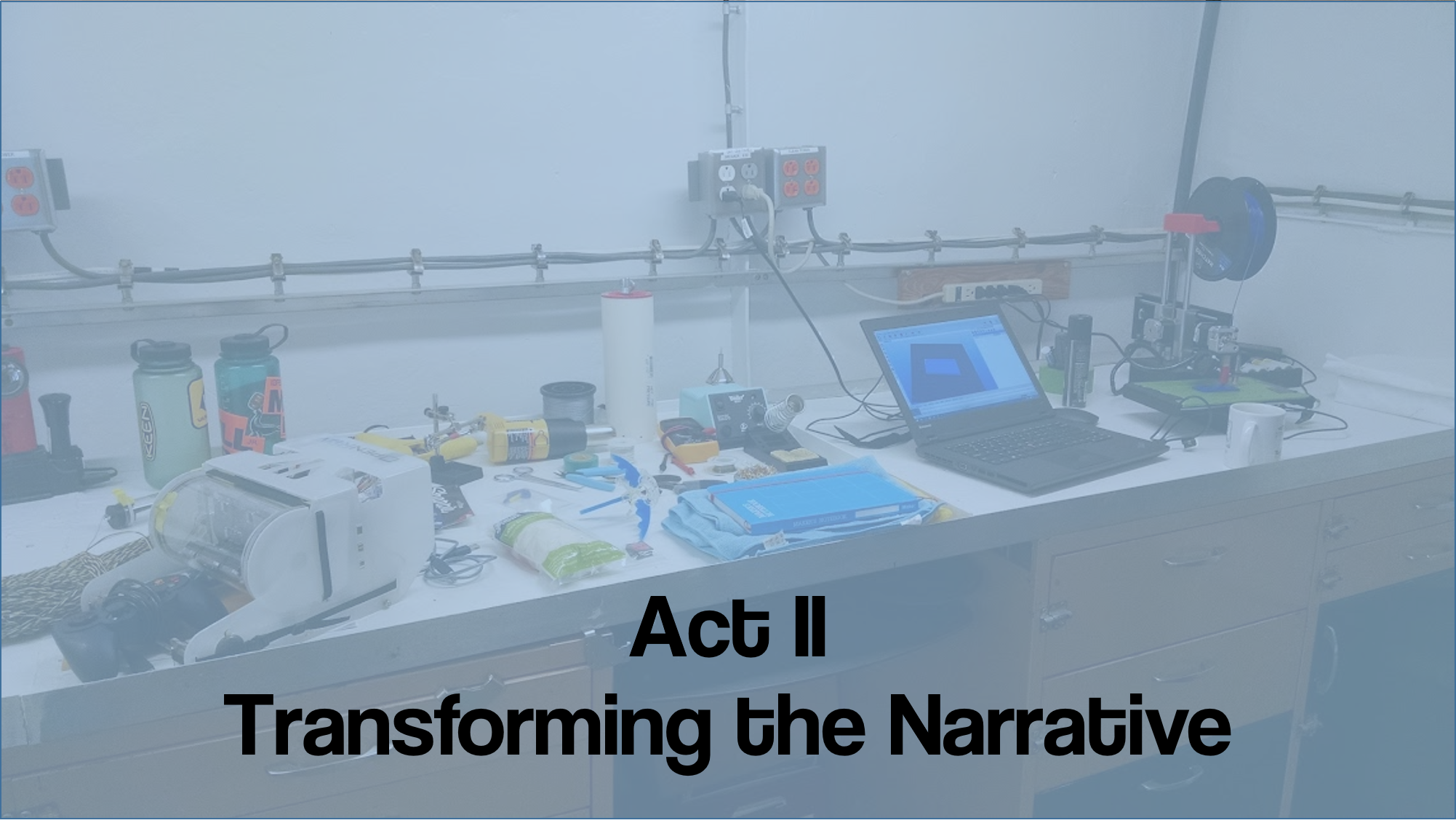
In Act I I discussed the underlying structure that frames narrative storytelling, but now I want to talk about how we can use the tools available to us on the internet to transform that narrative into something even more potent.

But before we can do that I have to tilt at some windmills.
Picture18

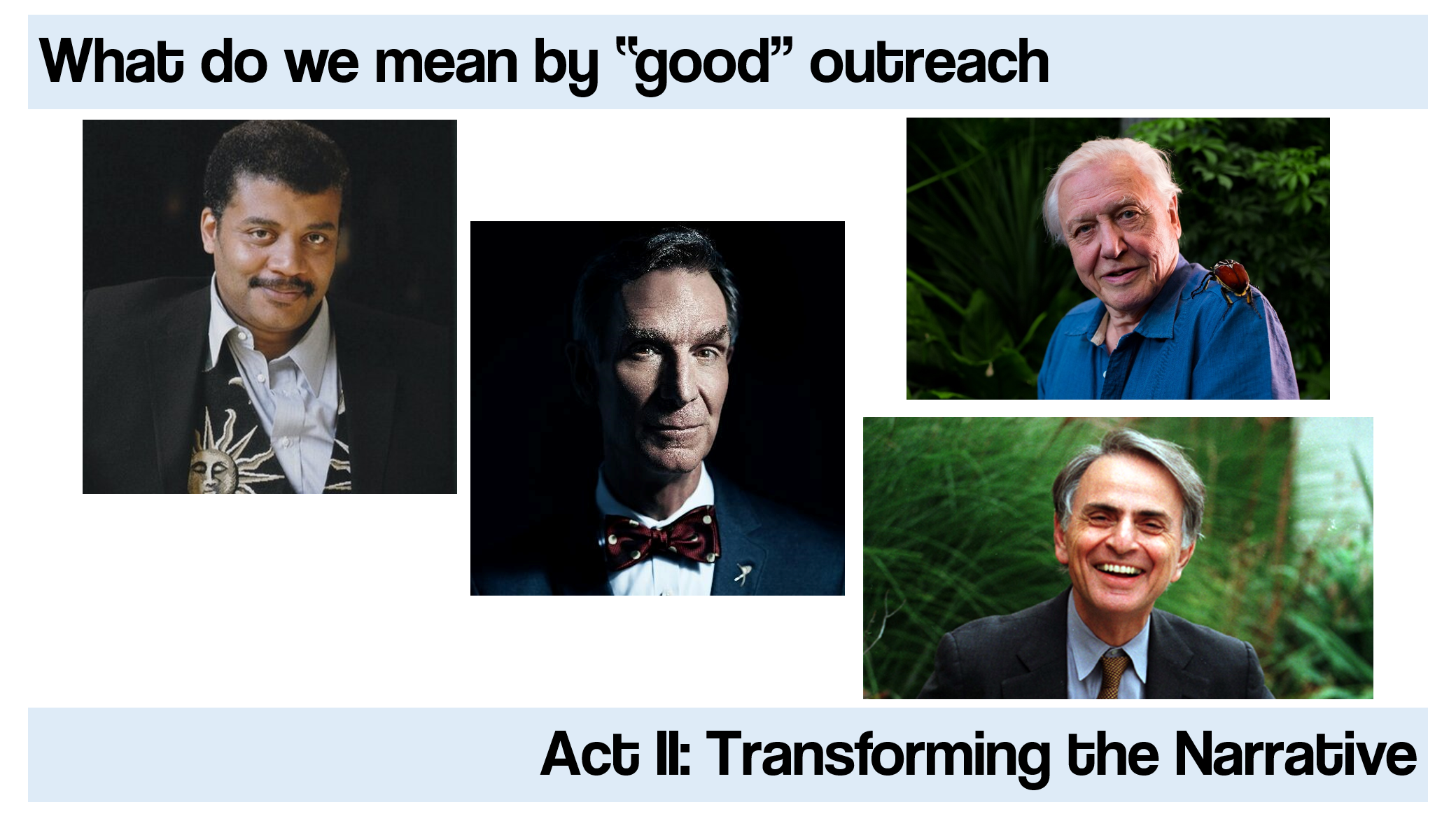
When we talk about good outreach, we often look to people like Neil deGrasse Tyson, like Bill Nye, like David Attenborough, and like Carl Sagan. These are the paragons of scientific outreach, the icons that we often hold up as examples for what constitutes good outreach. We talk about things like Cosmos, both Sagan’s and deGrasse Tyson’s, Bill Nye the Science Guy and his more recent work combating climate change, or David Attenborough and his astounding Nature Documentaries.

Read More “Ocean Outreach in an Evolving Online Ecosystem: Transforming the Narrative” »
Ocean Outreach in an Evolving Online Ecosystem: Science is Storytelling

Posted on August 9, 2016August 11, 2016 By Andrew Thaler 1 Comment on Ocean Outreach in an Evolving Online Ecosystem: Science is Storytelling
Blogging, Education

This is the transcript of the keynote I delivered at the Fourth International Marine Conservation Congress in St. John’s, Newfoundland. It has been lightly modified for flow. 

Picture2

Good morning and thank you all for coming, especially this early after a long week of conferencing. What I want to do today is talk a little bit about the history of online outreach, talk about how to build effective outreach campaigns, and look towards the future to think about how new technologies are shaping and reshaping the ways in which we think about public engagement with science and conservation.

Picture3So science is storytelling. Sometimes that story an adventure. Sometimes it’s a mystery. Sometimes it’s the dense and weighty exposition of Ulysses and sometimes it’s the absurdity of Finnegan’s Wake, but it is always a story.

Read More “Ocean Outreach in an Evolving Online Ecosystem: Science is Storytelling” »

The Importance of Scientific Discovery and Communication for a General Science Audience

Posted on June 3, 2016June 3, 2016 By Kersey Sturdivant
Education

The impetus for this piece was an essay I wrote for iBiology a year or so ago discussing the importance of scientific discovery for a a general science audience (i.e., our science peers who are not in our respective field). I was excited to write the piece because a lot of the Science FRIEDay articles I write focus on relatively recent scientific discoveries, and this article is more of an opinion piece. So why is scientific discovery important for an audience of science peers who do not explicitly work in our specific field?

It is easy to marvel at the wonders that exist on our planet and in the surrounding universe, the known discoveries. As a natural scientist, I also appreciate the beauty in the hidden mysteries of the natural world, those processes, behaviors, and functions that we have yet to elucidate. The notion and concept of scientific discovery is romanticized as a purist’s deed. Edwin Hubble said it best, “Equipped with his five senses, man explores the universe around him and calls that adventure Science.” A scientist’s basal desire is to further the state of knowledge, but equally we crave information about the fields of knowledge that are expanding around us, of which we are not explicitly involved. We aspire to understand the “99%”, at the very least surficially. The importance of this desire explains why scientific conferences play a major role in our profession, and journals such as Science and Nature are so popular. Yes, we as scientist want to share our new discoveries, but we are also equally as intrigued about what others have accomplished; we want to know how science is progressing outside of our bubble, especially those really groundbreaking feats. These coupled characteristics are a necessary component of science. Hearing and learning about the work of others fuels one’s own scientific passions to go and do more, and can often challenge an individual to think more creatively about their own research ideas and approaches. To a general audience of our scientific peers, sharing scientific discovery temporarily satiates the yearning that scientists have about the progression of knowledge, but also can serve as motivation and inspiration.

Read More “The Importance of Scientific Discovery and Communication for a General Science Audience” »

Ready, set, speak!  Tips for effectively communicating your science with public audiences

Posted on May 18, 2015 By Guest Writer
Uncategorized

About the author – Dr. Allison Coffin is Assistant Professor of Neuroscience at Washington State University Vancouver studying acoustic communication and hearing loss. Over the past 10 years she’s taught communication workshops to a variety of scientific and professional audiences and was the Audience Choice winner at the 2014 U.S. FameLab Finals, a science communication competition hosted by NASA and National Geographic.  She runs the science communication website communicatalyst.com and am a long-time member (junkie?) of Toastmasters International.

Why communicate your science?

You’re a scientist doing important and interesting work in conservation biology, right? You probably publish your research in reputable journals and give departmental seminars, but these reach a limited (and self-selected!) audience. Do you want your research to have a broader impact?  Head the call of recent editorials by Chris Parsons and Andrew Wright, and learn to advocate for your science – get out and communicate!

Between online forums, public scientific discussions such as Science Cafés, and interactions with the 24-hr media cycle, there are more venues than ever for us to communicate our science to lay audiences. However, being willing to communicate isn’t enough. To quote a recent JCom article by van der Wurff and colleagues, “Scientists…supposedly aim for a serious and scientific style in which complex matters are unraveled and accurately explained, remaining uncertainties acknowledged, and ideas not too quickly taken for granted.” Does this sound familiar?  For many scientists, our natural inclination (or perhaps, our training) makes it difficult to step out of this “information transfer” mode to connect with our audience.  At its heart, communication is about connection.  How can scientists connect with lay audiences, so that our message is both heard and received? This article is for all scientists who want to speak to the public, advocate for their science, and build their skills so that they can connect effectively.

Know your audience

Read More “Ready, set, speak!  Tips for effectively communicating your science with public audiences” »

Posts pagination

Previous 1 2

Popular Posts

That's not a blobfish: Deep Sea Social Media is Flooded by AI SlopThat's not a blobfish: Deep Sea Social Media is Flooded by AI SlopDecember 19, 2025Andrew Thaler
What Ocean Ramsey does is not shark science or conservation: some brief thoughts on "the Shark Whisperer" documentaryWhat Ocean Ramsey does is not shark science or conservation: some brief thoughts on "the Shark Whisperer" documentaryJuly 2, 2025David Shiffman
The story of the pride flag made from NASA imagery: Bluesky's most-liked imageThe story of the pride flag made from NASA imagery: Bluesky's most-liked imageSeptember 27, 2024David Shiffman
Screaming into the void - Why your scientific paper doesn’t matterScreaming into the void - Why your scientific paper doesn’t matterJune 18, 2026Chris Parsons
I can serve on your graduate thesis committee. Here’s what you can expect of me, and what I expect in return.I can serve on your graduate thesis committee. Here’s what you can expect of me, and what I expect in return.October 16, 2025David Shiffman
Shark of Darkness: Wrath of Submarine is a fake documentaryShark of Darkness: Wrath of Submarine is a fake documentaryAugust 10, 2014Michelle Jewell
The plague-busting, prairie-dog-vaccinating, ferret-saving droneThe plague-busting, prairie-dog-vaccinating, ferret-saving droneNovember 1, 2016Andrew Thaler
What is a Sand Shark?What is a Sand Shark?November 12, 2017Chuck Bangley
Fun facts and FAQs about Megalodon, Maryland's new (and definitely extinct) official state sharkFun facts and FAQs about Megalodon, Maryland's new (and definitely extinct) official state sharkApril 15, 2026David Shiffman
Our favorite sea monsters – Ningen (#4)Our favorite sea monsters – Ningen (#4)September 7, 2010Andrew Thaler
Subscribe to our RSS Feed for updates whenever new articles are published.

We recommend Feedly for RSS management. It's like Google Reader, except it still exists.

Southern Fried Science

  • Home
  • About SFS
  • Authors
  • Support SFS


If you enjoy Southern Fried Science, consider contributing to our Patreon campaign.

Copyright © 2026 Southern Fried Science.

Theme: Oceanly Premium by ScriptsTown