Skip to content

Southern Fried Science

Over 15 years of ocean science and conservation online

  • Home
  • About SFS
  • Authors
  • Support SFS

Tag: twitter

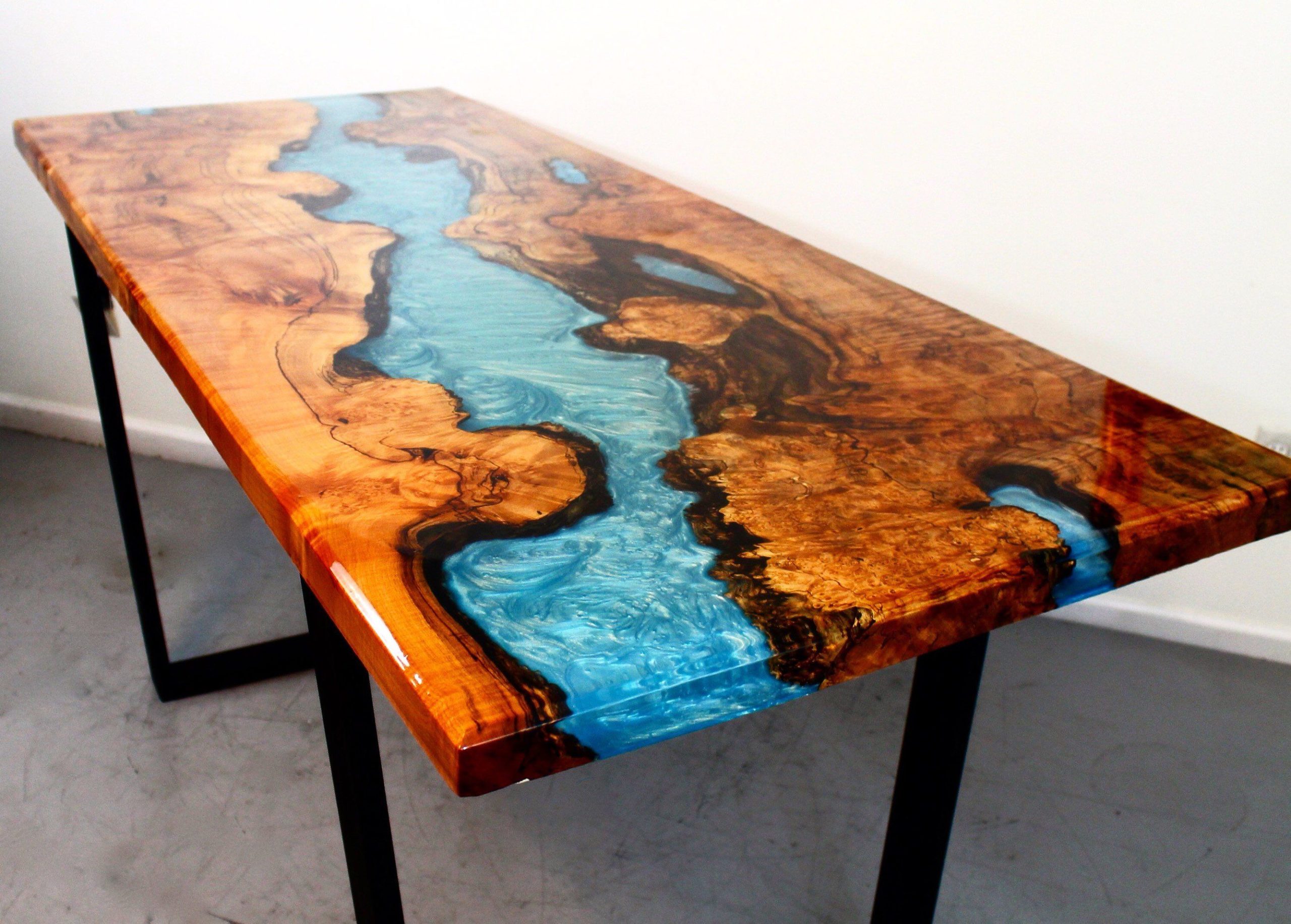
This is not an article about epoxy river tables.

Posted on June 4, 2024June 6, 2024 By Andrew Thaler
This is not an article about epoxy river tables.
Built to Last, Featured

Fourteen years ago, when Social Media was fresh and new and full of hope, I started teaching Social Media for Environmental Communications at Duke University. The internet was bursting with potential and we wanted to help ocean campaigners tap into that cognitive surplus for the good of the planet.  This was a data driven course, … Read More “This is not an article about epoxy river tables.” »

I am deep-sea ecologist Andrew Thaler and this is where you verify my social media accounts.

Posted on November 7, 2022November 21, 2022 By Andrew Thaler
Blogging

These are my active social media accounts: Twitter (automated posting): https://twitter.com/DrAndrewThaler Facebook: https://www.facebook.com/drandrewthaler Instagram: https://www.instagram.com/drandrewthaler/ TikTok: https://www.tiktok.com/@drandrewthaler Mastodon: https://mastodon.social/@DrAndrewThaler Project Mushroom: https://projectmushroom.social/@DrAndrewThaler

So Elon Musk bought Twitter…

Posted on October 28, 2022October 28, 2022 By Andrew Thaler
So Elon Musk bought Twitter…
Blogging

For a while it seemed like the deal wasn’t going to go through. After his initial offer, Elon Musk tried everything he could to back out of it, short of sitting for a deposition in the resulting law suit. But, at the end of the day, it went through, and Elon Musk now owns Twitter.

Lots of folks are worried about what a Musk-controlled Twitter will become. His conditional commitment to press freedom depends entirely on how much praise is heaped upon him. His record as an employer is a mess. And now he controls one of the most potent, though slowly waning, outlets for public engagement, and certainly the preferred medium of journalists and politicians.

I’ve taught Social Media for Environmental Communications at Duke University for the last 11 years. Every year there’s been some big social media shakeup, and every year we look at how that shakeup will impact professionals using social media primary as an outreach and engagement tool. This has the potential to big the biggest shift in how folks approach social media that we’ve seen in a long time. But it also could be a whole heap of nothing. It all depends on the whims of a single, inconsistent owner who may not really know what he has or what his vision for it is.

So what will this new Twitter look like? I suspect that we won’t see tectonic shifts in how Twitter operates immediately. It will take months for any of Musk’s vision to trickle into the user experience. I don’t get the impression that there are many people left for whom an ownership change is going to push them to finally get a Twitter account. The platform seems largely out of its growth phase. So there will likely be a slow and steady attrition of users as they get less and less out of using Twitter. They won’t be replaced.

Long-term, I expect to see a hard push towards monetization of an increasingly small active user base. Which, in itself, will make that user base even smaller.
Read More “So Elon Musk bought Twitter…” »

A decade of failures in Science Communication.

Posted on February 12, 2020February 18, 2020 By Andrew Thaler 4 Comments on A decade of failures in Science Communication.
Blogging

Eleven years is a long life for a science blog. Southern Fried Science was born in 2008, when the main writers were all graduate students. Over the last decade the online landscape has changed. Science Communication changed with it, adapting and evolving to meet an ever-shifting ecosystem. Looking back on the last decade and thinking about the next, it’s becoming easier to see where we went wrong. It’s not quite as easy to determine what we need to correct the course.

This is not a scientific assessment, this is my own personal observations from the last decade of running Southern Fried Science, from teaching Social Media for Environmental Communications for the last 7 years, from working with Upwell, one of the most dynamic and visionary ocean NGOs ever conceived, from helping build and launch multiple online platforms, dozens of novel programs, and hundreds of outreach campaigns, and from spending a lot of time since November 2016 reflecting on what we’ve done wrong.

That Hideous Deficit

Do we really need another 200 words on how bad the deficit model is and why it needs to die?

Apparently, yes.

The basic premise: that science perception and policy is shaped by an information deficit and that if we just make good science education content and spread it, we can combat the spread of misinformation, people will learn, and everything will get better.

It doesn’t work. It never worked. And it ignores the reality that misinformation is manufactured for political and financial gain, with tremendous incentives and, often, far better funding than science outreach campaigns. But beyond that, multiple studies have shown that, when confronted with information that challenges their fundamental world view, people don’t throw out their worldview, they reject the science, creating a more entrenched and intractable audience.

Read More “A decade of failures in Science Communication.” »

To tweet to whom – a tweeting guide for marine scientists

Posted on December 18, 2018December 19, 2018 By Chris Parsons
Uncategorized

“Logic is a tweeting bird” – Spock, Star Trek

Social media can be a great tool for spreading and disseminating published science. Potentially it can reach a wide audience and for free !

Most platforms allow you to insert links to direct readers to the original paper or publication. If you are working in an area that is relevant to conservation or policy, social media can be a great way of getting papers to the right audience that may need that information (Parsons et al., 2014). Moreover, there is now increasing data that using social media can increase download and citation rates of scientific papers, which in turn is good for the careers of scientists in an academic setting.

Read More “To tweet to whom – a tweeting guide for marine scientists” »

Southern Fried Science year-in-review, Palau’s Giant, a new challenge for deep-sea mining, Porgs are Puffins, and more! Monday Morning Salvage: December 25, 2017.

Posted on December 25, 2017December 25, 2017 By Andrew Thaler
Weekly Salvage

Happy Holidays from the Southern Fried Science Team!

Fog Horn (A Call to Action)

  • The Saipan Blog’s Angelo Villagomez put together a list of extraordinary Indigenous Pacific Conservationists to Follow on Twitter in 2018. Go. Follow them. Learn what’s really happening in Pacific Conservation.

Flotsam (what we’re obsessed with right now)

  • Do-it-yourself science is taking off. A growing movement seeks to make the tools of science available to everyone (including you). I love that The Economist now has a “Punk Science” heading.
  • Palau now requires all tourists to sign an environmental pledge when they enter the country. All flights in now feature this delightful short film.

https://www.youtube.com/watch?v=KhuY8eNLzBM

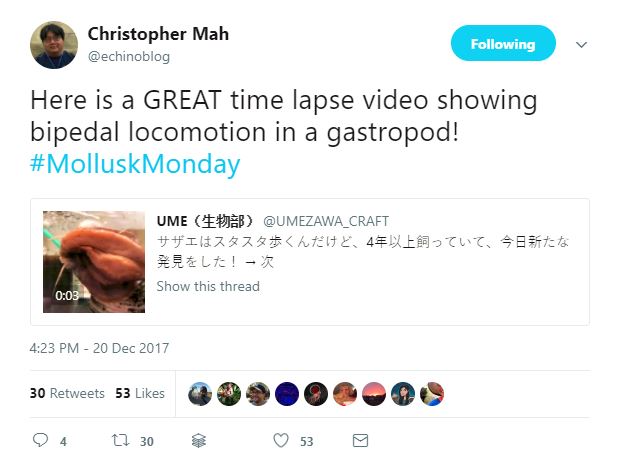
  • Arlo Guthrie was right! Cool short video of bipedal “walking” in gastropods. Clamzo boys, Clamzo!

Read More “Southern Fried Science year-in-review, Palau’s Giant, a new challenge for deep-sea mining, Porgs are Puffins, and more! Monday Morning Salvage: December 25, 2017.” »

Twitter Ocean Chess, lessons from the Vaquita, awe of the deep, and more! Monday Morning Salvage: November 13, 2017

Posted on November 13, 2017November 13, 2017 By Andrew Thaler
Weekly Salvage

Fog Horn (A Call to Action)

  • Ocean policy news breaking this week. We’ll have a comment template ready to go when it does. Please check back. We can’t announce until we know exactly what we’re dealing with.
  • Still time to register for OceanDotComm! Science Communication folks! Are you ready for OceanDotComm? Register now!

Flotsam (what we’re obsessed with right now)

  • This is an amazing piece about the importance of awe in deep-sea conservation. Unless we regain our historic awe of the deep ocean, it will be plundered.

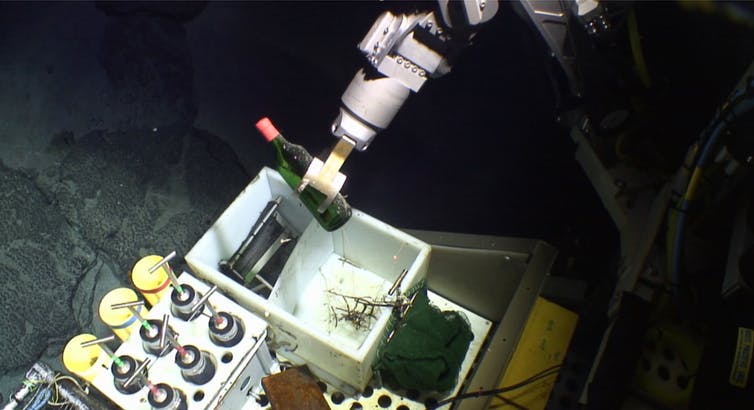
Wine bottle found in the deep North Atlantic. Laura Robinson, University of Bristol, and the Natural Environment Research Council. Expedition JC094 was funded by the European Research Council.

  • The Vaquita are going extinct and with them comes an importance lesson on the value of social science to conservation research:

My wife, on the other hand, is a social scientist who works on development here in Mexico. When we first started dating, I used to tease her for being a soft little scientist in her soft little science. I now understand that helping a community pull itself out of poverty is more complex than brain surgery or quantum physics.

There is no magic equation for community organizing but she begins by understanding that “the community” isn’t some monolithic creature that thinks as a unit. There are complex politics and power dynamics at work that can either aid or destroy all her efforts.

I now understand why the vaquita is going extinct. They sent too many people like me into the region and not enough like her.

source.

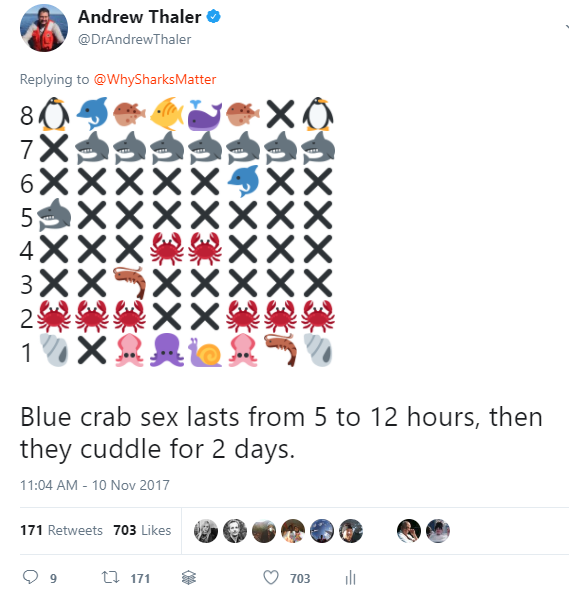
  • Would you like to play a game? Last week David and I unleashed Twitter Ocean Chess upon the internet and the results are in: it’s the only valid use of 280 characters.
    • Marine biology nerd chess is the only decent justification for 280-character tweets
    • Here’s what happened when two marine scientists played emoji chess on Twitter
    • Emojis + Marine biology triva = OCEAN CHESS 🐬🦀♞

Read More “Twitter Ocean Chess, lessons from the Vaquita, awe of the deep, and more! Monday Morning Salvage: November 13, 2017” »

See a Great White Shark from the inside with OpenROV, Vaquita, Narwhals, and more! Monday Morning Salvage: November 6, 2017

Posted on November 6, 2017November 6, 2017 By Andrew Thaler
Weekly Salvage

Fog Horn (A Call to Action)

  • Science Communication folks! Are you ready for OceanDotComm? Register now!

Flotsam (what we’re obsessed with right now)

  • Go shark diving with OpenROV Trident and maybe get a bit too close an personal with a great white shark.
  • Yes, that is the esophagus of a great white shark, in the wild. No, you should not attempt to replicate this experience.

Read More “See a Great White Shark from the inside with OpenROV, Vaquita, Narwhals, and more! Monday Morning Salvage: November 6, 2017” »

The most shocking, insightful ocean conservation solutions, as presented by a poorly-built Twitter bot.

Posted on October 4, 2017 By Andrew Thaler
Uncategorized

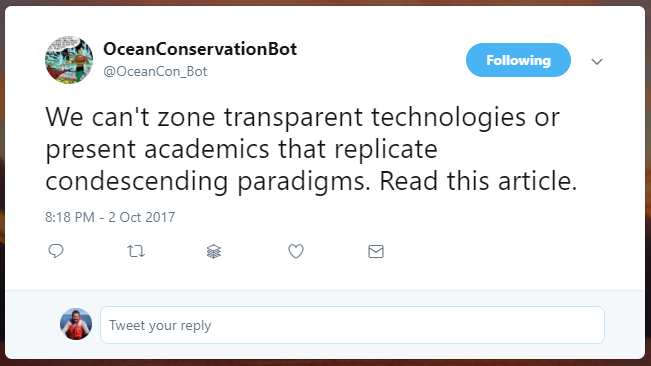
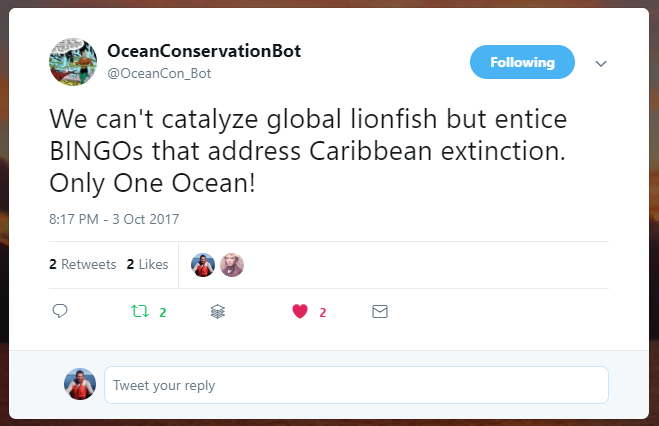
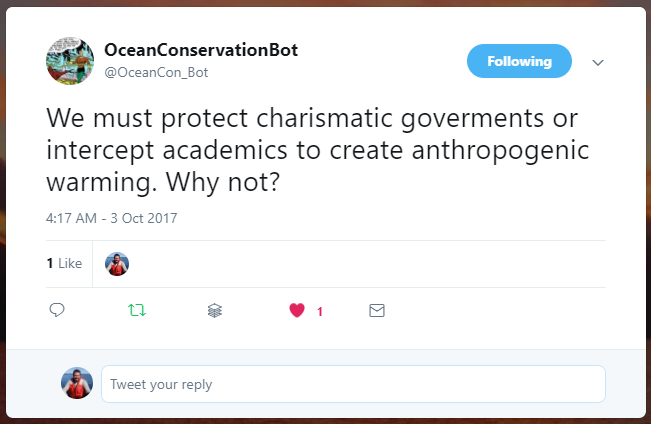
We made a bot. It’s not a very good bot but it does prognosticate on novel ocean conservation solutions. @OceanCon_Bot has been running for almost a month and it’s produced some real gems. Solid, salt-of-the-earth, diamond-in-the-rough, gabbro-in-your-lab, bro, solutions. And these are among my favorites.

We definitely need to stop presenting those condescending academics, but why so down on transparency, @OceanCon_Bot?

Catalyze lionfish and address Caribbean extinction? I guess you can’t really do both.

Ok, it’s possible we created an evil ocean bot.

Read More “The most shocking, insightful ocean conservation solutions, as presented by a poorly-built Twitter bot.” »

How to help Houston, GameBoy SONAR, buy a lighthouse, and more! Monday Morning Salvage: August 28, 2017

Posted on August 28, 2017August 28, 2017 By Andrew Thaler
Weekly Salvage

Fog Horn (A Call to Action)

  • Hurricane Harvey is sitting over the city of Houston, dumping biblical amounts of rain and flooding nearly the entire metropolitan area. There’s lots of great organizations to donate to, but in the immediate aftermath, it’s often best to donate to local relief programs that already have a ground team in place, rather than national groups that will take weeks to build up their infrastructure. I’m a fan of the Texas Diaper Bank and Portlight Inclusive Disaster Strategies, both of which serve communities that tend to be particularly vulnerable during natural disasters.

Flotsam (what we’re obsessed with right now)

  • Dr. Katharine Hayhoe has become one of the most important voices in Climate Change over the last few years. Her latest, I was an Exxon-funded climate scientist, is a sober look at who where the money really goes and who pulls the strings in the climate change denial industry.
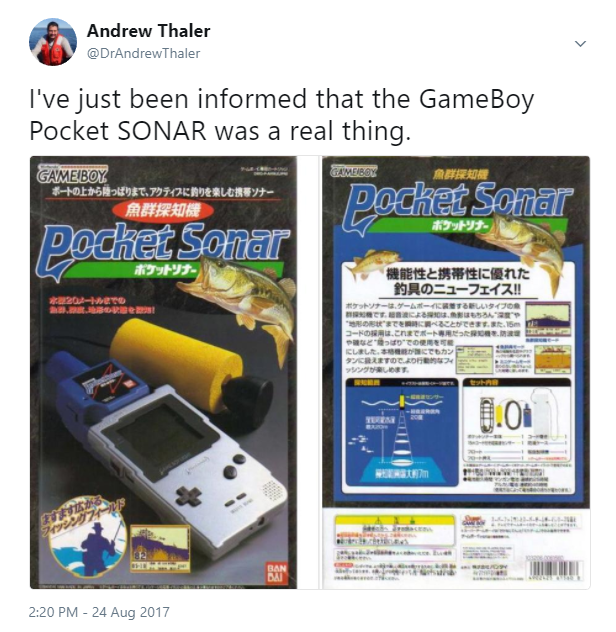
  • Bandai and Nintendo once made a SONAR that runs on a GameBoy Pocket, and I want one. Has anyone ever encountered one of these rare and wondrous techno chimeras?

Read More “How to help Houston, GameBoy SONAR, buy a lighthouse, and more! Monday Morning Salvage: August 28, 2017” »

Posts pagination

1 2 3 Next

Popular Posts

Shark scientists want their research to help save threatened species, but don’t know how. Our new paper can help.Shark scientists want their research to help save threatened species, but don’t know how. Our new paper can help.December 1, 2025David Shiffman
Norway and Cook Islands put their deep-sea mining plans on pause.Norway and Cook Islands put their deep-sea mining plans on pause.December 3, 2025Andrew Thaler
What Ocean Ramsey does is not shark science or conservation: some brief thoughts on "the Shark Whisperer" documentaryWhat Ocean Ramsey does is not shark science or conservation: some brief thoughts on "the Shark Whisperer" documentaryJuly 2, 2025David Shiffman
The Trouble with Teacup PigsThe Trouble with Teacup PigsOctober 14, 2012Andrew Thaler
What we know we don't know: impacts of deep-sea mining on whales, dolphins, sharks, turtles, and other migratory species.What we know we don't know: impacts of deep-sea mining on whales, dolphins, sharks, turtles, and other migratory species.November 20, 2025Andrew Thaler
2025: My year in writing, public speaking, and media interviews2025: My year in writing, public speaking, and media interviewsDecember 3, 2025David Shiffman
Urea and Shark OsmoregulationUrea and Shark OsmoregulationNovember 15, 2010David Shiffman
Shark of Darkness: Wrath of Submarine is a fake documentaryShark of Darkness: Wrath of Submarine is a fake documentaryAugust 10, 2014Michelle Jewell
How tiny satellites are tracking marine wildlifeDecember 1, 2025Andrew Thaler
Build a dirt cheap, tough-as-nails field computer in a Pelican caseBuild a dirt cheap, tough-as-nails field computer in a Pelican caseJuly 21, 2015Andrew Thaler
Subscribe to our RSS Feed for updates whenever new articles are published.

We recommend Feedly for RSS management. It's like Google Reader, except it still exists.

Southern Fried Science

  • Home
  • About SFS
  • Authors
  • Support SFS


If you enjoy Southern Fried Science, consider contributing to our Patreon campaign.

Copyright © 2025 Southern Fried Science.

Theme: Oceanly Premium by ScriptsTown