Skip to content

Southern Fried Science

Over 15 years of ocean science and conservation online

  • Home
  • About SFS
  • Authors
  • Support SFS

Try your hand at celestial navigation with an open-source, Glowforge-ready astrolabe!

Posted on March 28, 2018 By Andrew Thaler
Education

I have a bit of a soft spot for classic navigational instruments. In an age where more people interact with maps than ever before and yet spend much less time plotting their own course, being able to look up at the sky and discern your place in the world is a powerful skill. Unfortunately, it’s not exactly easy to make your own navigational instruments. Unless, of course, you have your own laser cutter.

I recently got a Glowforge, so honestly, you should have seen this coming.

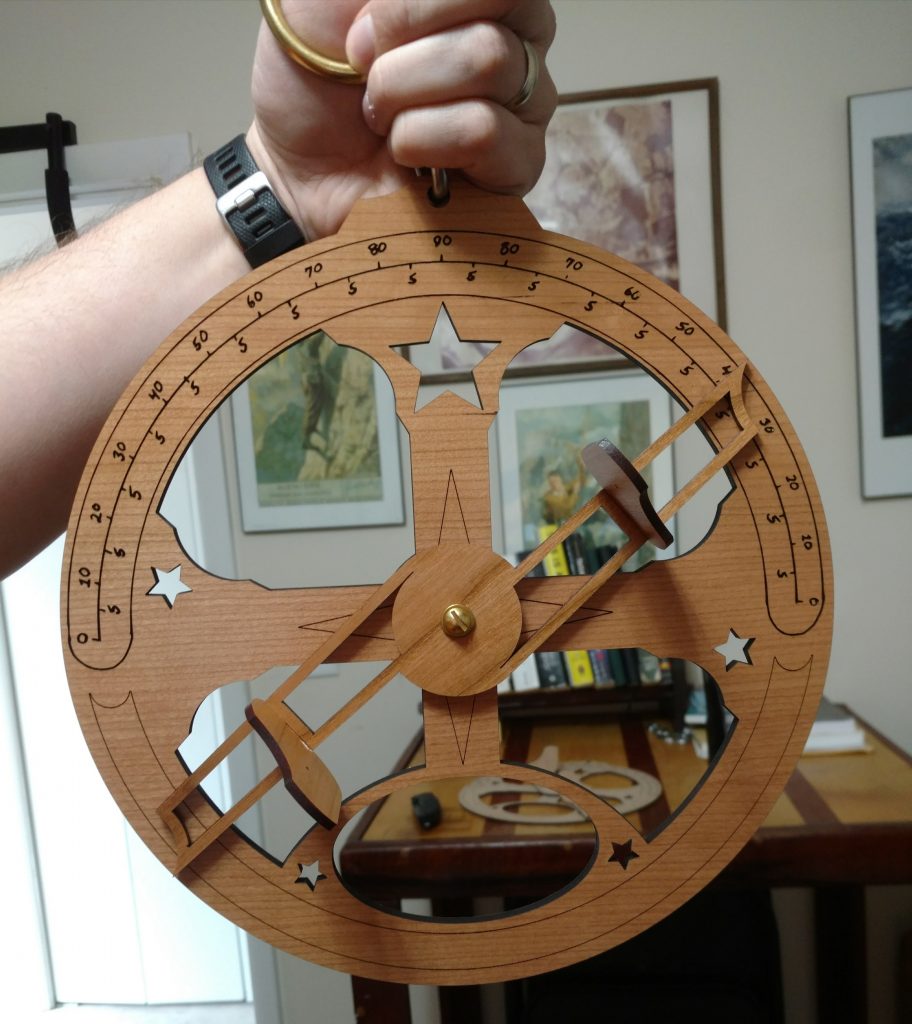
Say hello to the Mariner’s Astrolabe!

Developed in the Middle East to help traders chart their course through the desert, the astrolabe was the most popular western navigational instrument for centuries. Unlike more primitive tools like the kamal and latitude hook,  astrolabes work whether or not you can see the horizon. The astrolabe allowed navigators to track their latitude as they explored the world. Mariner’s Astrolabes were small, heavy, and designed to reduce windage. It took 3 people to take a proper sight. It was often more wrong than right. Notoriously difficult and inaccurate, Columbus reportedly hurled his overboard in the Sargasso Sea before making landfall half-a-world off course.

To use, sight Polaris through the pinholes in the alidade while holding the instrument level with the horizon and read the angle to calculate latitude. Astrolabes can also be use for dead reckoning by holding the instrument horizontally, aligning the top to North, and taking a bearing off you target.

Astolabes are a great tool for introducing students to celestial navigation and teaching trigonometry.

For inspiration and instruction, I use the following books: Latitude Hooks and Azimuth Rings: How to Build and Use 18 Traditional Navigational Tools (from which this design draws heavily), The Lo-Tech Navigator, and Emergency Navigation: Improvised and No-Instrument Methods for the Prudent Mariner.

Over the next year, I’m working on unveiling a series of classic and easy to reproduce navigational tool, from astrolabes to octants, that can be made on a laser cutter (or, I guess you could 3D print them, if you want).


If you enjoy Southern Fried Science, consider contributing to our Patreon campaign. For just $5 per month, you can support the SFS Writers Fund, which helps compensate your favorite ocean science and conservation bloggers for their efforts.

Share this:

  • Click to share on Bluesky (Opens in new window) Bluesky
  • Click to share on Facebook (Opens in new window) Facebook
  • Click to share on Reddit (Opens in new window) Reddit
  • Click to share on Threads (Opens in new window) Threads
  • Click to share on WhatsApp (Opens in new window) WhatsApp
  • Click to share on Mastodon (Opens in new window) Mastodon

Related

Tags: glowforge navigation

Post navigation

❮ Previous Post: Frisky Anglerfish, Persistent Aquatic Living Sensors, Make for the Planet Borneo, Sea Cucumber Mafia, and more! Monday Morning Salvage: March 26, 2018
Next Post: Giant whales and collapsing cod stocks: Thursday Afternoon Dredging, March 29th, 2018 ❯

You may also like

Uncategorized
Gliding on starlight: Celestial Navigation for Martian Explorers
January 23, 2016
Open Science
I made a ridiculous Glowing Wall Mount for my OpenROV Trident!
October 26, 2018
Education
I built a head-mounted LiDAR array that lets you see the world like a dolphin via vibrations sent through your jaw.
July 24, 2018
Weekly Salvage
Open Science in Africa, defend the ADA, the value of the outdoors, Minke whale rides, and more! Monday Morning Salvage: February 19, 2018.
February 19, 2018

Popular Posts

Shark scientists want their research to help save threatened species, but don’t know how. Our new paper can help.Shark scientists want their research to help save threatened species, but don’t know how. Our new paper can help.December 1, 2025David Shiffman
Norway and Cook Islands put their deep-sea mining plans on pause.Norway and Cook Islands put their deep-sea mining plans on pause.December 3, 2025Andrew Thaler
What Ocean Ramsey does is not shark science or conservation: some brief thoughts on "the Shark Whisperer" documentaryWhat Ocean Ramsey does is not shark science or conservation: some brief thoughts on "the Shark Whisperer" documentaryJuly 2, 2025David Shiffman
What we know we don't know: impacts of deep-sea mining on whales, dolphins, sharks, turtles, and other migratory species.What we know we don't know: impacts of deep-sea mining on whales, dolphins, sharks, turtles, and other migratory species.November 20, 2025Andrew Thaler
2025: My year in writing, public speaking, and media interviews2025: My year in writing, public speaking, and media interviewsDecember 3, 2025David Shiffman
The Trouble with Teacup PigsThe Trouble with Teacup PigsOctober 14, 2012Andrew Thaler
Urea and Shark OsmoregulationUrea and Shark OsmoregulationNovember 15, 2010David Shiffman
How tiny satellites are tracking marine wildlifeDecember 1, 2025Andrew Thaler
Shark of Darkness: Wrath of Submarine is a fake documentaryShark of Darkness: Wrath of Submarine is a fake documentaryAugust 10, 2014Michelle Jewell
Quick Tips for Graduate Student Life - Write a Book ReviewJanuary 23, 2014Andrew Thaler
Subscribe to our RSS Feed for updates whenever new articles are published.

We recommend Feedly for RSS management. It's like Google Reader, except it still exists.

Southern Fried Science

  • Home
  • About SFS
  • Authors
  • Support SFS


If you enjoy Southern Fried Science, consider contributing to our Patreon campaign.

Copyright © 2025 Southern Fried Science.

Theme: Oceanly Premium by ScriptsTown