
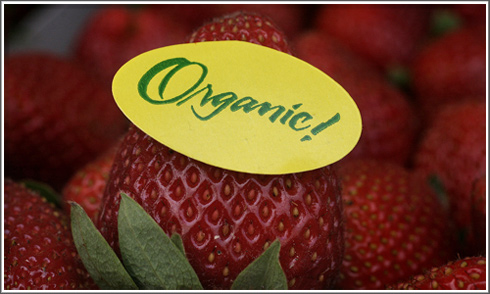
 The squishiness of the term sustainability also offers people pick of what they choose to think about and what kinds of changes they want to make in their lives. I return this week from a week of thinking about spaces of sustainability during the American Assocation of Geographers conference, where the series of sessions entitled “food alterity” was standing room only. One of the speakers started off her talk with the question “why are we all so obsessed with food, what it is about food that gets people excited where we really should be excited about energy”. She went on to give a fascinating talk about who gets to write the grower’s manual for organic strawberries (literally, it’s apparently a power struggle over legitimate knowledge). But her first question really stuck with me.
The alternatives for industrial agriculture food are many and growing with each passing year. Just think of the myriad labels facing you in the grocery store, especially when going to buy something contentious like coffee or chocolate. What combination of organic, shade grown, natural, fair trade, etc. should you get? Here’s a quick rundown of the labels I’ve encountered and looked into a little deeper:
 – organic: In the US, the USDA certifies this process as being (mostly) free of synthetic chemicals and fertilizers. A board meets every so often to decide on the rules and people are constantly petitioning to have them either loosened or strengthened. At least there’s a central, transparent place to understand what this label means.
 – natural: The term isn’t regulated at all. It’s generally used when a company can’t quite meet organic standards or they want to show off that you can pronounce all the ingredients.
 – Shade grown/cage free/animal welfare certified: Speaks to specific industry standard labels, sometimes certified by a third party, sometimes not. These specific techniques are generally product-specific and a lot of times, growers don’t want to delve into an education campaign necessary to explain all the different options.
 – Fair trade: This can be for gifts or food, but essentially guarantees that the producers made a living wage. Technically, it says nothing on the environmental sustainability of the product, but the two tend to go hand-in-hand.
– Community – supported: As in agriculture or fishery, this usually entails consumers purchasing a share of the year’s crops or catch and having it delivered or picked up once a week. More unusual ones have people come to the farm and pick what they want or offer a weekly bag of choices at the farmer’s market. The idea is “direct marketing” where consumers can interact directly with producers, ask them questions, learn about the production process, and build a level of trust.
– Local: People have to decide what ‘local’ really means. Farmers markets and stores generally use either a 100 mile or 250 mile radius to define local, but some use much narrower or wider ranges, from restaurants and breweries sourced entirely from their own farm to state or region wide labeling.
I’m sure the list goes on, but these are the big ones that come to mind. The point is not to define the different varieties of ‘alternative’ food, but to display how many different kinds there are. And of equal importance, the various certifications aren’t particularly easy to get all at the same time. To a certain degree, an eater has to decide whether they care more about the pesticides used on their crop or the miles that crop traveled. As a result, many of these food systems co-exist without the need to find a one-size-fits all panacea for food production. Consumers value options and choice to the point where foodie-ism takes on a whole new elevated status in society.
Yet, these options don’t stick around for other consumer items. People pay their power bill to a regional company that might have a blend of power sources (renewable and not), but the bevy of options to capture consumer choice isn’t yet there. Even the world of textiles is only slightly awakened to the alternatives to the industry’s standard labor and environmental practices. How often do you see a shirt labeled “sweatshop free” or “organic”? They’re out there, but consumers haven’t expressed as much demand for alternative fuels and fibers as they have with food.
So what it is about food? Is it because food is so intimate? We taste, feel, and digest the alternatives, not just buy them. Is it because, on some level, food is the most basic need beside water and we have to start somewhere? Is it because there’s something very different about eating really good, wholesome food that sets of different neurotransmitters than simply buying ethically? Whatever it is, the alternative food systems are alive, well, and growing. We might learn a lesson from them about living sustainably in other aspects of our lives.
Food is where the decision burden is highest. You go to a grocery store and might choose 40 items (out of 40,000 options). It’s where we most want good guidelines.
Also, food is cheap. The barrier to sustainable choices is therefore lower.
Plus, I don’t know where to find sustainable toothbrushes.
Food sellers have the most chances to convert you to their product by making it seem green/healthy/whatever, and we shop for food enough that we can pay attention to complicated categorizations of food. I shop for food about twice/week, and for clothes less than once a month – if something about the way clothes were marketed changed, I wouldn’t really notice it.
Also, eating “natural” or “organic” food (I don’t know that anybody eats “inorganic” food) seems like it would have effects on one’s health. The real motivation might be to preserve one’s self, and environmentalism is tacked on to it.