
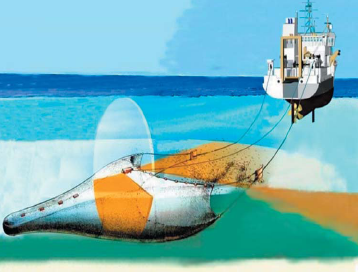
The least-impacted places in the ocean are mainly in the deep sea, but as fishing technology has improved, even seamounts, sponge gardens and deep-sea coral beds are no longer out of reach of our appetites for seafood. Bottom trawling, which involves dragging a heavy weighted net along the seabed, is so destructive to benthic habitats that it has been compared to clear-cutting a forest. Bottom gillnetting catches almost anything that swims into them (and isn’t smaller than the mesh size), resulting in enormous levels of bycatch.
The deep-sea fishing fleet of the European Union is one of the largest in the world, which is why it was so heartening to see the European Commission call for a phase-out of trawls and bottom gillnets recently. The Marine Conservation Institute, a longtime leader in marine protected areas, has obtained over 100 signatures (including mine) from marine scientists supporting a phase-out of bottom trawls and bottom gillnets by the EU fishing fleet. If you are a scientist who supports this measure, please consider adding your signature. This can be done by e-mailing DeepSeaTrawlPetition@Marine-Conservation.org and including your name, institutional affiliation, degree, title, and full mailing address. Please note that MCI is primarily interested in signatures from the scientific community, and that simply posting a comment on this blog post is not equivalent to signing the petition.However, feel free to post a comment letting us know that you contacted MCI!
The full text of the petition can be seen after the jump:
Declaration of support: Protect the deep sea from destructive fishing
We, the undersigned, represent the concerned public and include artisanal fishers, development and environmental organisations, and other stakeholders. We share a common interest in restoring Europe’s deep; sea fish populations and ensuring the long; term conservation of deep-sea ecosystems. To that end, we support the prevention of adverse impacts on deep sea ecosystems, which can be accomplished in large part by phasing out destructive fishing practices and requiring impact assessments for all deep-sea fisheries.
The European Union (EU) has one of the world’s largest deep-sea fishing fleets. There is already widespread evidence that deep-sea bottom trawling has significantly damaged deep-sea ecosystems, including coral reefs, sponge gardens and seamounts, and caused serious declines in deep-sea fish populations. We urge EU decision makers to take a strong and constructive role in protecting deep-sea ecosystems both within and outside EU waters.
We seek a clear mandate from EU policymakers for sustainable management of deep-sea resources. To date, legislation enacted by EU Member States has been insufficient to protect the vulnerable marine ecosystems of the deep sea from the adverse impacts of destructive fishing gear, primarily deep-sea bottom trawling. Despite the introduction of new regulations to curb overfishing, deep-sea fish populations are seriously depleted in the Northeast Atlantic and the catch of most species continues to be unregulated.
We applaud the European Commission’s July 19, 2012, proposal to reform the deep sea access regime – specifically the provision that requires a phase-out of bottom trawling and bottom gillnet fishing for deep-sea species within two years. The proposal rightly integrates EU commitments to protect the deep sea made over the past decade at the United Nations General Assembly and at the June 2012 Rio+20 Earth Summit. We urge the EU Council and Members of Parliament to honour those commitments by supporting the Commission proposal to overhaul its deep-sea fisheries.
We also support the current proposal which allows artisanal fishers who use selective fishing methods and gear to target species at levels that do not exceed scientific advice to continue to fish the deep sea sustainably and profitably. Artisanal fishers make important contributions to the social, economic and cultural fabric of Europe’s coastal communities in some of Europe’s outermost and deep-sea fishery dependent regions.
We call on European Union decision makers to transform deep-sea policy by:
- Ending destructive fishing practices through a mandatory phase-out of bottom trawling and bottom gillnet fishing for deep-sea species within two years;
- Requiring prior impact assessments for all deep-sea fisheries;
- Ensuring that fishing be permitted only if the catch, including any bycatch, can be limited to sustainable levels based on a clear scientific understanding of the species impacted, and that deep-sea fisheries are managed to minimize or prevent the catch of vulnerable, threatened, or endangered species;
- Ensuring that all deep-sea fisheries are managed to prevent adverse impacts on deep-sea ecosystems such as deep-sea coral, sponge and seamount ecosystems.
Playing devils advocate for a second, is there a petition for fisherman to sign that will phase out funding for scientific research (or salary support)?
Science aside, right or wrong, this is basically asking to phase out expected income from a particular group of people. Without another side to the story (ie. what are these people and equipment supposed to do instead?), this doesn’t look like a political recipe for success.
I think you’re right on the issue, but maybe it’s time to also walk a mile in the other guys shoes.
Joe, are you saying it is ok for people to earn money by any means they wish, regardless of consequences? I sure hope not. That kind of justification can be used for animal poaching too.
Not everything we do is ok as long as we make a few dollars. The scientists are calling for an end to a particular method of fishing which causes enourmous amounts of damage. These fishermen are fishing THEMSELVES out of income and employment by destroying the very habitat which nurtures their catch.
Scientists are sending down devices to measure and record the marine environment for the benefit of everyone, including fishermen. And still the fishermen want them to stop, saying they know better. Clearly the fishing industry has the wrong impression of scientists – they’re not out to end all fishing. They want to ensure fishing is possible in the forseeable future.
As someone who has worked on bottom trawlers, I think it is very important that the issue of bottom trawling and it’s impact be made clear to the public. I believe that it is important that the EU take responsibility for their fishing fleet and will commit to the objectives.
Good on you for working on this problem which has posed a serious menace to the ecology of the continental shelves for so long.
Interesting topic. Just two quesitons to better understand the issue:
1. I thought there were quotas and a discard ban to better manage the by-catch problem. If these tools work for pelagic fishing, why don’t they for deep-sea trawling?
2. As regards the damage to the sea grounds. Is really every bit of the ocean covered with corals and sponge gardens? I mean not every forest is a rain forest, and we found management tools that allow us to cut trees in a sustainable way without damaging fragile forest eco-systems. Wouldn’t is make more sense to ban deep-sea trawling only there were there are fragile deep-sea eco-systems?
Clarification from the scientists most welcome.
Thanks.
Walking in the other guys shoes is important. I grew up with clammers and scallopers (bottom trawlers), they are my friends, this is what they know how to do. You can’t take a lifelong fisherman and turn him into a high tech worker very easily. Most are good hard working men of the sea.
And we can’t continue to destroy the seabeds any more than we can load herbicides, pesticides, and nitrates into our rivers, lakes, streams and ultimately into the ocean. And just like fisherman, farmers are good hard working people, most don’t set out to destroy their waterways, they lose their seeds due to an infringement on Monstanto’s GMO’s and their hand is forced, or they need to remain competitive and make the choice themselves.
In New Jersey where I grew up this article says: “It is estimated that the entire area of the shelf off the New Jersey coast is dragged over twice a year. This is a world-wide problem, from every coastline to the deep seas.” http://njscuba.net/artifacts/ship_fishing.html
Continued destruction of habitat and over-fishing is not sustainable. I own a sportfishing business in San Diego (Megacat Sportfishing), and instead of catching sharks for our clients we now tag and release them for science and eat other fish. I launched a clothing company (PuraKai) to sell organic and recycled plastic clothing so I could help reduce the toxins dumped into the waterways. We need to find ways to help each other migrate to the new economy of sustainability, and it requires a new way of thinking.
This issue of trawling is an important one. What we need is some innovation to allow for a sustainable harvest of scallops and clams, and to stop the destruction. So lets brain storm on a new business that can solve these problems.
For long time I was concern of the development of new technologies to extract the potential of the pristine deep marine ecosystem. One of the first initiative whit these purposes started by the Japaneses that have a relatively new research (around 10-12 years) center studying the different applications of the potential extraction of the biological treasures of the deep sea. I was student of marine larvae culture at Kochi Prefectural Fisheries and Aquaculture station. Recently I have news regarding of the advances in the research of the potential of the deep sea. I will provide you the coordinates of this Center in order that you can communicate and ask for information of the type of research this center is doing. I am providing you this information because as many of you I am concern of the future of the marine ecosystem with the development of new methods to Detroit the few pristine ecosystem that are still on this planet. Please do not mention my name if you contact this institution in Kochi-Japan.
Sincerely,
Laura Torrentera, PhD.
Kochi Prefectural Deep Seawater Laboratory
7156 Aza-Maruyama, Murotomisaki-cho,
Muroto-shi, Kochi 781-7101 Japan
TEL: 011+81-0887-22-3136
FAX: 011 +81-0877-23-1253
Stop deep sea trawling!