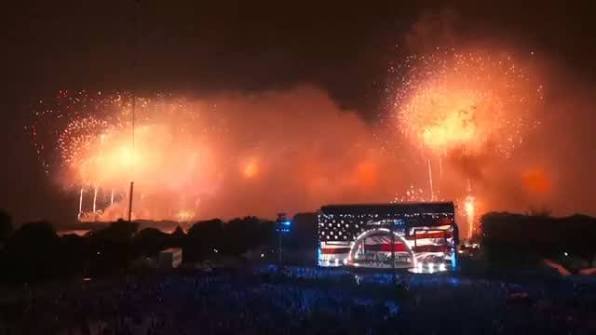
The “Freedom 250” activities in Washington DC have been controversial for a number of reasons, but after the fireworks display in the early hours of July 5th, the environmental and health impacts of this event became a concern. In the aftermath of the fireworks display on the National Mall, Washington D.C.’s Air Quality Index went up to an unhealth 288, leading to emergency announcements that:
“Outdoor air quality is unhealthy for seniors, kids, people with medical conditions. General public may experience health issues”
Conservationists and public health experts are now left to analyze the environmental fallout of the 40-minute firework display, which fired unprecedented levels of heavy metals, particulate matter, and chemical perchlorates into the air and waterways of the Potomac River watershed.
Here is a breakdown of the specific short- and long-term threats that this event poses to human health and the local ecosystem:
Air quality and heart lung impacts
Over 850,000 detonations of firework injected fine particulate matter (PM2.5) into the air reaching levels of 600 and 1,200 micrograms per cubic meter. This vastly exceeds safe breathing standards. These microscopic particles measure less than 2.5 micrometers across, roughly 30 times smaller than a human hair. They bypass standard biological filters, traveling deep into human lungs and entering the bloodstream directly.
At the same time, the severe local heatwave created an “atmospheric lid” over Washington DC. This effectively effectively trapped the toxic smoke, prolonging human exposure and causing health officials to advise wearing N95 masks for safety.
This poor air quality immediately led to acute asthma attacks and respiratory distress in many, in many, but there is also likely to be a spike in cardiovascular emergencies for a week to 10 days after the fireworks event.
Heavy metal rain
The color in fireworks are the direct result of burning toxic heavy metal salts. The majority of the firework were red (the cheapest color of firework) which relies on strontium and lithium for the color (green fireworks burn barium and blue burn copper).
Unlike organic smoke particles that eventually dissipate, these heavy metal contaminants do not break down. They can remain suspended in the air for 14 hours or longer before settling into the surrounding soil and water.
Once deposited on the earth, these metals leach into the soil. Local flora absorbs them, introducing toxic compounds into the bottom of the urban food chain where they bioaccumulate in urban wildlife such as songbirds, squirrels, and insects.
Perchlorate contamination in the Potomac
A significant portion of the fireworks display was launched from eight barges anchored directly inside the Potomac River. This means the Potomac aquatic ecosystem is directly in the firework fallout zone. Fireworks require a high-energy oxidizer to detonate. This is typically the toxic chemical perchlorate. Perchlorates directly mimic iodine, blinding the thyroid glands of animals. In juvenile fish and local amphibians, this chemical disruption halts standard developmental processes, leading to stunted growth, reproductive failures, and localized mortality.
Contaminants dropped near Theodore Roosevelt Island will become trapped due to a phenomenon called “tidal slosh,” where the river water flows back and forth rather than flushing rapidly downstream. Ongoing local drought conditions have further extended the time these chemicals will sit in high concentrations.
Acoustic trauma
As anyone with a pet in Washington DC can attest, unmitigated acoustic impact of 850,000 detonations over a 40-minute window results in extreme distress in animals (and also veterans suffering from PTSD). The timing of the Freedom 250 fireworks display directly coincided with the peak breeding season for regional ospreys. The Chesapeake Bay watershed hosts roughly 20 percent of the global osprey population. The thunderous explosions likely panicked nesting adults, causing them to flee their roosts. This leaves vulnerable chicks entirely unprotected from opportunistic predators or severe exposure.
Studies using telemetry data have shown that large-scale firework displays trigger panic flight responses in birds. Frightened birds take flight in total darkness, flying miles outside their home ranges. This blind flight frequently ends in fatal collisions with buildings, trees, and monuments.
Beyond the chemical smoke, the fireworks themselves have scattered debris and microplastics across regional wetlands. These plastic fragments slowly break apart over hundreds of years, presenting a permanent ingestion hazard for waterbirds and fish that mistake the debris for food.
In addition, exacerbated by the heatwave, there is also the risk of fireworks causing wildfires. In our DC suburb, the firetrucks were out in force dealing with the fiery aftermath of 4th July events. The impact of a wildfire occurring in a major city, could be catastrophic.
Do we need fireworks in this day and age?
Several major cities have done away with firework displays replacing them with drones (for example, Boston). For pets and PTSD sufferers, the near-silent operation of drones eliminates the sudden, booming noises that cause severe anxiety, panic attacks, and traumatic flashbacks. Environmentally, drones are entirely reusable, produce zero chemical runoff into local water supplies, and eliminate the risk of sparks igniting devastating wildfires.
Personally, after the first 5 minutes of bangs and flashes in a firework display, I get bored. There’s only so many ways you can make a firework go bang. Isn’t it time to shift away from a celebratory activity that actually causes negative impacts to so many citizens as well as wildlife and the environment, in exchange for something where the artistic effects are only limited by our imaginations?