 “It’s a mom and pop operation, you could say”, described Ted Davis, owner of White Rock Fish Farm in Vanceboro NC. His smile extended ear to ear as he talked about his farm – and the length he goes to ensure his fish are never stressed on their way to the market. The trick? The farm’s small size – 8 ponds – allow the fish to be harvested by hand, each one receiving individual attention on their way to a shipping container. Another thing that makes his farm special? The hybrid striped bass have personality. They’re scared of tractors, eat more when there’s algae in their pond, and elicit hugs from visiting children.
Mr. Davis takes a whole day, with a helper, in harvesting his hybrid striped bass before they begin their frozen journey to Canada. Other growers, including his neighbors down the road, will spend just hours handling even more fish. Hybrid striped bass, however, bleed when they’re stressed. This turns their flesh and fins red, muddling the prized stripes for the marketplace. Plus, stressed fish release stress hormones and other chemicals that consumers can taste. So the White Rock way is to remove as much stress from the fish’s life as possible.
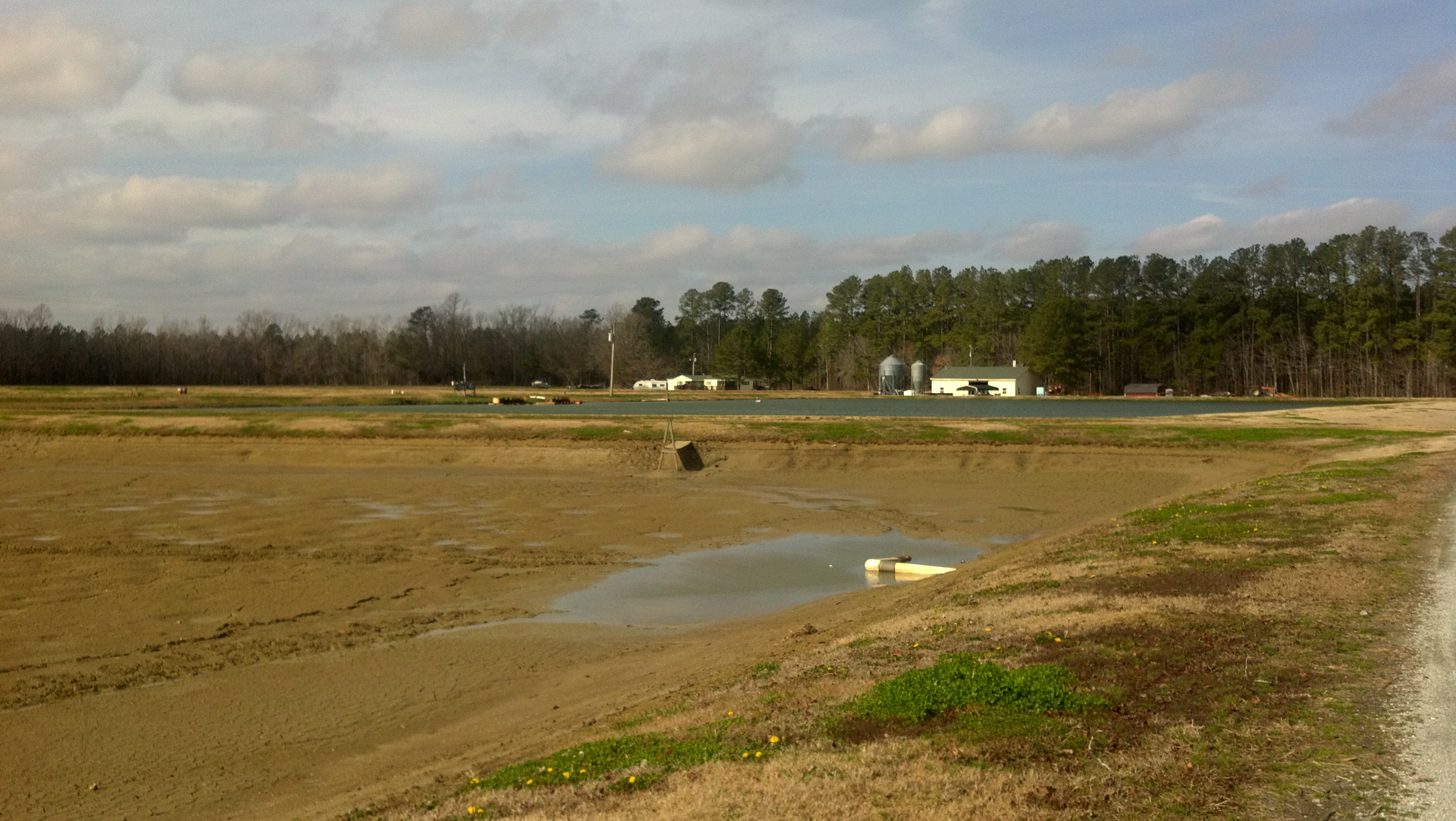
Every Monday is harvest day, which by stretching a net by hand across the length of the pond to be harvested. Ted and his employee then pull the net ever tighter, guiding the bass into a contraption that funnels the fish from the deepest part of the pond to a basket, which is then carried by hand to the packing house.
“We used to harvest by tractor, like everyone else, but it scared the fish”, remembers Ted. Hybrid striped bass can feel the vibrations – especially in cold weather – and thousands of them would jump, swimming as fast as they could away from the vibrating, frightening machinery. Other farms mostly still harvest this way, because it’s faster – you can mechanically move 300-400 pounds of fish in one go. The tradeoff is that the hormones start flowing right then, and many of them are injured against the sides of the net. Instead, Ted’s bass are carried by hand, basket by basket, to a large blue container common in the fishing industry. The containers hold up to 1200 lbs of fish – which is another difference about White Rock. Other growers pack them in 1600 lbs at a time, crushing a few in the process.
The container is filled with an ice slurry, which in most cases, is enough of a temperature differential to knock the bass out before it knows what’s going on. A quick shock of electricity, and the fish has painlessly – and stresslessly – met its end. The hybrid striped bass are then weighed and graded, packed into 50 pound boxes, and sent on their journey northward. Mr. Davis wishes the industry made boxes for smaller orders – 10 lb, or 25 lbs, for instance. That way he could sell directly to local restaurants. For now, the farm hosts Joey, a local sushi chef: he comes out the farm and fishes the bass out himself that will wind up on the menu later that evening in Greenville. It’d be great if all chefs could afford the time to collect their ingredients like that, but it’s not realistic. Until then, most of the bass grown at White Rock and 4 other local farms that form a cooperative will be sent to maritime Canada, where the fish markets are friendly and demand is high.
Mr. Davis has a couple of other tricks of the trade. In the summer, when the volatile blue-green algae blooms in the ponds, he temporarily moves the bass to clean holding ponds for 3-6 days. This time allows the blue-green algae’s smelly chemicals to off-gas and gets rid of the gross taste known in the industry as “off-flavor”. Apparently, every tasting panel is able to pick out even trace elements of this flavor.
The bass are also packed stomach-down to prevent the stomach acids from dousing the filet meat. Since Mr. Davis started the practice, fish house owners have started requesting other growers pack the same way. It’s becoming industry standard to pack stomach-down, in lasagna-layers of fish and ice to make sure every fish is surrounded by ice. Some of the White Rock practices are harder to adopt because of the increased time requirements, but this was an easy one to spread through the fish farming community.
Ted Davis is also committed to sharing his way of life and philosophy of fish with others – from other aquaculturists to local school groups. A rewarding moment of this effort? During a trip of special needs children from a local day-care, one little boy caught one of the bass and gave it a big hug, just like he might a teddy bear. He got to bring it home for dinner, too. The more Ted shares, he feels, the more he supports aquaculture development in eastern North Carolina – good both for the local economy and as a means to provide protein for a growing global seafood demand.
“We have a great water resource here, in the Castle Hayne”, Davis sent me off with a parting though on our shared aquifer, with its healthy abundance of minerals.
White Rock Fish Farm showed me that happy fish make tasty fish. Words to live by.
Is there anything he does to help ensure the sustainability of fish farming? I’m curious to know what he feeds them.
Also, did you sample the merchandise? How was it?