 Joey Maier is a biology professor at Polk State College where he uses every possible opportunity to encourage his students to spend time in the water, play with technology, and do #CitizenScience. As an undergraduate, he did a stint as an intern for Mark Xitco and John Gory during their dolphin language experiments. He then spent the years of his M.Sc. at the University of Oklahoma thawing out and playing with bits of decaying dolphin. After discovering that computers lack that rotten-blubber smell, Joey became a UNIX sysadmin and later a CISSP security analyst.
While his pirate game is weak, he is often seen with a miniature macaw on his shoulder. His spare time is spent SCUBA diving and trying to hang out with people who have submersibles. You can follow him on Twitter or Facebook.

There’s a Klingon bird of prey hanging from the ceiling in my office.
I may teach biology, but at heart I’m a sci-fi nerd. Naturally, I’m interested in futurism, robots, lasers and all manner of techy paraphernalia. I’d been watching the OpenROV project for a while, but hadn’t gotten one yet. They were obviously awesome little machines that gave me a serious case of gadget envy, and I knew that some of our students would love to pilot an ROV. I needed a much better reason than that, however, to justify getting one. There’s no line item in our budget for, “Wow, that’s cool!” and I was fairly certain that the college administration would tend to favor lower cost and more familiar forms of student engagement
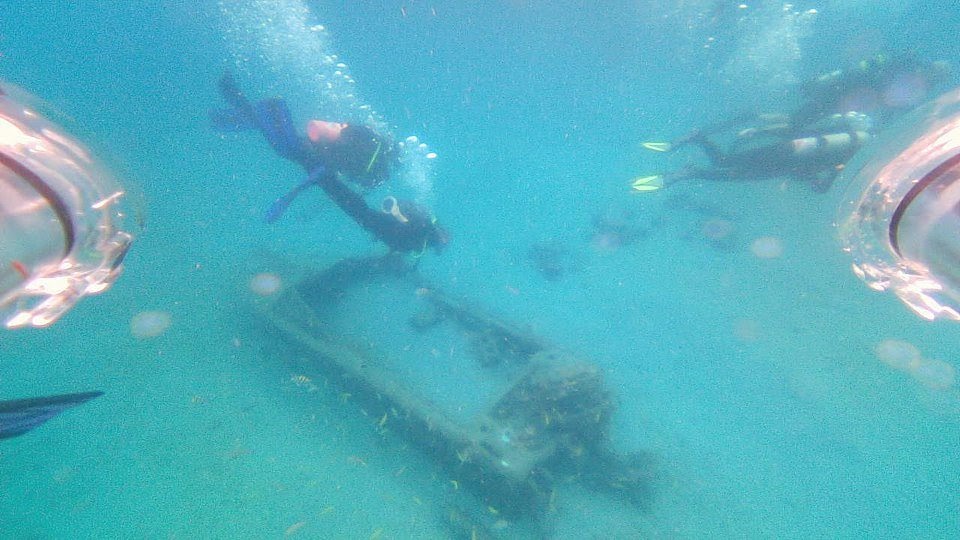
This tweet changed everything. When I found out that Andrew had designed a mini-Niskin bottle, the wheels in my head started turning. Assembling an OpenROV would, naturally, be a very STEM-oriented project. The times our students piloted the ROV could become water sampling field trips, and the kids could analyze their samples back at school as a laboratory activity. If students recorded the process, they could make a short film. I mulled over the possibilities and bounced ideas off of my dive buddies during the hours we spent traveling to and from the coast.
During these discussions, it quickly became apparent that my idea of a student ROV/Niskin build could be fleshed out into a broader – and hence, more interesting – interdisciplinary STEM program. The ROV and Niskin bottle would be assembled by a group of students involved in robotics. Depending on what you were testing for, collection and analysis of water samples would be relevant to classes like biology, microbiology, oceanography, or ecology. In August of last year I began talking with my co-workers, folks I know who work in the diving industry, people whose jobs are related to water pollution or underwater research. There was a lot of enthusiasm and support for what I had dubbed the #OceanSTEM project.
The owner of my local dive shop volunteered to let us use his pool for testing the ROV. Several co-workers agreed to prepare relevant lectures so we could set up a small seminar series. In addition to preparing a lecture, our oceanography prof loaned us equipment. One of the crew on the R/V Baseline Explorer recommended talking to Triton submarines, who then said we could bring a group of students to tour their facility. Maia McGuire of UF/IFAS agreed to talk with our students about microplastics, #CitizenScience and her Florida Microplastics Awareness Program. The project was starting to have legs.
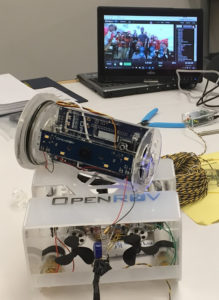
There’s a charter high school on one corner of our college campus. They had prior experience with Lego robotics, and their STEM instructor was happy to graduate from that to an OpenROV build. The high school had also had just purchased a 3-D printer, which is ideal because the niskin bottle design contains several 3-D printed parts. Clearly, the high school’s STEM class was going to become a key part of our project. They also had a group of digital media students who liked my idea of using this as the subject of an entry for film festivals.
I’m happy to announce that my colleagues and I were fortunate enough take all of these ideas and make them actually happen. We had a small lecture series covering:
- An intro to microbiology, water analysis and fecal coliforms, with a demonstration of how to use the Remel Dipslide tests.
- An introduction to hyperbaric medicine, with discussions of decompression, nitrox, trimix, nitrogen narcosis, decompression sickness, decompression illness, HPNS, and the medical use of hyperbaric chambers in both diving and non-diving applications.
- Water sampling methodology, basic water chemistry parameters, types of pollution, and biological oxygen demand.
- What microplastics are and methods of detecting them, with a demonstration of the technique that our students would later use.
Our college’s advanced manufacturing campus prepared a tour, with specific emphasis on their 3-D printing lab. We had trips to pool test the ROV, collect water samples at Blue Heron Bridge, and a tour of the Triton facilities where a submersible was being assembled. The high school’s digital media students created a short film about the project to show at the #WeRobot conference.
The #OceanSTEM project had participation from students in the high school STEM program, high school media program, the Healthcare Occupational Students Association, and college classes in biology, oceanography, anatomy & physiology, and physics. The semester is drawing to a close, but the wheels set in motion during this project continue to move. The OpenROV has already been used by the high school’s STEM program as a recruitment tool. There’s even talk of possibly having two teams of their students build OpenROVs in a competition format during the next school year. Some of the digital media students have continued working on a longer version of their “making of” film for a festival that’s held in St. Pete this November. New lab exercises for future semesters will have our college biology and oceanography classes continue to sample water and test it for fecal contamination and microplastics.
If I had white hair, rode around in a black GMC van and chewed on cigars, right about now I would be saying “I love it when a plan comes together.”
Great piece! We are doing many of these same exact things. OpenROV is a great entry-level tool to engage students and conduct research. Their Trident (coming out in a few months) will be even more so. Thanks for this nice summary.