My colleague Dr. Julia Wester and I have a new paper out in the journal Integrative and Comparative Biology reporting on the results of a survey distributed to over 800 scientists, science educators, and science communicators. I presented these results at the 2025 Joint Meeting of Ichthyologists and Herpetologists. Our study confirms a trend that’s been reported on by science and education journalists for a year or more: while Twitter was once the gold standard for online science communicators, it’s no longer fit for purpose and is being abandoned by scientists in droves. And it confirms that of the Twitter alternatives, scientists see Bluesky as the most popular, useful, and pleasant.
Golden Age Science Twitter was amazing, and played a major role in social media becoming a vital tool for scientists and conservationists. As I wrote in my American Scientist eulogy for Science Twitter, “At its best, Twitter has been the world’s most interesting cocktail party. It allowed anyone to get into any corner they liked and have fascinating conversations with the world’s leading experts on just about any topic they could imagine, including topics we never even thought about before we saw people discussing them. Because of Twitter, I learned something and thought about something new and (at least a little bit) interesting almost every single day since I signed up in 2009.”
For more than a decade, I was a Twitter power-user and evangelist- I trained over 2,000 early career scientists in public science engagement using online tools, and in each of those workshops and talks I stressed the power and utility of Twitter. Several of my most-influential and highest-cited scientific papers are guides for how to use Twitter for science communication or conservation advocacy, case studies of groups doing that successfully, or pleas for my field to embrace this powerful new technology. Several members of the JMIH community have published papers focusing on how social media in general, and Twitter specifically, helped them with environmental advocacy resulting in policy change, professional networking, public science engagement, fundraising, professional development, and even research.
But everything changed when Elon Musk took over Twitter and changed both the algorithm and the moderation policy. New Twitter- which I absolutely refuse to call “X,” because that is silly- encourages pseudoscience, conspiracy theory, an extremist political fringe, and harassment of experts (especially experts who are not white Christian men). Prior to us distributing this survey, many of my colleagues using Twitter reported a clear pattern that was confirmed by analytics data: they saw declines in monthly engagement of 90% or more even as their follower count remained the same. (Mine decreased by 99% eventually). I will note that a few colleagues have reported that their engagement has remained the same or even increased slightly, but at least some of these colleagues do not use a data-based analytics strategy-it’s clear that even if these declines aren’t universal, they are widespread and common.
A critical point that we need to stress here for people who use Twitter but aren’t especially familiar with the mechanics is that the algorithm which Elon Musk changed is unbelievably powerful. It affects what users see and do not see both from people they do not follow and from people they do follow. In other words, it doesn’t matter how well-written your posts are, or how important the topic is, or how long of a relationship you have with your followers: changes to the algorithm mean that most of them do not see your posts anymore, and there’s very little you can do to change that!
For scientists who use social media to encourage followers to visit external links (websites, papers, etc.,) here’s some data from this blog. For nearly a decade, Twitter was the #1 or #2 source of traffic to the blog almost every day. It hasn’t been in the top 10 sources of traffic to the blog in years, and a single SheetMusicPlus.com article from 2016 generates more traffic here than all of Twitter. So far this year, Bluesky is responsible for about 100x as much traffic as Twitter. AltMetric reports that despite Twitter having 10x the user base as BlueSky, BlueSky users share almost as many scholarly publications as Twitter users- and Twitter’s numbers are declining as Bluesky’s rise.
A quick note- if you’re not familiar with Bluesky, check out my paper from earlier this year in Fisheries, which includes a step-by-step guide to getting started and using Bluesky. Notably, the interface is very similar to Twitter (so if you know how to use Twitter there’s not much of a learning curve to using Bluesky,) but Bluesky has no central algorithm and it has stronger moderation policies.
A variety of reporting from science and higher education journalists, as well as our own experiences, suggested that academics and environmentalists were abandoning Twitter, and that of the many alternatives, many were choosing Bluesky. So we administered a survey to scientists, science educators, and science communicators who used to use Twitter and now use Bluesky (either in addition to or instead of Twitter).
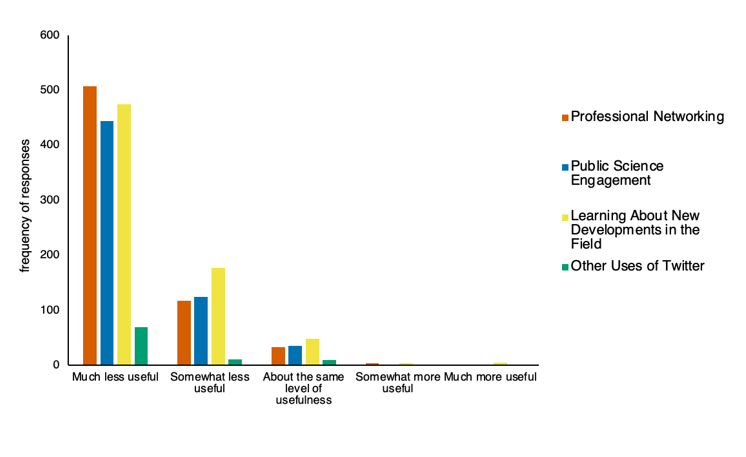
We received over 800 responses, and here are some critical findings.
For every professional purpose that our survey respondents said that they once used Twitter for, including professional networking, public science engagement, staying informed about new developments in their field, and all other uses, Twitter is described as much less useful than it was pre-Musk, with one respondent referring to Twitter as a “once cool, now abandoned shopping mall.“
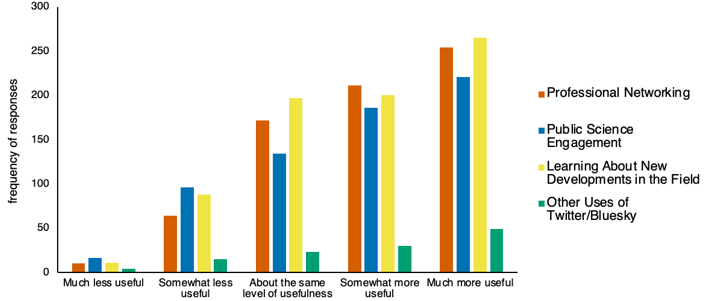
For every professional purpose that our survey respondents once used Twitter for, they overwhelmingly believe that Bluesky is better for achieving this goal than Twitter is. (Critically here, we are not comparing current Bluesky to Golden Age Science Twitter, an unfair comparison. We are comparing current BlueSky to current Twitter. Current Twitter was described by our respondents as “unpleasant,” “hostile,” ‘negative,” “anti-science,” “irrelevant,” and “filled with ads, spam, pornbots, and extremists.“)
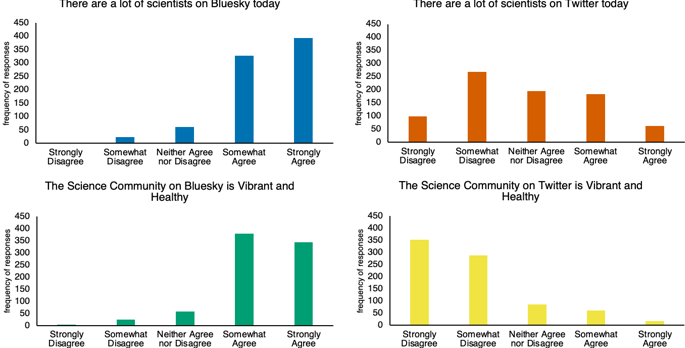
Our respondents also believe that there are no longer a lot of scientists on Twitter, and that there are a lot of scientists on Bluesky.
Hundreds of respondents expressed a strong personal animus towards Elon Musk, noting his role in the devastation of American scientific research, saying that they were pushed away from Twitter as much as pulled towards Bluesky. One respondent summed this feeling up nicely as “I don’t want to support Elon Musk because he sucks, and you shouldn’t either.“
While some people argue that scientists should remain on Twitter to try and reach, and hopefully persuade, the audience there, I ask you this: did you create a TruthSocial or 4Chan account to try and reach those people, or did you stay away because the audience is full of conspiracy-prone extremists who hate you? Twitter should absolutely be thought of in the same way now. And even if you want to stay, the algorithm is working against you.
And while some thinkpieces argue that Bluesky is bad because many of the users there are politically liberal, I don’t care about this, because I don’t use social media to argue with strangers about politics. I use social media to talk about fish. When I talk about fish on Bluesky, people ask me questions about fish. When I talk about fish on Twitter, people threaten to murder my family because we’re Jewish.
Social media has become a powerful tool in our toolbox, but the social media landscape has changed. It’s time to join your scientific colleagues in leaving Twitter and joining other platforms like Bluesky. Come on in, the water’s fine and the sky is blue.
Learn more:
Join Bluesky and follow some shark science and conservation experts through my Starter Pack

Agree Twitter/x dot com is much less fun than it used to be because of right wing trolls. If I need a break, I go to blusky which is haunted by left wing trolls.
Gotta love social media?
Thanks for investigating the changes in Twitter in more detail – it’s helpful to see some numbers on changes in engagement (such as from your own blog) and changes in perceptions.
Bluesky is working well for me personally, but I’d really like to encourage more researchers and students on to it – so having this kind of content (and your recent Fisheries paper) to share so they can consider it for themselves is very helpful.
npr left twitter in 2023, and saw that their site traffic dropped by less than 1%. If you’ve been on Twitter for any appreciable amount of time, your follower count is meaningless – only a few percent of accounts that follow you are still active, with the bulk being abandoned or deactivated accounts, people who don’t visit very often, bots and scammers, and so on.
I tested this in October 2024, looking at a small number of artists who posted on both Twitter and Bluesky (about 20 of them.) I looked at artists I knew were active, who had a range of follower counts on twitter, between 100 followers and 150,000 followers.
I measured “engagement” as any reply, like, or retweet, and then looked at engagement as a percentage of follower count, to see how active people’s audiences were, and how useful their social media account was for distributing their art to people. Historically with social media, the expected amount of “engagement” for any post is about 5% of your follower count, although that’s wildly variable depending on how tight-knit your audience is, how much you promote yourself, whether you provide some incentive to share your post, and of course, whether it blows up as a viral post.
Anyway, TLDR, Twitter’s engagement for the artists I checked averaged about 0.2-0.5% per post over the period of October 2024. Bluesky’s engagement for those same artists, over the same period, with the same posts was about 20% – so about 40-100 times better. Most of the artists I checked had about 50% of the follower total that they had on twitter, but… the difference is that most of their bluesky followers actually use the site.
I haven’t compiled any data since then, but for myself, Bluesky’s dropped to about 15% for my posts, but Twitter’s gone off a cliff, less than 1% of my followers are active there.