I am a huge fan of the Alien franchise…mostly. Alien and Aliens were ground-breaking movies and instant classics. Alien 3 had good parts (mostly the great British actors shining up a quickly knocked out script). Alien Resurrection was … not great. Alien: Romulus was pretty good, despite a dodgy CGI android and a practical effect monster that looked like it was dodgy CGI. But the recent Alien: Earth series was fantastic. However, Prometheus and Alien: Covenant were absolutely dreadful. The bad science in these films made them almost unwatchable.
Sadly, the next Alien movie (which was to be helmed by the showrunner of Alien: Romulus and to continue that story) has been taken over by Ridley Scott, and will follow on from his awful Prometheus (2012) and Alien: Covenant (2017).
The science in both these movies is widely considered to be comically bad, primarily because the characters routinely violate basic scientific protocols. Not only do the writers seem never to have read a high school science book, let alone have the slightest clue how genetics works, but the actual scientific and exploratory methodologies depicted in the movies are remarkably poor. Rather than acting like highly trained experts, the ‘world expert scientists’ in these films behave like reckless tourists, driving the plot forward through sheer professional incompetence.
Prometheus – bad science…everywhere
The opening sequence of Prometheus (where a lone Engineer drinks the black goo, violently dissolves into a waterfall, and watches his fracturing DNA strands magically reform to seed life) is visually impressive but biological nonsense.
From an evolutionary biology and biochemistry standpoint, this scene operates completely on “Hollywood Magic” rather than actual science. It fundamentally misunderstands genetics, the timeline of life, and how natural selection works.
- The reassembling DNA fallacy. The movie shows the Engineer’s DNA breaking apart into individual, shattered chemical links. Then, right before our eyes, those fractured, dead pieces miraculously snap back together and instantly begin cellular mitosis (cell division). In reality, deconstructing a giant, multicellular alien into a river would simply introduce dead organic waste to the water. It would not spontaneously trigger the formation of brand-new, functioning microorganisms.
Moreover, the cells are shown dividing instantly at a massive scale. Cell division requires a massive input of external energy and chemical building blocks. A dissolving corpse in a freezing river cannot violate the laws of thermodynamics to fuel instantaneous cellular growth out of nothing.
- Taking off helmets instantly. Upon entering an alien structure, the crew removes their helmets simply because the air is breathable. Real astrobiologists would never do this due to the extreme risk of unknown airborne pathogens, alien viruses, or microscopic spores.
- The “petting” incident. Millburn, the ‘biologist’, encounters an aggressive, hissing alien organism that looks like a space-cobra. Instead of maintaining a safe distance or using a containment tool, he tries to pet it like a stray puppy. Rule number one for a wildlife biologist is to never hug the dangerous wildlife.
- Nonexistent biosafety. The biological research depicted in these films completely throws out the concept of biosafety levels (BSL). Real-world labs studying Ebola or anthrax use BSL-4 protocols (positive-pressure hazmat suits, airlocks, chemical showers). The characters in these films handle extraterrestrial life with less care than a high school biology class.
- The lost cartographer. Fifield, the geologist, maps the entire cave system using high-tech, floating 3D lasers. Despite having the literal map of the structure broadcast directly to his suit, he promptly gets completely lost. Moreover, the bridge crew on the Prometheus (who can see the live 3D map and the exact GPS coordinates of every team member) completely fails to monitor their scientists, allowing the geologist and biologist to wander off and get trapped.
- A biologist who has never seen a snake. A basic rule of biology is recognizing threat displays. When Millburn encounters the “hammerpede” (the space-cobra), the creature is actively hissing, expanding its body, and raising itself into a striking posture. For a trained biologist to read a textbook predator threat display as “it’s friendly” is an insult to the profession.
- Contamination and archaeology. Upon finding a perfectly preserved, 2,000-year-old head of the first alien ever encountered by humans, paleobiologist Elizabeth Shaw doesn’t take localized tissue samples or run non-invasive MRI/CT scans. Instead, she hooks the specimen up to 20,000 volts just to see what happens. This causes the priceless archaeological artifact to violently explode.
- The absurdity of the “100% DNA match”. The film claims that human DNA is a 100% perfect match to the Engineers’ (the semitranslucent space giants) DNA. Biologically, a 100% DNA match means they are literally identical humans. Identical twins. Yet, the Engineers are 10-foot-tall, hairless, marble-skinned giants with entirely different physiological proportions and black eyes.
- There’s no evolution in Ridley Scott’s universe. After the Engineer’s DNA dissolved in that waterfall, go forward 4 billion years and humans are somehow an identical genetic match. This means human evolution did not actually happen. It implies that for 4 billion years, through mass extinctions, ice ages, and planetary shifts, that original strand of DNA lay perfectly unchanged in the mud until it spontaneously spits out Homo sapiens. Evolution is chaotic and completely blind. Even if you dumped perfect “human-precursor DNA” into a primordial ocean, natural selection and environmental mutations over billions of years would guarantee that the resulting creature would never look exactly like the original Engineer. That is not evolution; it’s creationism dressed up as sci-fi.
Alien: Covenant – The worsening
The blind landing. The crew of the Covenant diverts a massive colonization ship carrying thousands of human embryos to an entirely unstudied planet based on a single, garbled radio transmission. No satellite mapping is done, no automated rovers are dropped, and they land blindly in a mountainous valley during an electrical storm.
The safe atmosphere assumption. As in Prometheus, characters look at a digital readout, see that the air contains oxygen and nitrogen, and immediately conclude it is safe. In real astrobiology, a breathable atmosphere is actually the most dangerous thing you can find. It implies a functioning biome, which means the presence of microscopic life, bacteria, viruses, or fungal spores that the human immune system has zero evolutionary defenses against. Sure enough, they breathe the air completely unprotected, which directly leads to characters inhaling toxic, genetic-altering spores.
No basic quarantine. When a crew member is visibly infected and exploding with a back-burster, the remaining crew completely ignores standard bio-containment procedures, tracking blood and pathogens throughout the ship and letting the infection spread.
You cannae change the laws of physics! When Ledward steps on a fungal pod, microspores enter his ear canal, causing him to collapse and give birth to a “neomorph” alien within hours. From a biological standpoint, an organism cannot generate that much physical mass (bone, muscle, blood) out of thin air so rapidly without consuming an astronomical amount of energy or mass first. It violates the law of conservation of mass. This is a common thread throughout the recent Alien movies. Even Alien: Romulus is guilty of creatures rapidly growing, miraculously increasing in mass within minutes. This breaks fundamental rules of physics and biology.
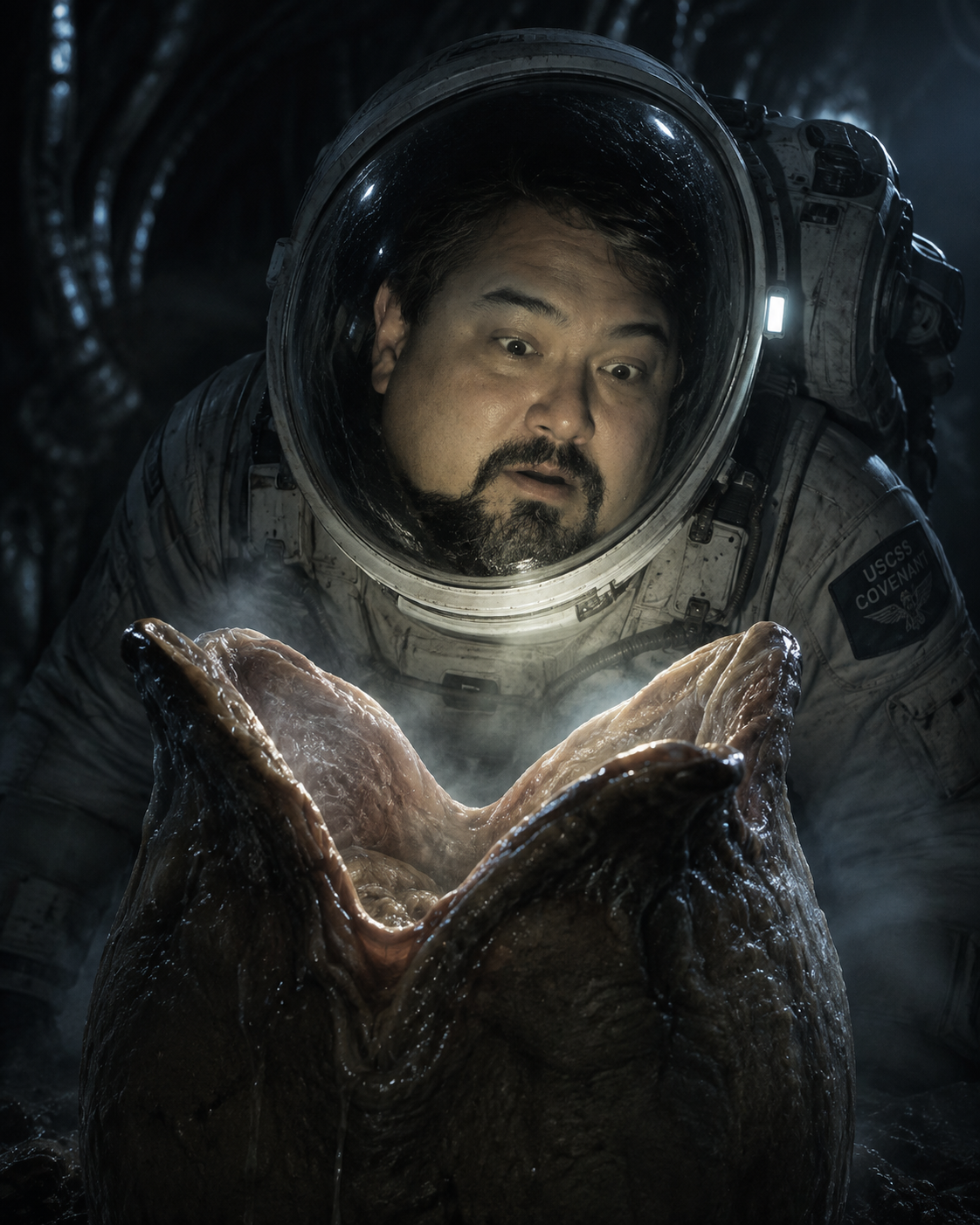
The “look into the egg” cliché. Oram, the captain of the ship, watches the synthetic android David interact with terrifying alien life forms and clearly realize David is untrustworthy. Yet, when David tells him to lean directly over a pulsing, open alien egg, Oram obliges, leading to an immediate facehugger attack.
The “black goo” problem. From a purely theoretical standpoint, both films rely heavily on the “black goo” (Chemical A0-3959X.91). Scientists and film critics alike note that this substance functions more like magic than actual science. It mutates things, creates life, acts as a biological weapon, melts DNA, and causes instantaneous pregnancy depending on what the script requires, violating any consistent laws of biology or chemistry.
How a real space science team would have acted
If a real scientific body, such as NASA, handled the Covenant landing, the protocol would look like this:
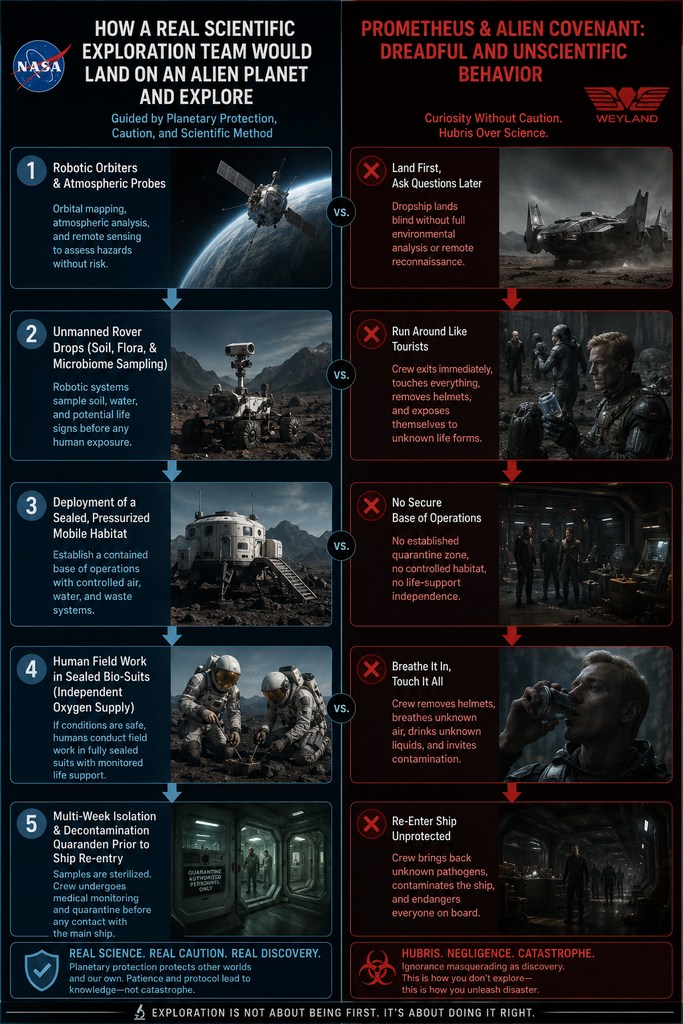
By completely ignoring every single step of this chain, the crews engineered their own extinctions long before the Xenomorphs ever showed up
Why Alien and Aliens are still classics
What makes Alien (1979; directed by Ridley Scott but written by sci-fi/horror writers Dan O’Bannon and Ronald Shusett) and James Cameron’s Aliens (1986) absolute masterpieces (especially when compared to the prequels) is their grounded, blue-collar realism and strict adherence to internal logic.
Instead of elite scientists behaving like reckless tourists, the original films feature everyday workers and military professionals who treat outer space with the extreme caution, fear, and respect it deserves. They do not make “stupid horror movie choices” to drive the plot; they make logical decisions that fail simply because the creature is an evolutionarily perfect nightmare.
In Prometheus, billionaire-funded scientists instantly break bio-containment rules. In Alien, the crew consists of space-truckers operating a commercial towing vessel.
- Strict safety protocol. When Kane is infected by a facehugger, Ripley refuses to let him back on the ship, citing a mandatory 24-hour quarantine. She explicitly obeys Weyland-Yutani’s biosafety regulations to protect the rest of the crew. The only reason the alien gets on board is because Ash (an android with a secret corporate agenda) violates protocol and overrides her doors.
- Relatable, human behavior. The Nostromo’s crew are regular workers complaining about their financial bonuses and contract shares. They do not touch weird things for “science.” When they explore the derelict ship, they do so slowly, cautiously, and with palpable dread.
When the characters realize they are being hunted, they don’t panic and run blindly down corridors. They use their actual professional skills to fight back.
- Practical solutions and improvisation (Alien). As maintenance workers and engineers, Parker and Brett ‘duct tape engineer’ functional flamethrowers and tracing devices from equipment on the ship. They systematically plan to herd the creature through the air ducts into an airlock.
- Tactical military logic (Aliens). The Colonial Marines are trained soldiers. When their heavy weaponry is compromised near the colony’s nuclear cooling tower, they immediately pivot. They fall back, weld doors shut, establish a hard perimeter, deploy automated sentry guns, and calculate exactly how long their ammunition will last under a siege.
The prequels rely on the chaotic, magical “black goo” to spontaneously create life out of thin air. The original films present a grounded, horrifyingly plausible parasitic life cycle heavily inspired by real-world terrestrial biology (like parasitoid wasps).
- Energy and consumption. The original Xenomorph doesn’t just appear fully grown. In Alien, it eats the ship’s food stores and structural materials off-screen to grow. In Aliens, the Xenomorphs require weeks to build a massive hive, cocooning human hosts to act as incubators for the eggs. It obeys the physical laws of nature and gestation.
- The “perfect organism”. Ash famously calls the Xenomorph a “perfect organism” because its traits make logical, predatory sense: it has structural biomechanical armor, a modular body, a secondary jaw for piercing prey, and concentrated acid for blood, thereby making it structurally impossible to shoot without breaching a ship’s hull.
One key scientific principle that was featured in Alien and Aliens, and few other movies of that era (e.g., Star Wars) was the lack of atmosphere in space and therefore no sound (it was literally in the movie’s tagline) “in space no one can hear you scream”.
Ultimately, Alien and Aliens are cinematic masterpieces because they are deeply rooted in physical reality and normal human behavior. The ships look greasy, rusty, and industrial. The characters react with authentic terror and practical problem-solving. By keeping the human’s behavior realistic, recognizable, and down-to-earth, the terrifying, otherworldly nature of the Xenomorph alien(s) is even more jarring.
With Ridley Scott running the next Alien movie, it will be interesting to see if he has learnt anything from his last two clangers. My two pieces of advice to him are to HIRE SCIENTIFIC ADVISORS early on and to ACTUALLY LISTEN TO THEM!