Conference schedules are gruelling. You wake up in a timezone and climate you aren’t used to, coffee in hand trudge into the first plenary session, and then spend the day bouncing between freezing conference rooms catching the talks in your area of expertise or to support your colleagues; All the while trying to set up meetings with grad students, potential funders, and drinking buddies from grad school. Conference presentations roll into poster sessions and happy hours and then chaotic group dinners with some of the smartest people you’ll ever meet. This goes on for two or three days or even two weeks; you are overwhelmed, exhausted, hung over, and dehydrated, and then it’s over and you’re back on the train or the airplane, returning to your regular life before you’ve even had a chance to absorb everything you’ve just experienced.
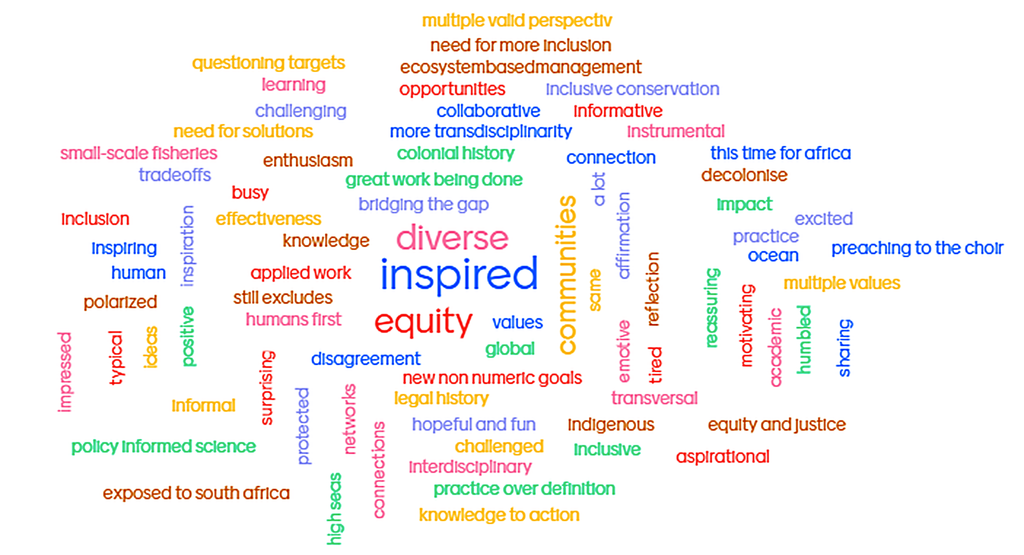
Knowing this, and wanting to create some shared take-home ideas, at the conclusion of the Seventh International Marine Conservation Congress (IMCC7) in 2024, we convened a session to create space for attendees to share and reflect their experiences from the conference, and to try to identify key lessons and priorities for the future of ocean conservation. This was an opportunity for roughly 60 attendees to reflect on these three questions (1) What were the most important takeaways? (2) What ideas can help expand and diversify the voices, knowledge, and tools informing ocean conservation? (3) and What is our collective vision for ocean conservation beyond 2031?
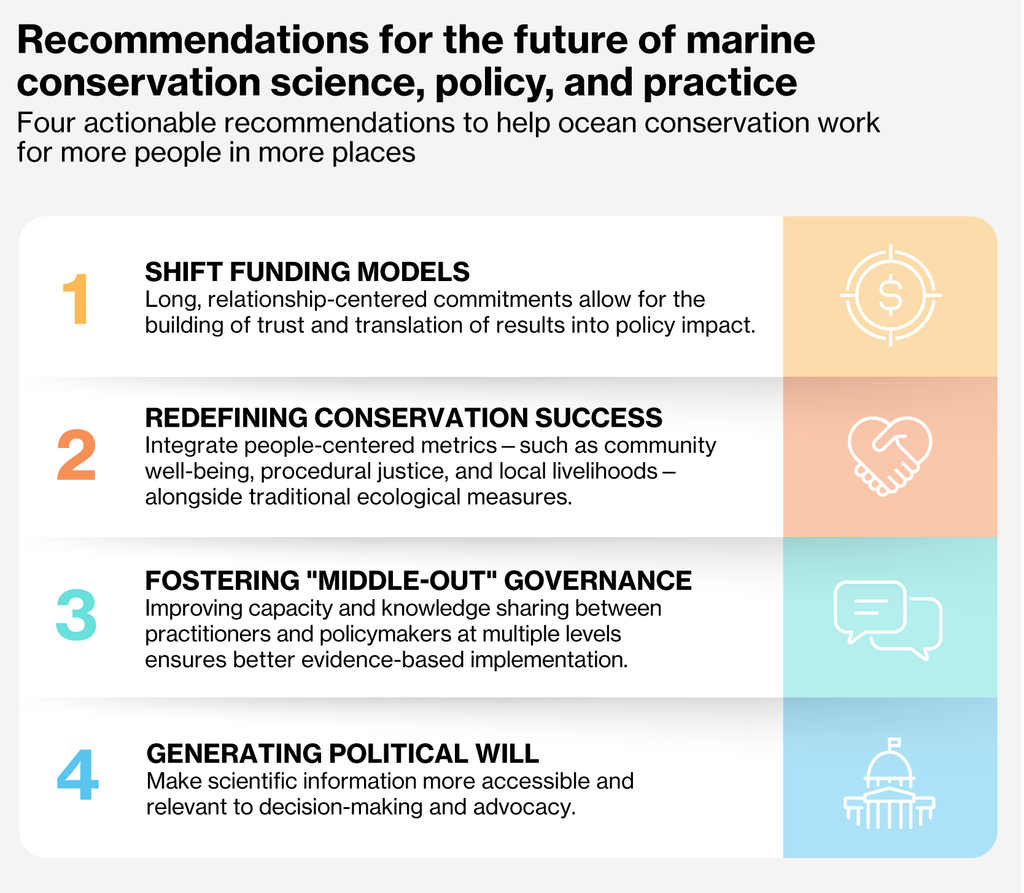
IMCC is one of the single largest gatherings of ocean conservationists in the world. The meeting’s transdisciplinary nature and participants’ geographic diversity offers a unique opportunity to discuss how to broaden participation and increase the relevance and equity of conservation science and practice. Participants in our reflection session emphasized the need to expand and strengthen transdisciplinary, people‑centered, and durable approaches that are equitable and practical. This blog synthesizes the session’s takeaways and proposes actions to help ocean conservation work for more people in more places. Participants articulated four broad themes for transforming the marine conservation field to better support equitable, evidence‑informed action (Fig. 2).
Shift Funding Models
A central theme raised during IMCC7 was the need to rethink how conservation, and the science that informs it, is financed. Participants urged a shift toward long‑term, relationship‑centered funding models that make space for trust‑building, co‑development, and sustained partnership with local communities and rightsholders, including co-designed science that is driven by locally defined questions. Short‑term, project‑based grants may deliver quick outputs, but they often undermine durable progress and fail to support the deep collaboration that effective conservation requires.
Philanthropic partners should move away from funding in purely short project cycles and towards 10-15 year funding commitments that reflect the time required to build trust, local leadership, and durable conservation outcomes. They should also provide core operational funding (not just project grants) to Indigenous organizations, local NGOs, and community based institutions. This could include supporting locally-led funding mechanisms, which can look like regional funding pools managed by local leaders, with supported and manageable application and reporting requirements.
Philanthropic partners should fund and institutionalize the full evidence-to-action cycle—co-design, data collection, analysis, synthesis, decision use, and iterative learning—rather than treating science as a standalone output. Co-design should be supported as a participatory process that brings scientific expertise into equitable, sustained collaboration with decision-makers and affected communities to define questions, methods, and usable science results and outputs.
Redefine Conservation Success
A second theme focused on redefining what counts as “successful” conservation. Participants highlighted the importance of incorporating people‑centered metrics alongside ecological measures and embedding these indicators in monitoring, evaluation, and learning systems that inform management decisions.
Governments should redefine conservation success beyond area-based targets, especially as the global post-2030 conservation framework begins to take shape. They should require that evaluations of marine protected areas or other conservation actions include ecological and social outcomes—including social and economic well-being, food security, participation quality, and equity and justice metrics. Participants emphasized the need for indicators that capture community well‑being, social and economic resilience, procedural justice, and the lived experience of those most directly connected to marine ecosystems. Broadening evaluation frameworks in this way helps ensure that conservation outcomes are both equitable and durable. Finally, governments should encourage reporting frameworks that make “people outcomes” as essential as biodiversity outcomes.
Middle-Out Governance
Third, participants underscored the need for stronger connections between conservation practitioners and policymakers. Bridging this gap was described as essential for closing the long‑standing divide between knowing what needs to be done and doing it. Many supported “middle‑out” governance approaches that link local, regional, and national processes, enabling information to flow upward and downward through decision‑making systems in ways that better support evidence-based implementation.
Conservation NGOs should adopt and publicly commit to anti-parachute science standards. This includes establishing internal guidelines that require local co-leadership on all in-country projects, ethical data sharing, fair crediting and authorship, and support for local capacity and governance.
Philanthropic partners and international NGOs should build peer learning networks where communities and local NGOs can share knowledge and experiences directly, rather than relying on external intermediaries. Where local NGOs are unable to lead an effort, international NGOs should create pathways for community members to transition to paid staff or co-investigators, not just volunteers or stipend recipients.
Better Understand Political Will
Finally, participants emphasized the value of innovating research methods and approaches that generate political will and accelerate knowledge uptake. This includes improving stakeholder and rightsholder mapping to better understand who is impacted by and advocates on certain issues, as well as making scientific information more accessible and relevant for those individuals and decisionmakers. These tools are key for building broad‑based support and ensuring that conservation policies move from paper to practice.
Conclusion
We are really excited that the idea of creating a reflection space has been integrated into the upcoming IMCC8, taking place in Edinburgh, Scotland from November 13-17. Over the course of the Congress, organizers will ask for participants’ feedback and reflections on session outcomes. There will also be lunchtime dialogues to discuss these ideas and a closing plenary session to reflect on the conference’s collective learning.
The IMCC community has been calling for more equity for over a decade; embedding equity in practice remains the work ahead. IMCC7 showcased real‑world examples of participatory science, science‑informed policy, and people‑centered conservation that can help mainstream these approaches. Yet legacies of injustice, ongoing discrimination, and accelerating climate and biodiversity crises demand urgency. Progress at scale will require sustained partnerships, inclusive decision‑making, and funding models that value relationships. Big change can start in small communities—beginning with the IMCC community and rippling outward through our collective networks.
Acknowledgements
This blog was drafted for peer review by Alia S. Hidayat, Jason P. Landrum, Angelo O. Villagomez, Kerry J. Sink, Diva Amon, Asha de Vos, Loyiso AV. Dunga, Stefano Mariani, and Steven Mana‘oakamai Johnson. We submitted it for peer review, but ultimately decided it would better serve its purpose as a blog. Thank you to the journal editors and reviewers who took the time to read earlier drafts of this paper. Alia, Angelo, and Jason organized and ran the workshop and compiled notes with support from Steven and Stefano. Alia and Angelo wrote the first draft. Asha, Jason, Kerry, Diva, and Loyiso contributed text. All authors edited the text. The authors would like to thank the organizers of IMCC7 and all participants in this reflective session.