
Skip to content

Southern Fried Science

Over 15 years of ocean science and conservation online

  • Home
  • About SFS
  • Authors
  • Support SFS

Alberta, Canada is the proud owner of the largest man-made pyramid on the planet

Posted on October 16, 2012October 16, 2012 By Andrew Thaler
Science

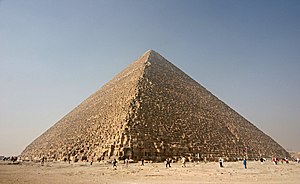
Great Pyramid of Giza. Photo by Nina Aldin Thune.

Pharaoh Khufu must be rolling in his monumental grave. Since its construction in 2560 BC, the Great Pyramid of Giza stood as the largest man-made pyramid ever built*. For 3800 years, it held the title of the tallest man-made structure of any kind. It wasn’t until the Industrial Revolution that our buildings began dwarfing this wonder of the ancient world. Even still, the Great Pyramid is massive, with a volume of 2,580,000 cubic meters. But there is another pyramid, more massive than Giza, and it wasn’t built to entomb a mighty king. It’s not a monument of any kind. The largest (by volume) pyramid in the world resides in Alberta, Canada and it’s made entirely of sulfur.

Wait, what?

Alberta is home to two major oil companies, Syncrude and Suncor, who rule the Alberta oil sands from Fort McMurray. Oil sands are petroleum deposits rich in bitumin, a tar like substance, that can be processed into bituminous oil. Alberta is the world’s leading producer of bituminous oil. Among the byproducts of bitumin mining is sulfur. Unfortunately, sulfur is produced in such massive quantities that the refining process has completely tanked the market for it. With nowhere for the sulfur to go, at least one company, Syncrude, has developed a truly novel solution–build pyramids.

Technically, they’re ziggurats, for now. These structure are built from blocks of liquid elemental sulfur that are poured and solidified. The image below shows three of the great pyramids of Alberta–and yes the Google satellite images are washed out around the tar sands facilities (see for yourself).
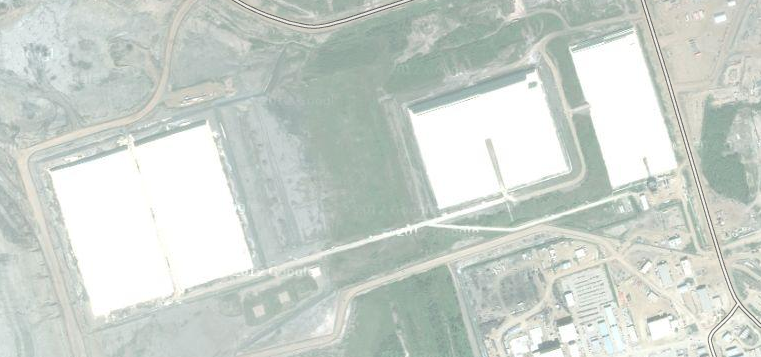
Three sulfur pyramids in Alberta. Image from Google Maps

So how do they stack up against other legendary pyramids? According to the recently published Visit Sunny Chernobyl, an excellent book about pollution tourism, the largest of these pyramids has a quarter-mile long base and stands almost 60 feet tall. Here, for scale, is the largest sulfur pyramid compared against Khufu’s tomb:
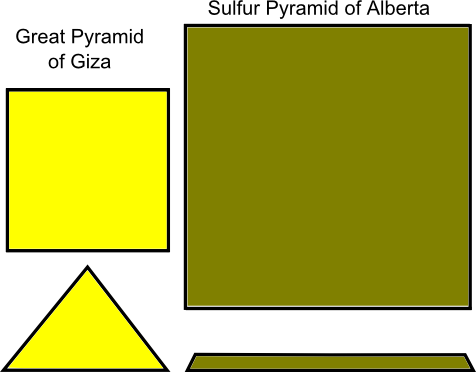
The Great Pyramid of Giza and the Alberta Sulfur Pyramid, to scale

So the sulfur pyramid is shorter, with a much bigger base. How does its volume compare to that of the Great Pyramid? The Great Pyramid is 2,580,000 cubic meters. The Sulfur Pyramid of Alberta? 2,840,000** cubic meters and still growing! One expert suggests that at the current rate, the total area needed for sulfur storage in Alberta in the next hundred years will be 150 square kilometers of 50 foot stacks. That’s 405,000,000,000*** cubic meters, which means, if built as a single structure, the sulfur stacks are on track to become the most massive man-made structure, ever.

The Sulfur Pyramids of Alberta are quite possibly the greatest wonder of the industrial world.


*A reasonable argument could be made for The Great Pyramid of Cholula as largest. Cholula is a massive complex of successive structure, built by several groups over 600 years. When accounting for the base of the main pyramid structure, rather than the entire complex, Cholula tops out at a very respectable 1,800,000 cubic meters. The total volume of the complex is approximately 4,450,000 cubic meters, making Cholula the largest monument in the world.

**Based on photographs of these mounds (see here, here, and here), the sides range from shear to slightly sloped, so I am using an estimated angle of 15 degrees for the side. If anyone has more accurate measurements (perhaps a Syncrude rep would like to chime in), I would greatly appreciate that information.

***Assuming the walls are all shear.

Share this:

  • Click to share on Bluesky (Opens in new window) Bluesky
  • Click to share on Facebook (Opens in new window) Facebook
  • Click to share on Reddit (Opens in new window) Reddit
  • Click to share on Threads (Opens in new window) Threads
  • Click to share on WhatsApp (Opens in new window) WhatsApp
  • Click to share on Mastodon (Opens in new window) Mastodon

Related

Tags: Alberta Giza industry mining oil pyramids Sulfur tar sands

Post navigation

❮ Previous Post: Help students in need with the DonorsChoose Science Bloggers Challenge!
Next Post: Anonymity, Pseudonymity, and a Reasonable Expectation of Privacy ❯

You may also like

Weekly Salvage
2 minutes to midnight, 3D printed turtle eggs, awkward fiddlers, Egyptian welders, and more! Monday Morning Salvage: January 29, 2018.
January 29, 2018
Weekly Salvage
Crab industry in crisis, world’s largest deep-sea mining vessel takes to sea, Bayou Women, ocean trash, and more! Monday Morning Salvage: May 7, 2018
May 7, 2018
Conservation
One-fifth of all known hydrothermal vents are threatened by deep-sea mining
November 6, 2013
Science
A selection of primary literature on the ecology of deep-sea hydrothermal vents in Manus Basin
August 7, 2012

Popular Posts

What Ocean Ramsey does is not shark science or conservation: some brief thoughts on "the Shark Whisperer" documentaryWhat Ocean Ramsey does is not shark science or conservation: some brief thoughts on "the Shark Whisperer" documentaryJuly 2, 2025David Shiffman
I can serve on your graduate thesis committee. Here’s what you can expect of me, and what I expect in return.I can serve on your graduate thesis committee. Here’s what you can expect of me, and what I expect in return.October 16, 2025David Shiffman
The story of the pride flag made from NASA imagery: Bluesky's most-liked imageThe story of the pride flag made from NASA imagery: Bluesky's most-liked imageSeptember 27, 2024David Shiffman
What can the funniest shark memes on the internetz teach us about ocean science and conservation?What can the funniest shark memes on the internetz teach us about ocean science and conservation?November 8, 2013David Shiffman
Shark of Darkness: Wrath of Submarine is a fake documentaryShark of Darkness: Wrath of Submarine is a fake documentaryAugust 10, 2014Michelle Jewell
The Trouble with Teacup PigsThe Trouble with Teacup PigsOctober 14, 2012Andrew Thaler
I turned my woodshop into a personal solar farm.I turned my woodshop into a personal solar farm.June 21, 2021Andrew Thaler
"Twitter sucks now and all the cool kids are moving to Bluesky:" Our new survey shows that scientists no longer find Twitter professionally useful or pleasant"Twitter sucks now and all the cool kids are moving to Bluesky:" Our new survey shows that scientists no longer find Twitter professionally useful or pleasantAugust 19, 2025David Shiffman
Nodules, Lost Mines, and Dark Oxygen: A new documentary on deep-sea mining asks important questions about the future of the industry.Nodules, Lost Mines, and Dark Oxygen: A new documentary on deep-sea mining asks important questions about the future of the industry.July 24, 2025Andrew Thaler
Blackfish: the Science Behind the MovieBlackfish: the Science Behind the MovieSeptember 18, 2013Chris Parsons
Subscribe to our RSS Feed for updates whenever new articles are published.

We recommend Feedly for RSS management. It's like Google Reader, except it still exists.

Southern Fried Science

  • Home
  • About SFS
  • Authors
  • Support SFS


If you enjoy Southern Fried Science, consider contributing to our Patreon campaign.

Copyright © 2025 Southern Fried Science.

Theme: Oceanly Premium by ScriptsTown