Skip to content

Southern Fried Science

Over 15 years of ocean science and conservation online

  • Home
  • About SFS
  • Authors
  • Support SFS

Author: Andrew Thaler

Marine science and conservation. Deep-sea ecology. Population genetics. Underwater robots. Open-source instrumentation. The deep sea is Earth's last great wilderness.

What does a day of discarded plastic from a molecular lab look like?

Posted on November 14, 2012 By Andrew Thaler
Science

To complement my post earlier today on the need for best practice guidelines to minimize plastic waste in a conservation genetics lab, I asked my labmates to save all of their consumables from a day of molecular benchwork. The above picture (Sharpie for scale) is the result. All told, we produced about 1/2 kilogram of plastic … Read More “What does a day of discarded plastic from a molecular lab look like?” »

Establishing Best Practices to Minimize Waste in a Conservation Genetics Lab

Posted on November 14, 2012 By Andrew Thaler
Conservation, Science

I am, among other things, a conservation geneticist. What that means is that I use the tools of molecular ecology and population genetics to make observations about species and populations in at-risk ecosystems, assess the status of anthropogenically disturbed populations, and generate data that has direct applications to conservation and management issues. Essentially, the only difference between what I do and what a population geneticist or molecular ecologist does is the motivation—I select systems to work in that have a high conservation priority.

This motivation leads to a constant intellectual conflict at the bench. The tools of molecular ecology—PCR, gene sequencing, and, more frequently, high-throughput sequencing—are waste intensive. In order to avoid cross-contamination and practice precise, clean, technique, we use thousands of tiny plastic consumables every day. These come in the form of pipette tips, sterile packaging material, micro-centrifuge tubes, and numerous other plastic widgets. Often, because of the biohazard potential, these consumable cannot be recycled.

So we have a problem. As a conservation geneticist, we need these tools to produce the data necessary to make wise conservation and management decisions. As a sustainability minded individual, I find the massive daily accumulation of plastic waste inexcusable. Do we just accept this waste as the cost of conservation genetics? I believe that the answer is no. I think we can and should develop best practices to minimize the amount of plastic waste produced by a molecular lab while maintaining good, sterile technique. I would like to propose four guidelines, based off the principles of Reduce, Reuse, and Recycle, for minimizing waste in a conservation genetics lab.

Read More “Establishing Best Practices to Minimize Waste in a Conservation Genetics Lab” »

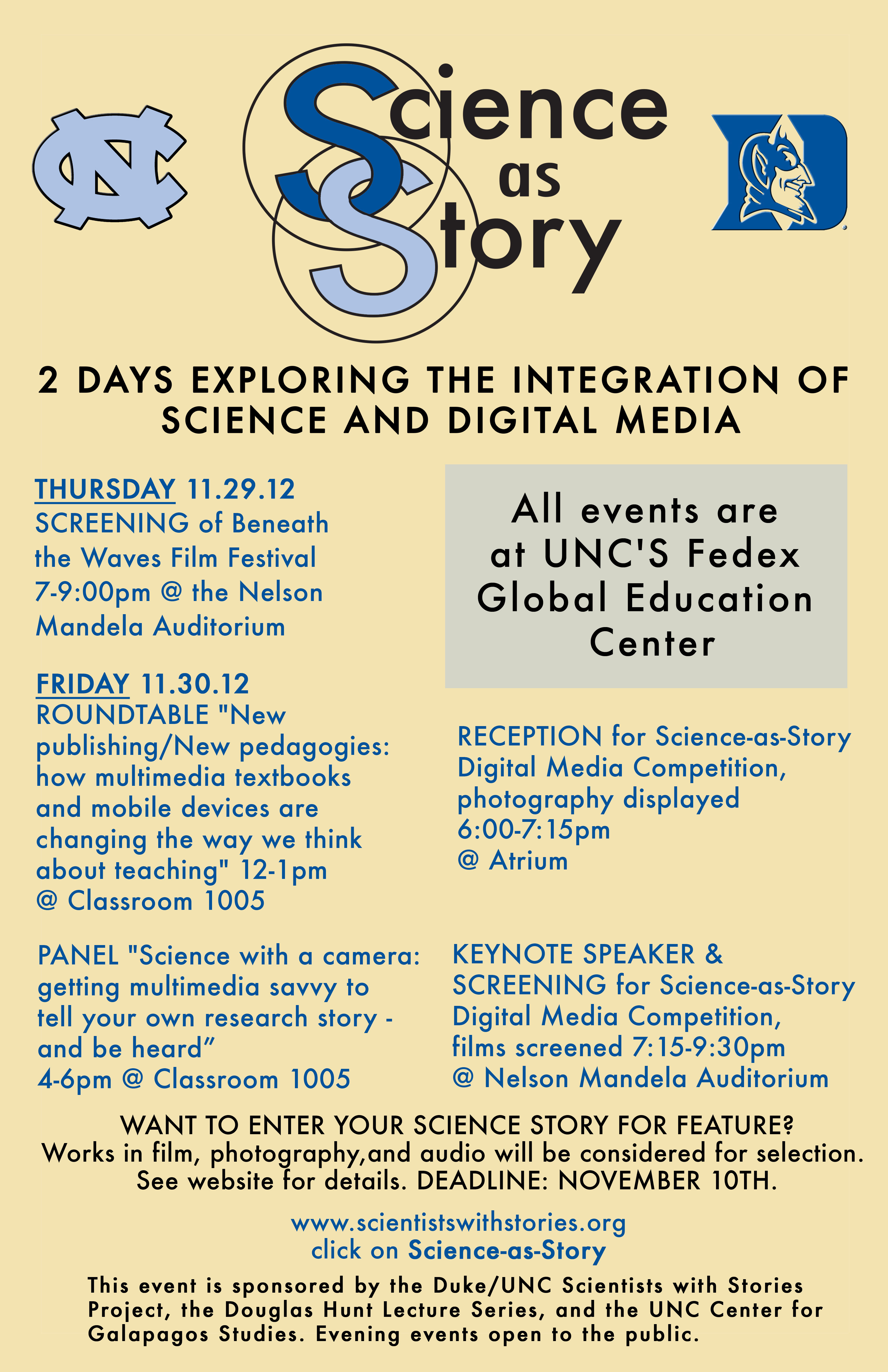
Science as Story – two-day event exploring science, media, & the environment

Posted on November 12, 2012 By Andrew Thaler 2 Comments on Science as Story – two-day event exploring science, media, & the environment

Communique from Southern Fried Science contributor Megumi Shimizu.


Scientists with Stories is a collaborative project by PhD students affiliated with the Duke University Marine Laboratory (DUML) and the UNCʼs Institute of Marine Sciences (IMS) to help young scientists develop the skills needed to communicate mediums of communication: digital photography, web videography, podcasts, and blogging.

We have successfully achieved intensive filmmaking workshop in this summer, and going to have film and photography exhibition in UNC Chapel Hill on November 29th and 30th.

There are two ways to join our Festival. First, you can submit your works in film, photography and audio to our Exhibition (Duke and UNC students only). Please see our website today and contact to Rachel Gittman, one of our student leaders to tell that you are submitting. Second this event is open to public, please visit UNC’s Fedex Center for Global Education. We have keynote speakers, film screening in addition to our exhibition. Details in below.

Read More “Science as Story – two-day event exploring science, media, & the environment” »

Hurricane Sandy Update and Open Thread

Posted on October 28, 2012October 31, 2012 By Andrew Thaler 4 Comments on Hurricane Sandy Update and Open Thread
Uncategorized

At 450 nautical miles, Hurricane Sandy is currently tied as the second largest storm on record. Right now she’s sitting off the Carolina coast delivering massive amounts on rain to Southern Fried Science HQ, but the real trouble is going to start in a two days, when she makes landfall somewhere between Maryland and New … Read More “Hurricane Sandy Update and Open Thread” »

What if you’ve never seen the ocean? Donor’s Choose Project – In Search of Marine Diversity

Posted on October 24, 2012October 24, 2012 By Andrew Thaler 5 Comments on What if you’ve never seen the ocean? Donor’s Choose Project – In Search of Marine Diversity

While my illustrious co-blogger has taken over running the Donor’s Choose challenge for Southern Fried Science this year, I decided to take up a single, worthy project to focus on. One of the challenges with Donor’s Choose is that it’s hard to fund the most expensive projects. People like to see the results of their … Read More “What if you’ve never seen the ocean? Donor’s Choose Project – In Search of Marine Diversity” »

Anonymity, Pseudonymity, and a Reasonable Expectation of Privacy

Posted on October 17, 2012 By Andrew Thaler
Uncategorized

Since the outing of one of reddit’s most notorious trolls last week, the internet has been buzzing with issues of anonymity, pseudonymity, and privacy. Joe Scalzi’s discussion of the larger issues of privacy is the best I’ve seen, so rather than rehash, I’ll just point you there. What I would like to do, is take a moment to review Southern Fried Science’s policy as it applies to our own community. We welcome both anonymous and pseudonymous commenters, and, of course, we post under pseudonyms (granted, our real identities are literally one click away). Our pseudonyms are a matter of convenience, consistency, and tradition, but we recognize that our commenters may have other reasons to use a pseudonym, including, but by no means limited to, protecting themselves from physical, social, and emotional harm as a result of voicing their opinions. Southern Fried Science strives to create a safe space for people to discuss science, politics, conservation, and any of a thousand issues related to our oceans, our planet, and our future.

Read More “Anonymity, Pseudonymity, and a Reasonable Expectation of Privacy” »

Alberta, Canada is the proud owner of the largest man-made pyramid on the planet

Posted on October 16, 2012October 16, 2012 By Andrew Thaler
Science

Great Pyramid of Giza. Photo by Nina Aldin Thune.

Pharaoh Khufu must be rolling in his monumental grave. Since its construction in 2560 BC, the Great Pyramid of Giza stood as the largest man-made pyramid ever built*. For 3800 years, it held the title of the tallest man-made structure of any kind. It wasn’t until the Industrial Revolution that our buildings began dwarfing this wonder of the ancient world. Even still, the Great Pyramid is massive, with a volume of 2,580,000 cubic meters. But there is another pyramid, more massive than Giza, and it wasn’t built to entomb a mighty king. It’s not a monument of any kind. The largest (by volume) pyramid in the world resides in Alberta, Canada and it’s made entirely of sulfur.

Wait, what?

Read More “Alberta, Canada is the proud owner of the largest man-made pyramid on the planet” »

The Trouble with Teacup Pigs

Posted on October 14, 2012June 12, 2017 By Andrew Thaler 13 Comments on The Trouble with Teacup Pigs
Popular Culture, Science

I adore Here Comes Honey Boo Boo. That’s right, I said it. There’s a soft spot in my brittle old heart for that whole family, Sugar Bear, Mamma June, and all. Especially Glitzy.

Glitzy the Pig. Image from The Learning Channel.

Glitzy, for those of you who don’t know, is a “Teacup” Pig (as you can tell from the video, pigs don’t like to be held). Pigs are cute. Piglets are super cute. Pigs are very intelligent, highly social, and make surprisingly good, house-trainable pets. Unfortunately, 800-lb hogs are not cute. Over the years, various breeders have tried to create pigs that retain all of the adorableness of a piglet without reaching the potential half ton plus mass of a full grown adult hog. Among the most popular “miniature” is the Vietnamese pot-bellied pig, a delightfully spry porcine that tops the scales at a manageable 300 pounds. When legitimate breeders talk about miniature pigs, they’re talking about these 300-lb cuties. Pot-bellied pigs are surprisingly diverse, and, although extremely rare, adults have been reported as small as 20 pounds (most breeders would regard an adult pig that size to be extremely malnourished). This huge size range prompted many breeders to attempt to create even smaller pig breeds, selecting from only the smallest stock. Enter the teacup pig.

A teacup pig (or a micro pig, nano pig, or any of a half dozen variations of “small”) is supposedly a tiny pig breed. Some breeders claim that their pigs only reach up to 30 pounds in weight. Combined with the intelligence and sociability that pigs possess, it would seem that teacup pigs should make a perfect pet. There is only one problem: there’s no such thing as a teacup pig.

Read More “The Trouble with Teacup Pigs” »

Brief Blog Notice: Changes to the Comment Policy

Posted on October 8, 2012October 19, 2012 By Andrew Thaler 4 Comments on Brief Blog Notice: Changes to the Comment Policy
Uncategorized

We’ve updated the ever-evolving, often changing comments policy and added a link to John Scalzi’s excellent “How to be a good commenter” article. As an experiment, I cleared the moderation queue giving previously banned commenters a second chance. Here is the current policy in its entirety: Commenters (including blog authors) are asked to adhere to the philosophy … Read More “Brief Blog Notice: Changes to the Comment Policy” »

An open letter to my newborn niece

Posted on September 29, 2012September 29, 2012 By Andrew Thaler 4 Comments on An open letter to my newborn niece
Science

Dear Tinsley,

Welcome to the world. I know it must feel like a very small world right now–just big enough to keep you safe and sheltered and loved–but trust me, as you keep growing, so will the world. Even after you stop growing, it will keep getting bigger. This big, old world that you have suddenly appeared in is huge and strange and beautiful and mysterious. There is more to discover in this world than all of us who have ever lived, working together, can ever know. Even before you can speak, you will think things and know things that no one has ever thought or known before. That is wonderful.

We are explorers. Not just your aunt and uncle, or your family, but all of us: this whole, gigantic group of people that call ourselves “humanity”. Today, there are over 7 billion of us and every last one, every person you will ever meet, can trace their heritage back, through thousands of millennia, to a small tribe of primates somewhere on the African savannah  We were explorers then, too. This tribe made its way across Europe and Asia. They sailed across the Pacific to Australia and a thousand tiny islands. They marched across the Bering Sea–land once connected Alaska to Russia–and traveled all the way down to the tip of South America. And, no matter how far they traveled, no matter how much they explored, the world just kept getting bigger.

We’re still exploring, today. We’ve built an enormous machine called the Large Hadron Collider–some say it’s the most complicated machine humanity has ever built—that allows us to explore the tiniest things in the universe: the sub-atomic particles that hold our world (and every world) together. We’ve even begun to explore beyond our own world. We have massive telescopes that allow us to explore distant galaxies. We’ve built probes that have left our own solar system. We have satellites orbiting Jupiter and Saturn. This summer, we landed a robot on Mars. It has already discovered that Mars was once more like our own world than we previously believed. We named that robot “Curiosity”.

Read More “An open letter to my newborn niece” »

Posts pagination

Previous 1 … 70 71 72 … 149 Next

Popular Posts

The story of the pride flag made from NASA imagery: Bluesky's most-liked imageThe story of the pride flag made from NASA imagery: Bluesky's most-liked imageSeptember 27, 2024David Shiffman
"Why Sustainable Seafood Matters" is now available for preorder! Here's what it's about, and why I decided to write it."Why Sustainable Seafood Matters" is now available for preorder! Here's what it's about, and why I decided to write it.June 8, 2026David Shiffman
Tackling the least important debate in deep-sea mining: the desultory hyphenTackling the least important debate in deep-sea mining: the desultory hyphenJune 8, 2026Andrew Thaler
The evolution of the International Whaling Commission – from  whaling quotas to whale conservationThe evolution of the International Whaling Commission – from  whaling quotas to whale conservationJune 10, 2026Chris Parsons
What Ocean Ramsey does is not shark science or conservation: some brief thoughts on "the Shark Whisperer" documentaryWhat Ocean Ramsey does is not shark science or conservation: some brief thoughts on "the Shark Whisperer" documentaryJuly 2, 2025David Shiffman
Deep-sea Mining, Domestic Cats, Star Trek, and Ocean Exploration: Andrew's mid-year podcast round-up.Deep-sea Mining, Domestic Cats, Star Trek, and Ocean Exploration: Andrew's mid-year podcast round-up.June 6, 2026Andrew Thaler
Shark of Darkness: Wrath of Submarine is a fake documentaryShark of Darkness: Wrath of Submarine is a fake documentaryAugust 10, 2014Michelle Jewell
Isn’t ironic, don’t you think: dismantling the Ocean Observatories Initiative on World Oceans DayIsn’t ironic, don’t you think: dismantling the Ocean Observatories Initiative on World Oceans DayJune 9, 2026Southern Fried Science
What is a Sand Shark?What is a Sand Shark?November 12, 2017Chuck Bangley
That's not a blobfish: Deep Sea Social Media is Flooded by AI SlopThat's not a blobfish: Deep Sea Social Media is Flooded by AI SlopDecember 19, 2025Andrew Thaler
Subscribe to our RSS Feed for updates whenever new articles are published.

We recommend Feedly for RSS management. It's like Google Reader, except it still exists.

Southern Fried Science

  • Home
  • About SFS
  • Authors
  • Support SFS


If you enjoy Southern Fried Science, consider contributing to our Patreon campaign.

Copyright © 2026 Southern Fried Science.

Theme: Oceanly Premium by ScriptsTown