Skip to content

Southern Fried Science

Over 15 years of ocean science and conservation online

  • Home
  • About SFS
  • Authors
  • Support SFS

Author: Andrew Thaler

Marine science and conservation. Deep-sea ecology. Population genetics. Underwater robots. Open-source instrumentation. The deep sea is Earth's last great wilderness.

Epilogue to the Return of the Science of Aquaman: Costume Palettes at Depth

Posted on September 14, 2012September 15, 2012 By Andrew Thaler 3 Comments on Epilogue to the Return of the Science of Aquaman: Costume Palettes at Depth
Popular Culture, Science

In response to yesterday’s review of Aquaman Volume 1: The Trench, Al Dove made a simple request via twitter:

Your next post should be "What would aquaman look like at different depths?"
Your next post should be “What would aquaman look like at different depths?”

This question is more complex than it first appears, and needs a little unpacking. Water is denser than air. When light passes through, the water acts as a filter, absorbing visible light in a predictable pattern from longest wavelengths (infrareds and reds) to shortest wavelengths (purples and ultraviolets). As Aquaman dives deeper, the brilliant colors of his orange and green costume will begin to fade.

Read More “Epilogue to the Return of the Science of Aquaman: Costume Palettes at Depth” »

Return of the Science of Aquaman: Welcome to the Trench

Posted on September 13, 2012September 14, 2012 By Andrew Thaler 2 Comments on Return of the Science of Aquaman: Welcome to the Trench
Popular Culture, Science

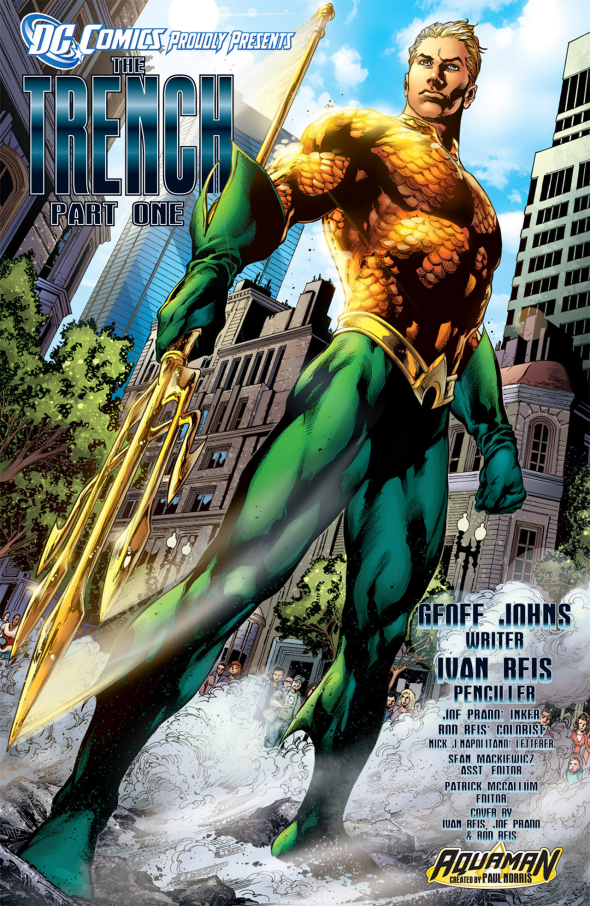
Seriously, is no one else bothered by the fact that his trident has five points? Aquaman: The Trench. From DC Comics.

After reducing Aquaman to a hypothermic, hyposmotic, constantly famished, case study in psychological trauma, I figure that I owe the king of Atlantis a second chance. After all, Aquaman was and still remains the most interesting hero in the DC universe. A generous fan sent me a copy of Aquaman Volume 1: The Trench, arguing that the New 52 version of everybody’s favorite aquatic hero is even more compelling than previous incarnations, with a stronger backstory, powers that make sense, and plenty of humor.

Last time I paid the hapless mariner a visit, many readers interpreted my incisive criticism of the science behind Aquaman as evidence that I had it out for our scale-clad hero. Since you all know that I’m going to take the misguided marine science in this volume to task, let’s start with all of the good stuff in this reimagination of DC’s oft-mocked champion.

The central conceit of New 52 Aquaman is that the comic book world has the same perception of Arthur Curry that we do–a hero with oddly specific and mostly useless powers that talks to fish. In addition, the citizens of the DC Universe believe that Atlantis is a fairy tale, so Aquaman’s kingly status is meaningless to the surface dwellers. The hybrid of a human father and Atlantean mother, Aquaman feels out of place in Atlantis and chooses to return to the surface with his wife, Mera. Comparing himself to his lighthouse-keeper father, he explains that even though he loves the sea, someone must protect the shore.

Read More “Return of the Science of Aquaman: Welcome to the Trench” »

Flesh-eaters of the Crystal Coast: why I prefer my oysters roasted

Posted on September 10, 2012September 9, 2012 By Andrew Thaler 1 Comment on Flesh-eaters of the Crystal Coast: why I prefer my oysters roasted
Science

Title screen for "Escape from the Manatee II", a thing that happened (at least twice)  in the eighties.
Title screen for “Escape from the Manatee II”, a thing that happened (at least twice) in the eighties.

Imagine swimming out from the beach on a warm, summer day. You feel a tingle in your spine and the ba-dumping chords of the Jaws theme inexplicably rise from your subconscious. There is something in the water and it is going to kill you. The deadliest creature in the ocean has chosen you, and there is no escape. You panic. You scan the waves, searching for a sign, something that reveals the threat. Where is it? What is it?!

You could be forgiven if you think, perhaps due to that ominous tune, a shark is stalking you. Despite their killer reputation, sharks rarely attack people and shark attacks, when they do occur, are rarely fatal. Perhaps you are fresh from a Marine Invertebrate Zoology course and your nightmares are now filled with images of cubozoans, the deadly box jellyfish. Box jellies may be extremely venomous, but they are responsible for less than 50 deaths a year and envenomation results in approximately a 20% mortality rate. Ah, but you’re clever, and you watch Discovery channel specials about the “Ten Most Deadly X in Y”, so you know that the deadliest creature is the ocean is the lethal sea snake, relative of the cobra. Clearly one must be stalking you through the shallows. Wrong. While sea snake venom is quite potent, only 1 in every 10 bites results in envenomation, and even then, the mortality rate is a comforting 10%.

No matter how hard you look, you won’t see the monster slowly gliding up behind you. The deadliest marine organism is not a shark, a jellyfish, or a snake. It is not the beautiful blue ring octopus or the unassuming cone snail. It is not the giant squid, the killer whale, or the murderous, man-eating, manatee. The undisputed king of maritime mortality is the lowly bacteria, Vibrio vulnificus.

Read More “Flesh-eaters of the Crystal Coast: why I prefer my oysters roasted” »

Climate Change Anecdotes Volume 1: Sea Ice and Nuclear Reactors

Posted on August 28, 2012August 29, 2012 By Andrew Thaler 6 Comments on Climate Change Anecdotes Volume 1: Sea Ice and Nuclear Reactors
Science

anecdote 

noun.

1. a short account of a particular incident or event, especiallyof an interesting or amusing nature.

2. a short, obscure historical or biographical account.

Dictionary.com

Climate Change

noun.

A change of climate which is attributed directly or indirectly to human activity that alters the composition of the global atmosphere and which is in addition to natural climate variability observed over comparable time periods.

United Nations Framework Convention on Climate Change

Climate change is real and human activity is the cause. The theory that we are fundamentally altering our planet’s climate is supported by overwhelming evidence. Prominent global warming skeptics have, in the face of such evidence, acknowledged that climate change is happening, and that humans are the cause.

And still climate change denial continues to persist.

In the last decade, we have passed a threshold where the reality of climate change is no longer a hypothesis buried in bar graphs or something to be assessed by minute changes in careful measurements, but an observable phenomenon. Rather than anticipating the effects of human impacts on the climate, we must now live them. Thanks to a well-organized and well-funded climate denial industry, we missed our chance to change course. If the last decade was the hurricane warning, than this decade is landfall.

Read More “Climate Change Anecdotes Volume 1: Sea Ice and Nuclear Reactors” »

A selection of primary literature on the ecology of deep-sea hydrothermal vents in Manus Basin

Posted on August 7, 2012August 7, 2012 By Andrew Thaler
Science

Deep-sea mining is once again in the news. As Kevin Zelnio frustratingly points out on twitter, news articles often fail to mention the primary research that has been conducted at these sites or make more than a cursory statement concerning their ecology. This has the effect of marginalizing an entire ecosystem and makes it difficult for the public to grasp the richness and diversity of deep-sea hydrothermal vent communities, some of which may face commercial exploitation. Here is a selection of recent primary literature, with abstracts, on the ecology of deep-sea hydrothermal vents at the center of the mining debate, Manus Basin (you may recognize some of the authors).

Read More “A selection of primary literature on the ecology of deep-sea hydrothermal vents in Manus Basin” »

The importance of being Aquaman, or how to save the Atlantean from his briny fate

Posted on July 30, 2012September 14, 2012 By Andrew Thaler 2 Comments on The importance of being Aquaman, or how to save the Atlantean from his briny fate
Popular Culture, Science

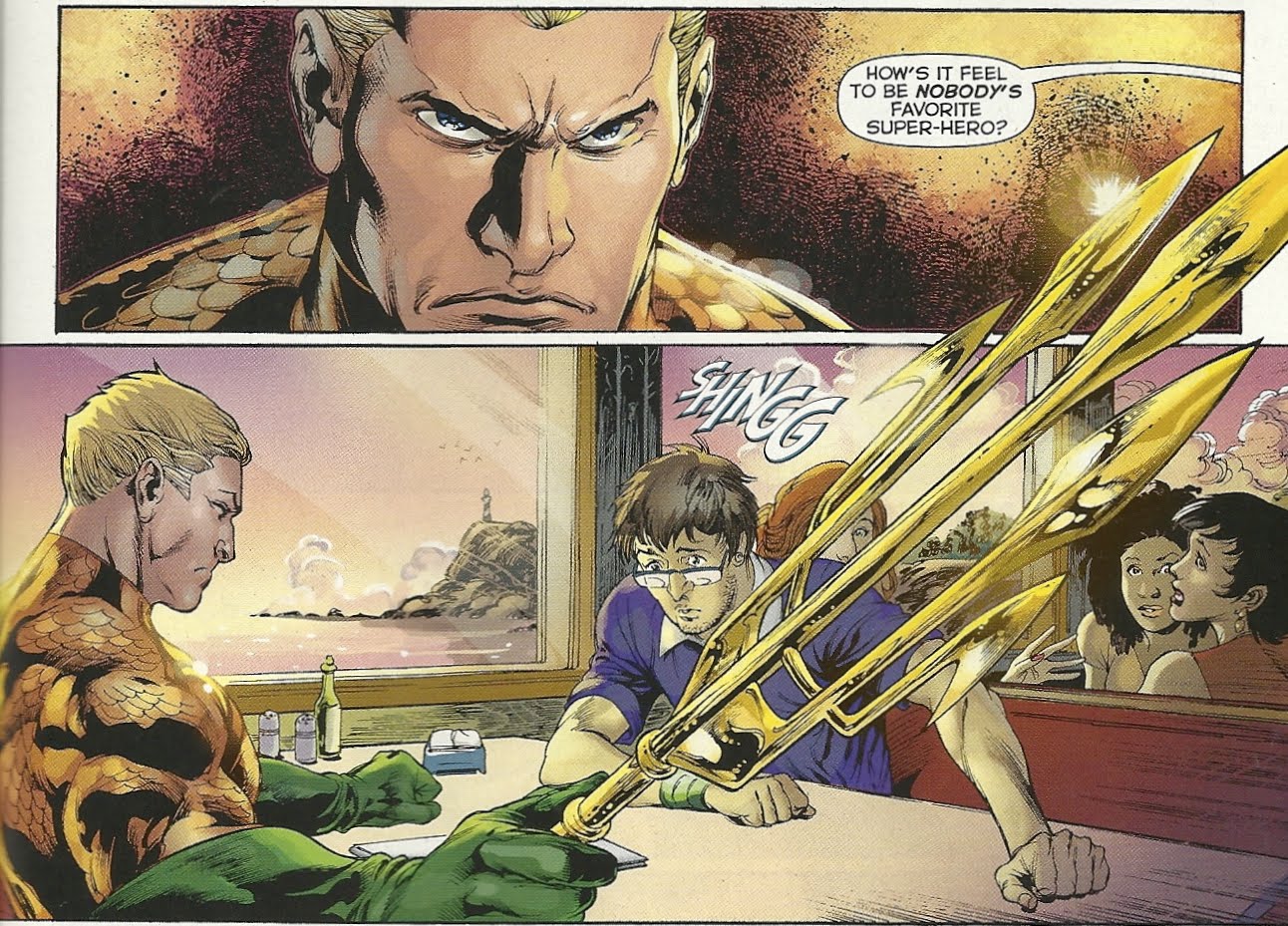
Aquaman has an unpleasant lunch. From New 52 Aquaman #1
Aquaman has an unpleasant lunch. From New 52 Aquaman #1 DC Comics.

Two weeks ago, I challenged the world to consider how the greatest hero in the DC Universe would fair if forced to survive in the real world. The result was a hypothermic, brain-dead lump of jerky with brittle bones forced to suffer through constant screams of agony even as he consumes sea life at a rate that would impress Galactus. In short, the ocean is a rough place, even for Aquaman.

Since that post made its way across the internet, several people have asked me to discuss what adaptations Aquaman would need to survive in this, science-based, ocean. So I went back to my comic books and my textbooks to assemble an Aquaman with a suite of evolutionary adaptations that would allow a largely humanoid organism to rule the waves, trident triumphantly raised.

Read More “The importance of being Aquaman, or how to save the Atlantean from his briny fate” »

Update on Blue Pints

Posted on July 27, 2012October 27, 2013 By Andrew Thaler 1 Comment on Update on Blue Pints
Uncategorized

Last month we launched the video component of Southern Fried Science–Blue Pints. Blue Pints was designed to be an informal conversation among marine scientists about current issues in marine science and conservation. Our first four episodes covered topics ranging from shark finning to Japanese kelp fishing to Sea monsters and hoax UFO’s. Thanks to Google+, we could broadcast these discussions live while recording them for posterity. It took several episodes for us to hit our stride and I’m certain that we’ll continue to perfect and change the formatting as we continue, which leads us to the big question on everyone’s mind:

What is next for Blue Pints?

A weekly episode proved a bit too much for our current schedules, so we’re cutting down on the number we produce every month. On top of that, as many of you know, I’m defending my doctoral dissertation next month, so my southern fried schedule is pretty much completely packed until then. Finally, as much as you all love to see mine, David’s, and Amy’s faces, I’m sure you’d much rather we mix up the hosts a bit.

Two things are happening between now and the end of August. First, we’re soliciting guests to join in on our broadcasts. If there are issues in marine science and conservation that you’d like to talk about, or you just want to hang out online with us talking about the ocean, drop us a line or leave a comment on this post and we’ll start assembling a schedule of ocean communicators. Second, we’re launching a complementary program–A shot of Blue–which will be a short (5 minutes or less) discussion covering a single topic. This will help round out the schedule with out demanding too much of our time. We may continue to run episodes during this month, but will not be sticking to a regular schedule.

Check out the first 4 episodes of Blue Pints:

Read More “Update on Blue Pints” »

Live from Dayton: Using twitter to shed light on the Scopes Monkey Trial, 87 years later

Posted on July 23, 2012July 23, 2012 By Andrew Thaler
Science

Clarence Darrow and William Jennings Bryan, 1925

Over the last 2 weeks, I’ve taken to twitter to “live-tweet” the Scopes Monkey Trial, as it happens, 87 years after the event. Through the news reports of H.L. Mencken and several historical documents, I attempted to capture the atmosphere of 1925 Dayton, Tennessee, the tension of the trial, the exciting, and sometimes irreverent, nature of the proceedings.

To accomplish this, I drew from several publications, most notably Mencken: The American Iconoclast by Marion Elizabeth Rodgers and A Religious Orgy in Tennessee: A Reporter’s Account of the Scopes Monkey Trial a collection of Mencken’s Scopes Trial reports assembled by Art Winslow. The website The Evolution-Creationism Controversy: A Chronology was very helpful in establishing the dates for various events during the trial State v. Scopes: Trial Excerpts provided access to the public testimony for several key trial events.

Below the fold is the entire archive of my Scopes Trial tweets, with added resources and additional content. Enjoy!

Read More “Live from Dayton: Using twitter to shed light on the Scopes Monkey Trial, 87 years later” »

The horrifying physiological and psychological consequences of being Aquaman

Posted on July 18, 2012December 27, 2012 By Andrew Thaler 20 Comments on The horrifying physiological and psychological consequences of being Aquaman
Popular Culture
Aquaman. DC Comics.
Aquaman. DC Comics. A rational response to seal poaching is to lob a polar bear at the aggressors.

Aquaman may not be everybody’s favorite superhero, but since his creation in 1941, he has been among DC’s most enduring icons. During the Golden Age of comic books, he held his own against Superman, Batman, and Wonder Woman. Silver Age Aquaman was a founding member of the Justice League. His powers, tied to the ocean, forced writers to create a compelling, complex hero with explicit limitations. In the early days, when Superman’s strength was practically infinite, and Batman’s brilliance was unmatched, Aquaman had to become more than just a superhero, he had to be a person.

If Superman existed to show us how high the human spirit could fly, and Batman to show us the darkness within even our most noble, Aquaman is here to show us the world that triumphs in our absence. The ocean is not ours, and no matter how great our technology, we will never master it as we have mastered land, but Aquaman has. Through this lonely ocean wanderer, we can experience a world that we can never truly command. In many ways, Aquaman was stronger than the Man of Steel and darker than the Dark Knight. He knew loneliness that the orphan and the alien exile never could.

Roll on, thou deep and dark blue Ocean – roll!
Ten thousand fleets sweep over thee in vain;
Man marks the earth with ruin – his control
Stops with the shore; — upon the watery plain
The wrecks are all thy deed, not does remain
A shadow of man’s ravage, save his own,
When for a moment, like a drop of rain,
He sinks into thy depths with bubbling groan,
Without a grave, unknell’d, uncoffin’d, and unknown.

Byron

Even though Aquaman had to fight harder, endure the jokes of other, less limited heroes, and find relevance in an ecosystem hostile to the humans that had to empathize with him, Aquaman was never forced to confront the truly horrifying consequences of life in the ocean.

Read More “The horrifying physiological and psychological consequences of being Aquaman” »

Watch Episode 4 of Blue Pints: Sea Grant and Sea Monsters

Posted on July 13, 2012October 27, 2013 By Andrew Thaler 2 Comments on Watch Episode 4 of Blue Pints: Sea Grant and Sea Monsters
Uncategorized

httpv://www.youtube.com/watch?v=RIfiPiQJ3pU

Read More “Watch Episode 4 of Blue Pints: Sea Grant and Sea Monsters” »

Posts pagination

Previous 1 … 71 72 73 … 149 Next

Popular Posts

The story of the pride flag made from NASA imagery: Bluesky's most-liked imageThe story of the pride flag made from NASA imagery: Bluesky's most-liked imageSeptember 27, 2024David Shiffman
"Why Sustainable Seafood Matters" is now available for preorder! Here's what it's about, and why I decided to write it."Why Sustainable Seafood Matters" is now available for preorder! Here's what it's about, and why I decided to write it.June 8, 2026David Shiffman
Tackling the least important debate in deep-sea mining: the desultory hyphenTackling the least important debate in deep-sea mining: the desultory hyphenJune 8, 2026Andrew Thaler
The evolution of the International Whaling Commission – from  whaling quotas to whale conservationThe evolution of the International Whaling Commission – from  whaling quotas to whale conservationJune 10, 2026Chris Parsons
What Ocean Ramsey does is not shark science or conservation: some brief thoughts on "the Shark Whisperer" documentaryWhat Ocean Ramsey does is not shark science or conservation: some brief thoughts on "the Shark Whisperer" documentaryJuly 2, 2025David Shiffman
Deep-sea Mining, Domestic Cats, Star Trek, and Ocean Exploration: Andrew's mid-year podcast round-up.Deep-sea Mining, Domestic Cats, Star Trek, and Ocean Exploration: Andrew's mid-year podcast round-up.June 6, 2026Andrew Thaler
Shark of Darkness: Wrath of Submarine is a fake documentaryShark of Darkness: Wrath of Submarine is a fake documentaryAugust 10, 2014Michelle Jewell
Isn’t ironic, don’t you think: dismantling the Ocean Observatories Initiative on World Oceans DayIsn’t ironic, don’t you think: dismantling the Ocean Observatories Initiative on World Oceans DayJune 9, 2026Southern Fried Science
What is a Sand Shark?What is a Sand Shark?November 12, 2017Chuck Bangley
That's not a blobfish: Deep Sea Social Media is Flooded by AI SlopThat's not a blobfish: Deep Sea Social Media is Flooded by AI SlopDecember 19, 2025Andrew Thaler
Subscribe to our RSS Feed for updates whenever new articles are published.

We recommend Feedly for RSS management. It's like Google Reader, except it still exists.

Southern Fried Science

  • Home
  • About SFS
  • Authors
  • Support SFS


If you enjoy Southern Fried Science, consider contributing to our Patreon campaign.

Copyright © 2026 Southern Fried Science.

Theme: Oceanly Premium by ScriptsTown