
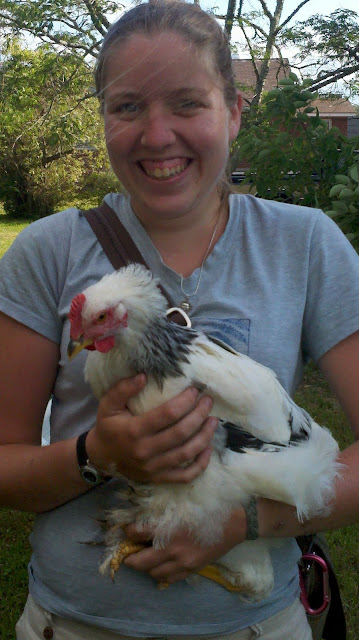
I awoke one morning early last spring to a noise I has been dreading for weeks, the first crow of a chicken that was not supposed to be a rooster. It took me several minutes to fully register what I was hearing. Rather that the classic cock-a-doodle-do we often associate with the rooster’s crow, the sound emanating from my hen house was an awkward, unstable noise not unlike a turkey squawking through a vat of molasses while being vigorously shaken. Over the next several months, two more cocks arrived crowing, in my flock. All three roosters, different breeds from different parents, made noises resembling nothing like a rooster’s crow. There was no pattern; some mornings they would crow off-and-on for a few hours, other mornings they would, for lack of a better word, gargle for half-an-hour straight.
I raise my chickens from day-old hatchlings. Those three roosters, from my very first flock, had never met an adult chicken. They imprinted on Amy and me and looked to us for guidance. When we introduced them to new food, new water dispensers, even small changes to their habitat (like a particularly terrifying log), we had to teach them. Instinctively, they would scratch for food, and if left to their own devices, they would attempt to eat everything, but for the most part, we had to show them how to eat, how to drink, how to roost. But we could not teach them how to crow.
Which is why Casey B. Mulligan’s Economix article in the New York Times – Species Protection and Technology – which argues that cloning could be an effective tool to restore extinct species (a topic I’ve been thinking about quite a bit in terms of population dynamics), is fatally flawed.
When it comes to rebuilding an ecosystem, genetics only gets you so far. Animals learn from other members of the population and develop relationships with their ecosystem that define them both behaviorally and evolutionarily. To clone an animal back into existence only gives you the rudimentary mechanical and behavioral components. You’re far from creating a viable population. For some applications, that’s fine. I’d love to see a woolly mammoth cloned for preserved remains, but no matter how many clones you make, woolly mammoths are still extinct, along with the ecosystem that supported them, much of the food they consumed, and the predators that hunted them. An animal is the product of both its genes and interactions with its environment.
Things get a little trickier when talking about currently extant, but threatened species. Can we bolster a population by introducing cloned individuals, increasing the size of the population and, perhaps, its resilience. The short answer is probably, but there are caveats. Practically, it’s not much of a leap beyond using artificial insemination to bolster a wild population using a small captive breeding stock. Adding clones to a population does not introduce new genetic diversity, so the risk of inbreeding depression is greater and may trigger an extinction vortex. Raw numbers alone do not determine the survival of a species.
Cloning a species back to life ignores the underlying issues that caused that species to go extinct. Unless you’re a passenger pigeon, it is unlikely that hunting and poaching alone caused your extinction. Habitat loss, climate change, pollution, and resource depletion all play a roll, and without addressing those causes, cloning a species back from extinction is ultimately futile. Like all conservation issues, though, this is entirely context dependent. While cloning an extinct mammoth does not herald the return of the mammoth, cloning extinct plants, fungi, or microorganisms, whose lives are less dependent on learned behavior and tend to be more resilient, may still be a possibility.
Regardless, cloning extinct species is an exercise in vanity. By opting to store genetic material instead of protecting habitats and preventing extinction from happening in the first place, we’re shunting the burden of preservation onto the next generation, where we assume that they, having never seen a passenger pigeon, will want to commit the resources to building a habitat from scratch and repopulating it with not only cloned passengers pigeons, but all other species that they depend on. If we think something is worth protecting, we should protect it now. A cloned mammoth is a curiosity, suitable for display, but no more part of the ecosystem than a taxidermied dodo.
The Tasmanian Tiger habitat is still there.
The idea of cloning an extinct species back also operates from a complete ignorance of microbial ecology. Even if we can clone woolly mammoths or passenger pigeons (still a big “if”), they’ll be little more than laboratory novelties. The genome of an organism doesn’t encode the microbial ecosystems that lived on and in it, but those bacteria, fungi, viruses, and protozoans were nonetheless a crucial and inseparable part of that species when it was alive.
We should go ahead and try to resurrect these species’ genomes, because the experiment will undoubtedly tell us useful things about them, but we should not pretend that the genome is the organism, no matter how well it crows.
Well said Andrew.
Put another way, scrambling the egg is a lot easier than unscrambling it…
Personally, I do think it is possible to resurrect an extinct organism by cloning – or will be soon.
However, the scientific possibility is not really at question here. We are already having the hardest of times to keep critically endangered species with perhaps a few hundred living from going extinct. So why should we believe that we could resurrect an extinct species even if we could clone a few hundred of them into existence?
Not to mention the obvious flaws inherent in these cloned creatures like Dolly. For the time being, cloned creatures will be inferior and less fit than the current species in existence.
I’m paying “blog calls” to each @scio12 attendees blog to say “Hi” and give a shout out on twitter! I look forward to seeing you again in January!
Thanks! I love the “blog call” idea. See you in a few weeks!