Skip to content

Southern Fried Science

Over 15 years of ocean science and conservation online

  • Home
  • About SFS
  • Authors
  • Support SFS

Biodiversity Wednesday: Flesh eaters of the Savanna

Posted on February 16, 2011February 16, 2011 By Andrew Thaler
Uncategorized

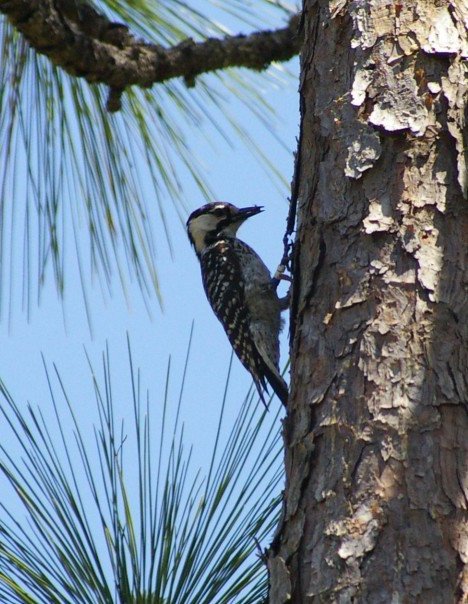
Red-cockaded Woodpecker in Croatan Forest. Photograph by Andrew David Thaler.

The wet, temperate understory of a longleaf pine savanna, is not the first place one would thing to search for some of nature’s most fearsome predators. These maritime ecosystems stretch down the Atlantic seaboard, from southern Virginia to northern Georgia, but are most common in North and South Carolina. Boomerang-shaped bays, called Carolina bays, formed behind ancient sand dunes, provide the foundation for these biodiversity rich regions. More than 50 endangered species are native to the Carolina lonfleaf pine savannas, including the Cape Fear Threetoothed land snail and the iconic Red-cockaded Woodpecker, but among the most evocative inhabitants of these pocosin wild-lands are the many-jawed monsters of the the understory – the Venus Flytrap.

North Carolina is a hotspot for carnivorous plant biodiversity. Dozen of species are native to it’s forests and wetlands, some found no where else in the world. Among the most common are pitcher plants, sundews, trumpets, butterworts, and, of course, the Venus flytrap. A collection of common NC carnivorous plants can be found here.

Carnivorous plants extract extra nitrogen from insects and other prey species that fall into their trap. They do this through a combination of chemical signals and diabolical mechanics that lure their prey in and then trap them. From Audubon Magazine:

The Venus flytrap is an exquisite deception, an aggregate of biochemical, electric, and passive elastic components with a single purpose: to kill. A specialized leaf grows into a two-part blade, hinged in the middle. Each blade half is held taut with a distinctive outward curvature—think of a tennis ball sliced nearly in half, and each side pushed inside out. An insect—ant, beetle, spider, fly—scents an array of nectar glands whose glistening secretions line the edge of this snare, and investigates. The bug brushes against modified plant hairs, which send an electrical impulse through the leaf at a speed of some 10 centimeters per second. Almost instantly, the plant responds, flooding elongated cells on the outer face of those inside-out leaves, and stressing their concave geometry. Pushed beyond its limit of stability, the leaf trap snaps shut, closing in less than one-tenth of a second. The hapless bug is pinned inside a tooth-fringed, bean-shaped pouch, thrashing in its verdant prison, where plant glands gush digestive enzymes.

source

Carnivorous plants face many threats, including habitat loss, but their number one threat is poaching. Carnivorous plants are prized in the rare and exotic plant trade, and poachers have been caught trying to smuggle literally thousands of Venus flytraps out of protected areas. Enforcement is limited and many people are unaware that the flytraps they buy from home and garden centers may have been acquired illegally from some of the most threatened plant populations in the country.

Share this:

  • Click to share on Bluesky (Opens in new window) Bluesky
  • Click to share on Facebook (Opens in new window) Facebook
  • Click to share on Reddit (Opens in new window) Reddit
  • Click to share on Threads (Opens in new window) Threads
  • Click to share on WhatsApp (Opens in new window) WhatsApp
  • Click to share on Mastodon (Opens in new window) Mastodon

Related

Tags: carnivorous plants Carolina Bay longleaf pine forest North Carolina Red-cockaded Woodpecker south carolina threetooth snail venus flytrap

Post navigation

❮ Previous Post: Japan temporarily suspends Antarctic whale hunt
Next Post: Science Fails in Pop Music Songs ❯

You may also like

Science
South Carolina Governor Nikki Haley slashes funding for coastal science and sustainable development
July 12, 2012
Conservation
Understanding Sea Level Rise: Why a linear extrapolation is the least reasonable predictor of future changes
June 14, 2012
Climate change
Is a Changing Environment Bringing Baby Bull Sharks to North Carolina?
April 16, 2018
Conservation
Biodiversity Wednesday: South Carolina’s Santee Cooper Lake System
March 23, 2011

Popular Posts

Shark scientists want their research to help save threatened species, but don’t know how. Our new paper can help.Shark scientists want their research to help save threatened species, but don’t know how. Our new paper can help.December 1, 2025David Shiffman
Norway and Cook Islands put their deep-sea mining plans on pause.Norway and Cook Islands put their deep-sea mining plans on pause.December 3, 2025Andrew Thaler
What Ocean Ramsey does is not shark science or conservation: some brief thoughts on "the Shark Whisperer" documentaryWhat Ocean Ramsey does is not shark science or conservation: some brief thoughts on "the Shark Whisperer" documentaryJuly 2, 2025David Shiffman
The Trouble with Teacup PigsThe Trouble with Teacup PigsOctober 14, 2012Andrew Thaler
What we know we don't know: impacts of deep-sea mining on whales, dolphins, sharks, turtles, and other migratory species.What we know we don't know: impacts of deep-sea mining on whales, dolphins, sharks, turtles, and other migratory species.November 20, 2025Andrew Thaler
2025: My year in writing, public speaking, and media interviews2025: My year in writing, public speaking, and media interviewsDecember 3, 2025David Shiffman
Urea and Shark OsmoregulationUrea and Shark OsmoregulationNovember 15, 2010David Shiffman
Shark of Darkness: Wrath of Submarine is a fake documentaryShark of Darkness: Wrath of Submarine is a fake documentaryAugust 10, 2014Michelle Jewell
How tiny satellites are tracking marine wildlifeDecember 1, 2025Andrew Thaler
Build a dirt cheap, tough-as-nails field computer in a Pelican caseBuild a dirt cheap, tough-as-nails field computer in a Pelican caseJuly 21, 2015Andrew Thaler
Subscribe to our RSS Feed for updates whenever new articles are published.

We recommend Feedly for RSS management. It's like Google Reader, except it still exists.

Southern Fried Science

  • Home
  • About SFS
  • Authors
  • Support SFS


If you enjoy Southern Fried Science, consider contributing to our Patreon campaign.

Copyright © 2025 Southern Fried Science.

Theme: Oceanly Premium by ScriptsTown