 As part of our Biodiversity Wednesday series, we’ve discussed amazing ecosystems all over the world. This week’s post will focus on an area a little closer to home (at least a little closer to my home). The Santee Cooper lake system, home to unique fish and a fascinating history, is less than an hour from Charleston. If you’ve ever driven on I-95 through South Carolina, you’ve gone right over it.
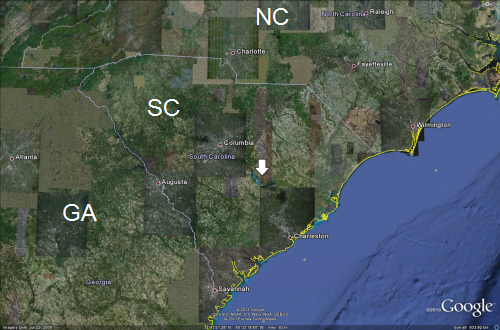
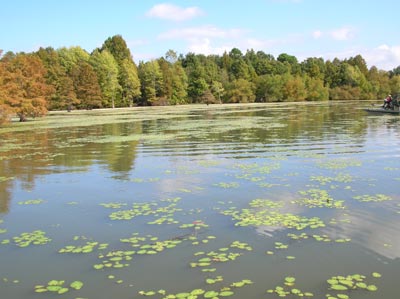
More formally known as Lake Moultrie and Lake Marion, this system was created in the 1930’s when a hydroelectric power plant dammed the Santee river as part of the New Deal (the nearby Cooper river was also affected by this plant). At the time, this was the largest land-clearing construction project in the history of the United States.
Damming a river can be devastating to fishes that migrate from fresh to salt water, such as the salmon of the Pacific Northwest. We don’t have any salmon in South Carolina, but we have an anadromous fish species. When the migration path of the striped bass was blocked by the Santee Cooper hydroelectric plant, something unexpected happened. Instead of dying out, they adapted, and the Santee Cooper system is now home to an entirely freshwater population of so-called “stripers”. This region is now a destination for anglers from all over the world, and several other states stock their lakes with South Carolina freshwater striped bass. To keep up with the demand, millions of stripers are grown in aquaculture facilities.
Numerous other plants and animals utilize the Santee Cooper lake system as well as it’s 400 miles of shoreline and tens of thousands of acres of surrounding forest habitat. These include alligators, wild turkeys, bald eagles, deer, foxes, migrating waterfowl, and osprey. Much of this habitat is currently protected in the form of the 15,000 acre Santee National Wildlife Refuge (Federal) and the 18,000 acre Santee Wildlife Management Area (State). Additionally, current land use plans call for preserving of at least 70% of the shoreline in it’s natural state (yes, we are preserving the natural state of a man-made lake system). Not all of the ecosystem is natural, however. The lake system is home to an invasive species known as the blue catfish.
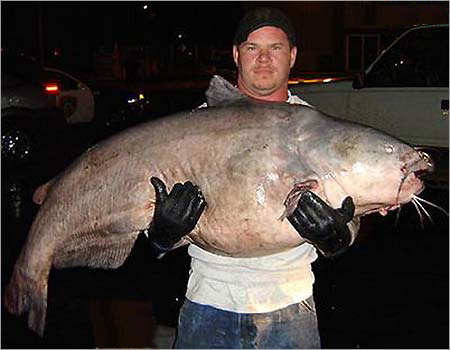
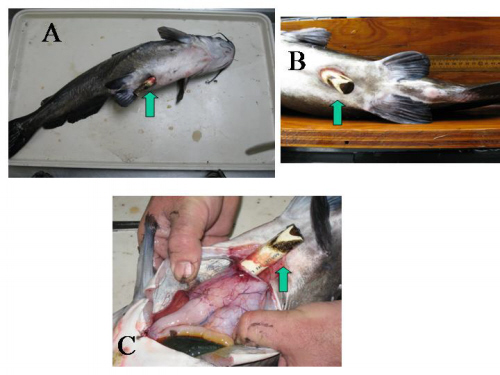
As you can see from the above image, blue catfish are quite large. They are also voracious predators. Unlike many invasive species, however, blue cats were introduced on purpose. They supported a thriving recreational fishery in parts of their native range, and in the 1960’s South Carolina Department of Natural Resource biologists traded some freshwater stripers to their colleagues in Arkansas for blue catfish. In order to understand how blue cats use the Santee Cooper system, SCDNR biologists attempted to use internal acoustic tags to track them. These tags, which emit a noise at a particular frequency, are surgically implanted inside the body wall of a fish. Using a hydrophone (an underwater microphone) and a boat, biologists can then follow the fish by listening for it’s frequency. This is a well established technique that has been used on countless fish species all over the world, but it didn’t work very well in this case. Researchers decided to keep some blue cats captive after their surgery to see what went wrong.That’s when they made a discovery that ranks among the craziest things I’ve ever heard of. When a foreign object is inserted inside a blue catfish, their intestines wrap around that object and expel it through the body wall.
The mix of natural history and human history make the Santee Cooper region a fascinating place. Next time you’re driving through South Carolina on I-95, stop at exit 98 and look around. The lake is beautiful, folks are friendly, and the cornbread at Lonestar BBQ and mercantile is out of this world.

I am in the corporate communications department of Santee Cooper, the state-owned electric and water utility that constructed, owns and manages the Santee Cooper Lakes (in conjunction with the S.C. Department of Natural Resources at several levels) for the people of South Carolina. A couple of minor points: The Cooper River, a short tidal river, was never dammed in the creation of the lakes from 1939 to 1942. It was the Santee River that was dammed. The Cooper River’s flow was altered by the discharge of water from the Jefferies Hydroelectric Station located on the Tailrace Canal, the four-mile long manmade canal that flows into the west branch of the Cooper River. The “lower lake” as it is often called, did create dams and dikes (East and West Pinopolis dams and dikes)to hold back the water created by the diversion of water from Lake Marion, through the Diversion Canal, into lake Moultrie. As a final note, the old hyphen between “Santee” and “Cooper” was formally dropped by Santee Cooper in 1976, although I doubt it will ever disappear from use. The term “Santee Cooper” is a state and federally registered service mark, similar to a trademark, that denotes the products (primarily electricity) and services delivered by Santee Cooper, whose formal name is the South Carolina Public Service Authority, headquartered in Moncks Corner, S.C. Thank you.
Thanks for reading, Willard. Sorry for the small mistakes, I’ll change them right away.
Man, that intestines expelling acoustic tags thing is freaky. It’s a good thing dogfish don’t do that.