Skip to content

Southern Fried Science

Over 15 years of ocean science and conservation online

  • Home
  • About SFS
  • Authors
  • Support SFS

Category: Blogging

Cascading planetary-wide ecosystem effects of the extirpation of apex predatory Krayt dragons on Tatooine

Posted on July 22, 2014 By David Shiffman
Blogging, Conservation, Popular Culture, Science

Author’s note: this post is part of the “Science of Tatooine” blog carnival. Though obviously about science fiction and not the real world, it includes real ecological theories,  and it uses some real peer-reviewed scientific papers as references. Whenever possible, I’ve linked to accessible copies of those papers and explainers of these ecological terms. Many of the same issues are associated with shark population declines. 

ABSTRACT

Predators play an important role in structuring ecosystems, with predator population declines being linked to a variety of negative ecological effects. Here, we present evidence that the planet Tatooine, famous throughout the Galaxy for being a desert planet, experienced desertification as a result of unintended changes in herbivore populations caused by the intentional large-scale killing of apex predators by offworld colonists. Fossil evidence and interviews showing traditional ecological knowledge suggest that once-abundant Krayt dragons were hunted to near extinction by early human colonists. As a result of the decline in predation, populations of large herbivorous banthas populations grew out of control and overgrazed the plants once found throughout Tatooine.

INTRODUCTION

Studies of numerous ecosystems have consistently shown the importance of intact populations predators to healthy ecosystems, with a recent review (Estes et al. 2011 “trophic downgrading of planet Earth”) noting that “the loss of apex consumers is arguably humankind’s most pervasive influence on the natural world.” Population declines of top predators can cause a trophic cascade, resulting in unintended consequences that ripple through a food chain. Sea otter population declines in the Pacific Northwest of the United States resulted in predation release of otter prey (sea urchins), and an overabundance of sea urchins destroyed entire kelp forest ecosystems by overgrazing (Estes et al. 1998 “killer whale predation on sea otters linking oceanic and nearshore systems.) Wolf population declines in Yellowstone National Park resulted in predation release of wolf prey (elk,) and an overabundance of elk destroyed aspen pine forests by overgrazing (Ripple et al. 2011 “trophic cascades among wolves, elk, and aspen on Yellowstone National Park’s northern range.”)  Ecosystem-wide effects stemming from the loss of predators has also been listed as the proximate cause of disease outbreaks (Pongsiri et al. 2009 “biodiversity loss affects global disease ecology,”), increasing destructive wildfires (Perrings et al. 1997 “biodiversity resilience and the control of ecological-economic systems: the case of fire-driven rangelands,”) and overall biodiversity loss (Paine 1969, “Pisaster-tegular interaction: prey patches, predator food preference, and intertidal community structure.”)

Though the planet Tatooine in the Tatoo system of the Outer Rim is known by researchers to have once been covered by oceans and lush vegetation, it is commonly known now as a desert planet (source). While it is famous in Republic circles primarily for being the home of Jedi Master Skywalker, Tatooine also has native sentient species, including Jawas and Tusken Raiders (the latter are derisively referred to by locals as “sand people” ).  Native non-sentient animals include banthas (large herbivores used as beasts of burden) and the now mostly extinct Krayt dragon (a large predatory species that fed on banthas).

Read More “Cascading planetary-wide ecosystem effects of the extirpation of apex predatory Krayt dragons on Tatooine” »

Fun Science FRIEDay – Fasting Fights Cancer?

Posted on July 18, 2014July 15, 2014 By Kersey Sturdivant
Blogging

Happy Fun Science FRIEDay to everyone. FSF is back and with a new name!

After a brief hiatus to sort out some legal issues regarding the title of FSF, and a trip to the World Cup, I am hopefully back into the swing of providing you with mostly weekly, fun, and interesting science facts!

Up this week is cancer, and what we as a species are doing to kick its ass! … along w/ the involuntary help of the Mus musculus species.

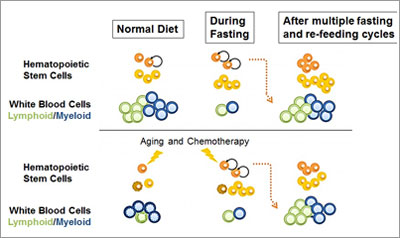
Relatively recent work by Dr. Longo, of the University of Southern California, and his colleagues, has shown that a simple dietary adjustment may help combat the negative influence of chemotherapy and age on immune cell function! In short, their findings suggest that fasting, yes you heard right, FASTING, may provide benefits for cancer patients and the elderly by replenishing stem cells in the blood.


Conceptualization of the influence prolonged fasting has to promote stem cell regeneration and reverse immunosuppression. (Photo credit: Cheng et al. 2014)

Read More “Fun Science FRIEDay – Fasting Fights Cancer?” »

These things are related.

Posted on July 16, 2014July 16, 2014 By Andrew Thaler 3 Comments on These things are related.
Blogging, Science

Exhibit A. At Boing Boing, Maggie Koerth-Baker publishes an article talking about her disenchantment with Richard Feynman after learning that he was a gigantic womanizing creeper. Matthew Francis follows up with more information about Feyman’s inexcusable behavior. Armies of Feyman supporters rush to his defense, arguing that we should judge him as a product of his times or that he was a great physicist, so we should just ignore the fact that he was a misogynistic creep that, as a faculty member, pretended to be an undergraduate to pick up students. Janet Stemwedel has more.

Read More “These things are related.” »

Why exploding whale stories just won’t die and how we can use them to help save the ocean

Posted on July 15, 2014 By Andrew Thaler
Blogging

Exploding whales are an endless source of amusement, even when they don’t explode. When a cetacean detonation made a guest appearance on Saturday Night Live, it was clear that we had reached peak exploding whale saturation. Now that we’ve all had a few months to decompress, it’s time to take a step back and look at why these stories are important and how we can leverage them into effective ocean outreach.

Good, effective outreach has to have a reason to exist. Outreach without a clearly defined objective is flat and meaningless. Deep-sea fauna with googly eyes exists explicitly to remind people, through the proliferation of viral images, that there is life in the deep sea, an ecosystem few people think about on a day to day basis. The Fukushima Debunking Initiative was created to help halt the proliferation of bad science and pseudoscience that distracted from the real tragedy of the Fukushima-Daichi Nuclear Disaster and shifted attention away from real problems impacting the US West Coast. Hasthewhaleexplodedyet.com was designed to leverage the mass media attention focused on the exploding whale to accomplish one simple goal: to disseminate information about what to do when you encounter a stranded marine mammal.

Read More “Why exploding whale stories just won’t die and how we can use them to help save the ocean” »

Can the world’s luxury yacht owners help reduce ocean scientists’ biggest expense: ship time?

Posted on July 7, 2014 By David Shiffman 1 Comment on Can the world’s luxury yacht owners help reduce ocean scientists’ biggest expense: ship time?
Blogging, Science

The International SeaKeepers Society is offering yachts for marine science expeditions, free of charge.

Marine scientists perform research ranging in scope from global food security to threatened species conservation to climate change, research that is critical to a healthy environment. As with other scientific disciplines, however, funding cuts threaten the future of this research. A recent Joint Ocean Commission Imitative report gave the United States government a D minus on funding for ocean sciences, and one of the primary funding programs for ocean exploration has been proposed for termination.

Even as funding is reduced, costs associated with ocean science research are rising. In particular, the fuel costs for research vessels, of which there are fewer and fewer each year, are increasing. Ship time often costs tens of thousands of dollars each day. This huge expense is critical, as researchers have to get to their study area before they can begin to study it. The International SeaKeepers Society, a non-profit founded by a group of luxury yacht owners, wants to help reduce or eliminate this cost by hosting marine science expeditions on private yachts. “By providing scientists in need of a research platform at sea with the opportunity to work off a privately owned vessel at little to no cost, SeaKeepers helps remove one of the most costly aspects of data collection: access to the water,” says Brittany Stockman, Director of Programs and Policies for the International SeaKeepers Society.

Read More “Can the world’s luxury yacht owners help reduce ocean scientists’ biggest expense: ship time?” »

Bad Gas Supplemental

Posted on June 19, 2014 By Andrew Thaler
Blogging

In which I respond to some of the comments and questions raised by the first two videos in my ocean acidification project. httpv://www.youtube.com/watch?v=Q1xlE-P8EWs

Absurd headlines about sharks, adjusted for accuracy

Posted on June 11, 2014June 11, 2014 By David Shiffman 1 Comment on Absurd headlines about sharks, adjusted for accuracy
Blogging

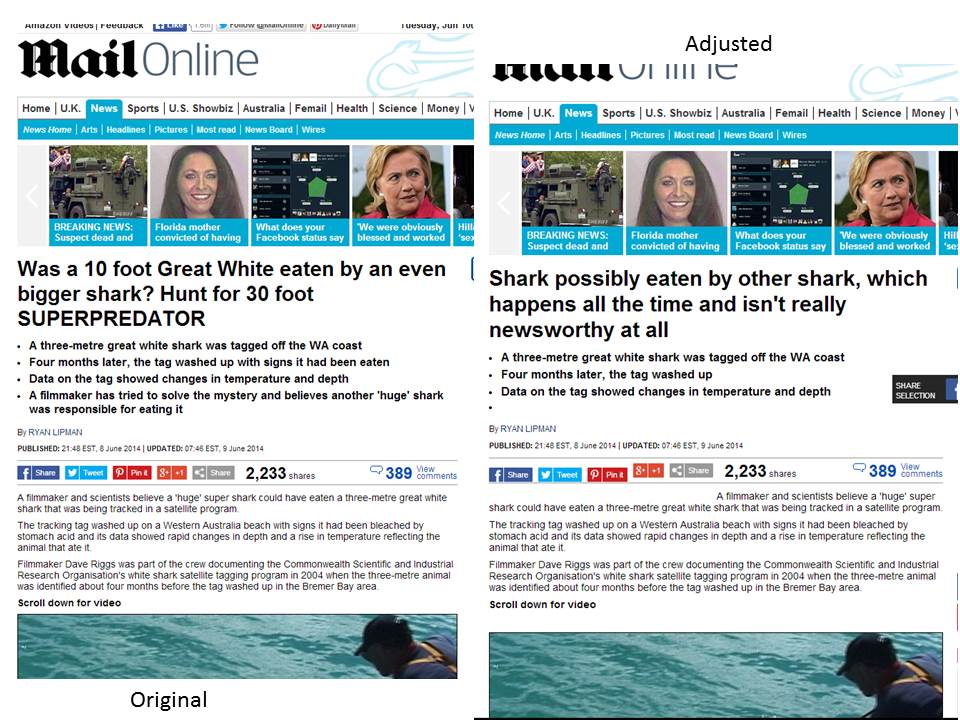
The mainstream media doesn’t always have the greatest reputation for accuracy when it comes to reporting stories about sharks. Inspired by this brilliant campaign, I decided to “adjust” the headlines of some particularly absurd recent news stories about sharks.

This story about a shark that may have been eaten by another shark. 

1


Read More “Absurd headlines about sharks, adjusted for accuracy” »

Exploring new models to fund ocean science and outreach

Posted on May 28, 2014May 28, 2014 By Andrew Thaler
Blogging

It’s an open secret that I’ve been struggling over the last few years to keep Southern Fried Science growing while making it financially sustainable. Ocean outreach matters, because the oceans matter. Many of us believe that protecting the oceans is the most important thing we’ll ever do. Our survival depends on a healthy ocean. So we write about overfishing and shark finning, climate change and ocean acidification, mining and trawling and bycatch runoff. And, since, as St. Jacques once said, “people protect what they love”, we do what we can to make people love the ocean as much as we do.

For most of its existence, Southern Fried Science and my other outreach projects have been funded by science. Research grants, outreach fellowships, even graduate student stipends went towards keeping our servers running. But science funding is in crisis, and that model is no longer valid. In a disturbing reversal, today, income from outreach related work–selling articles, consulting for NGO’s, running workshops–is being used to fund my scientific research. Neither model is viable.

It’s time to try something new.

Read More “Exploring new models to fund ocean science and outreach” »

Dawn take you all: Bilbo Baggins’ approach is better than “don’t feed the trolls”

Posted on May 21, 2014 By David Shiffman 4 Comments on Dawn take you all: Bilbo Baggins’ approach is better than “don’t feed the trolls”
Blogging, Science

“Dawn take you all, and be stone to you!”For just at that moment the light came over the hill, and there was a mighty twitter in the branches. William never spoke for he stood turned to stone as he stooped; and Bert and Tom were stuck like rocks as they looked at him. And there they stand to this day, all alone, unless the birds perch on them; for trolls, as you probably know, must be underground before dawn, or they go back to the stuff of the mountains they are made of, and never move again. – “The Hobbit,” J.R.R. Tolkien. (Yes, it really says twitter in this section of text. This is the only place in “The Hobbit” or any of the Lord of the Rings books where the word twitter appears.)

Trolls at the world premiere of "The Hobbit: An Unexpected Journey". Creative Commons license from Flickr user Kewl
Trolls at the world premiere of “The Hobbit: An Unexpected Journey”. Creative Commons license from Flickr user Kewl


Though I have largely enjoyed my experiences with online outreach, there are, to put it mildly, lots of unpleasant people on the internet. An extremist opinion and an anonymous forum for expressing it can be a recipe for some particularly nasty conversations. Some people seem to take pleasure in disrupting a conversation even when they have no particular stake in it, and these people are commonly referred to as “trolls.” There are various strategies for dealing with them (for example, here’s an explanation of this blog’s comment policy). In general, “don’t feed the trolls”  is a common piece of advice for those engaged in online discussions. “Don’t feed the trolls” means that if someone is behaving in an inflammatory manner, you should simply not respond. While it’s certainly true that many internet trolls enjoy a combative discussion and that engagement may give an extremist idea more exposure than it would otherwise receive, I’ve never liked the idea of “don’t feed the trolls.”

Read More “Dawn take you all: Bilbo Baggins’ approach is better than “don’t feed the trolls”” »

A style guide for journalists who want to write about something covered on Southern Fried Science

Posted on May 8, 2014May 9, 2014 By Andrew Thaler
Blogging

Thank you for your interest in one of our articles. Please feel free to contact any of our authors for further information but do keep in mind that we are all science writers. If your publication is looking for a more than a brief (less than 300 word) interview, please consider contracting one of us to write the piece.

For press queries, please contact southernfriedscientist at gmail with the subject line PRESS QUERY.

A few key points of style.

1. The name of the website is Southern Fried Science. The URL is southernfriedscience.com with no capitals. Our writers are either correspondents, senior correspondents, or editor-in-chief. You can find out who is what on our author page. If unsure, please refer to them as either authors or scientists.

Read More “A style guide for journalists who want to write about something covered on Southern Fried Science” »

Posts pagination

Previous 1 … 13 14 15 … 19 Next

Popular Posts

What Ocean Ramsey does is not shark science or conservation: some brief thoughts on "the Shark Whisperer" documentaryWhat Ocean Ramsey does is not shark science or conservation: some brief thoughts on "the Shark Whisperer" documentaryJuly 2, 2025David Shiffman
Shark of Darkness: Wrath of Submarine is a fake documentaryShark of Darkness: Wrath of Submarine is a fake documentaryAugust 10, 2014Michelle Jewell
What is a Sand Shark?What is a Sand Shark?November 12, 2017Chuck Bangley
Save the seals.  Congress is trying to shoot its way to salmon recoverySave the seals.  Congress is trying to shoot its way to salmon recoveryJuly 22, 2026Southern Fried Science
Why would a serious scientist agree to participate in a nonsense Shark Week show?Why would a serious scientist agree to participate in a nonsense Shark Week show?July 15, 2025David Shiffman
What can the funniest shark memes on the internetz teach us about ocean science and conservation?What can the funniest shark memes on the internetz teach us about ocean science and conservation?November 8, 2013David Shiffman
The “Conservation Paywall”: why saving the planet has become a luxury sportThe “Conservation Paywall”: why saving the planet has become a luxury sportJuly 23, 2026Chris Parsons
That's not a blobfish: Deep Sea Social Media is Flooded by AI SlopThat's not a blobfish: Deep Sea Social Media is Flooded by AI SlopDecember 19, 2025Andrew Thaler
Jumping the shark: New study reviews the breaching behavior of sharks and raysJumping the shark: New study reviews the breaching behavior of sharks and raysSeptember 19, 2024David Shiffman
Our favorite sea monsters – Ningen (#4)Our favorite sea monsters – Ningen (#4)September 7, 2010Andrew Thaler
Subscribe to our RSS Feed for updates whenever new articles are published.

We recommend Feedly for RSS management. It's like Google Reader, except it still exists.

Southern Fried Science

  • Home
  • About SFS
  • Authors
  • Support SFS


If you enjoy Southern Fried Science, consider contributing to our Patreon campaign.

Copyright © 2026 Southern Fried Science.

Theme: Oceanly Premium by ScriptsTown