Skip to content

Southern Fried Science

Over 15 years of ocean science and conservation online

  • Home
  • About SFS
  • Authors
  • Support SFS

Category: Blogging

Dawn take you all: Bilbo Baggins’ approach is better than “don’t feed the trolls”

Posted on May 21, 2014 By David Shiffman 4 Comments on Dawn take you all: Bilbo Baggins’ approach is better than “don’t feed the trolls”
Blogging, Science

“Dawn take you all, and be stone to you!”For just at that moment the light came over the hill, and there was a mighty twitter in the branches. William never spoke for he stood turned to stone as he stooped; and Bert and Tom were stuck like rocks as they looked at him. And there they stand to this day, all alone, unless the birds perch on them; for trolls, as you probably know, must be underground before dawn, or they go back to the stuff of the mountains they are made of, and never move again. – “The Hobbit,” J.R.R. Tolkien. (Yes, it really says twitter in this section of text. This is the only place in “The Hobbit” or any of the Lord of the Rings books where the word twitter appears.)

Trolls at the world premiere of "The Hobbit: An Unexpected Journey". Creative Commons license from Flickr user Kewl
Trolls at the world premiere of “The Hobbit: An Unexpected Journey”. Creative Commons license from Flickr user Kewl


Though I have largely enjoyed my experiences with online outreach, there are, to put it mildly, lots of unpleasant people on the internet. An extremist opinion and an anonymous forum for expressing it can be a recipe for some particularly nasty conversations. Some people seem to take pleasure in disrupting a conversation even when they have no particular stake in it, and these people are commonly referred to as “trolls.” There are various strategies for dealing with them (for example, here’s an explanation of this blog’s comment policy). In general, “don’t feed the trolls”  is a common piece of advice for those engaged in online discussions. “Don’t feed the trolls” means that if someone is behaving in an inflammatory manner, you should simply not respond. While it’s certainly true that many internet trolls enjoy a combative discussion and that engagement may give an extremist idea more exposure than it would otherwise receive, I’ve never liked the idea of “don’t feed the trolls.”

Read More “Dawn take you all: Bilbo Baggins’ approach is better than “don’t feed the trolls”” »

A style guide for journalists who want to write about something covered on Southern Fried Science

Posted on May 8, 2014May 9, 2014 By Andrew Thaler
Blogging

Thank you for your interest in one of our articles. Please feel free to contact any of our authors for further information but do keep in mind that we are all science writers. If your publication is looking for a more than a brief (less than 300 word) interview, please consider contracting one of us to write the piece.

For press queries, please contact southernfriedscientist at gmail with the subject line PRESS QUERY.

A few key points of style.

1. The name of the website is Southern Fried Science. The URL is southernfriedscience.com with no capitals. Our writers are either correspondents, senior correspondents, or editor-in-chief. You can find out who is what on our author page. If unsure, please refer to them as either authors or scientists.

Read More “A style guide for journalists who want to write about something covered on Southern Fried Science” »

Announcing a F1000 research collection on shark biology and conservation

Posted on May 6, 2014May 6, 2014 By David Shiffman
Blogging, Science

An announcement from Cesar Berrios-Otero, Outreach Director at Faculty of 1000:

f1000-researchShark Week is fast approaching and with it the potential for misinformation (re Megalodon special 2013) as well as an excellent opportunity for public education and outreach. Furthermore, with 25% of all sharks and their relatives in danger of extinction due to over fishing, at F1000Research (a new open science journal launched in 2013) we believe this is the ideal opportunity to raise awareness of elasmobranch biology and conservation efforts. In order to support these efforts we are planning the release of an article collection to coincide with this event. We are encouraging authors to contribute their work in order to highlight the importance of these indispensable apex predators.
 

We are looking for passionate shark biologists who would like to publish articles in the following areas:

  • Policy, regulations and laws regarding shark conservation.
  • Migration, feeding, ecology and behavior of sharks.
  • Profiles of shark fisheries and future needs.


Read More “Announcing a F1000 research collection on shark biology and conservation” »

Florida fisherman catches an 18 foot goblin shark, the second ever caught in the Gulf of Mexico

Posted on May 2, 2014May 2, 2014 By David Shiffman 5 Comments on Florida fisherman catches an 18 foot goblin shark, the second ever caught in the Gulf of Mexico
Blogging, Science

Last week, commercial fisherman Carl Moore was fishing for royal red shrimp off the coast of Key West Florida.  When he pulled up a net from more than 2,000 feet, Moore had caught something other than just shrimp. In his net was an unusual looking enormous fish—a goblin shark more than 18 feet long. As … Read More “Florida fisherman catches an 18 foot goblin shark, the second ever caught in the Gulf of Mexico” »

How much shark fin soup could you make from an adult megalodon?

Posted on April 26, 2014 By David Shiffman
Blogging

Carcharocles megalodon, commonly known as the megalodon, was likely the largest shark that ever lived. I say “was”, because despite claims by certain Discovery Channel “documentaries”, there is absolutely no doubt whatsoever that the megalodon is extinct and has been for millions of years.

It isn’t surprising, though, that the largest shark that ever lived has such an impact on pop culture. Recently, we watched the latest in the spectacular “mega shark vs.” science fiction series, one of my favorite movie series based on extinct giant sharks coming back to life and wreaking havoc on the modern world.  The Southern Fried Scientist, who recently calculated how much Old Bay seasoning you’d need to properly cook the latest Aquaman villain,  asked me how much shark fin soup you could get from an adult megalodon.

Based on my calculations, the answer is about 70,000 bowls of shark fin soup, more than enough for everyone who lives in Greenland to have a bowl. Explaining where this number comes from can tell us a lot abTTout one of the most important ocean conservation issues facing the world today.

Read More “How much shark fin soup could you make from an adult megalodon?” »

Watch Mega Shark vs. Mecha Shark on Netflix Wednesday at 10 p.m., and tweet along with us!

Posted on April 22, 2014 By David Shiffman
Blogging

Mega Shark vs. Mecha Shark, the third installment of the amazing “Mega Shark vs.” series, is now on Netflix streaming! In 2009’s Mega Shark vs. Giant Octopus, a megaladon and a giant octopus were accidentally released by climate change, which led to a path of destruction around the world… until a scientific team involving Debbie Gibson … Read More “Watch Mega Shark vs. Mecha Shark on Netflix Wednesday at 10 p.m., and tweet along with us!” »

My five favorite responses to the Loch Ness Debunking.

Posted on April 21, 2014April 21, 2014 By Andrew Thaler 1 Comment on My five favorite responses to the Loch Ness Debunking.
Blogging

I didn’t expect a throw-away post I made last Friday debunking an alleged image of the Loch Ness Monster to go viral, but this is the internet and these things happen. As you might expect, my inbox, social media accounts, and this website have been inundated with comments about that post, how wrong I must be, what’s really going on, and why X theory is clearly the correct one. For the record, it’s still a boat wake, but in light of the amount of attention the post received, I updated it with a bit more information about how that image could occur.

With that out of the way, here are my five favorite responses to the latest Loch Ness Monster sighting:

Read More “My five favorite responses to the Loch Ness Debunking.” »

Collecting organisms to save their species

Posted on April 21, 2014April 21, 2014 By Guest Writer 3 Comments on Collecting organisms to save their species
Blogging, Conservation, Science

 ProsantaDr.Prosanta Chakrabarty is an Assistant Professor at Louisiana State University and an ichthyologist and evolutionary biologist. He is also Curator of Fishes at LSU’s Museum of Natural Science. You can learn more about him from his website www.prosanta.net and follow him on Twitter @LSU_FISH.

A recent piece in Science (Minteer et al. 2014) titled “Avoiding (Re)extinction” advocated avoiding collecting specimens for the sake of confirming the existence of a species. In lieu of killing and collecting the animal the authors suggest using “high-resolution photography, audio recording, and nonlethal sampling.” As a natural history curator of fishes I found this to be a pretty bad idea.

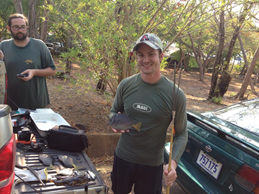
My PhD students (Bill Ludt and Caleb McMahan) in Costa Rica collecting specimens for their thesis projects. These guys better not just come back with pictures.

I don’t like killing animals, I was a strict vegetarian for 10 years (now I just eat sustainable seafood – hey, I live in Louisiana). I certainly wouldn’t want to endanger a species by over collecting it. I know of no scientific collectors who kill rare animals just so he or she can say they have it in their collections. We collect for a few simple reasons: because specimens are not available otherwise via loan, or additional specimens are needed for a comparative study, or because we need vouchers as evidence of the existence of the taxon.

I’ve collected rare species in the past, particularly some of the cavefishes I work on. For one of these species, Typhleotris mararybe, we collected the only two specimens we or anyone ever saw. We were in a very remote part of Madagascar and we were only allowed to collect two specimens from any given locality. I knew these individuals were part of a species new to science as soon as I looked at them. Did removing two samples place this species at risk of extinction? Guessing the population was much larger than what we found just at the surface, I would suppose not. What were we to do? Not collect them and just take pictures? We wouldn’t have been able to do the necessary comparative descriptive analysis to actually prove their novelty required by the ICZN (International Commission of Zoological Nomenclature). We collected these specimens so that we could formally describe this new and fantastic new species so that the world can be aware of their existence and so that measures can be put in place to conserve them and study them further.

Read More “Collecting organisms to save their species” »

Distracted by abstracts: Tips for writing a good abstract for a scientific conference

Posted on April 7, 2014September 2, 2014 By Chris Parsons 4 Comments on Distracted by abstracts: Tips for writing a good abstract for a scientific conference
Blogging, Science

ParsonsDr. Chris Parsons has been involved in whale and dolphin research for over two decades and has been involved in research projects in every continent except Antarctica. Dr. Parsons is an Associate Professor at George Mason University as well as the undergraduate coordinator for their environmental science program. He’s a member of the scientific committee of the International Whaling Commission (IWC), has been involved in organizing the International Marine Conservation Congress (IMCC) (the world’s  largest academic marine conservation conference) and is currently the Conference Chair and a Governor of the Society for Conservation Biology. In addition, Dr. Parsons has published over 100 scientific papers and book chapters and has written a textbook on marine mammal biology & conservation.

I have just read and reviewed through close to 100 scientific abstracts for a conference, and my main conclusion is that ” ‘abstract’ – this does not mean what you think it means!”

An abstract is supposed to be a concise summary of your entire paper or study. Basically a written version of the 30 second “elevator pitch”. In these days of information overload there is so much emphasis on publishing, and so many journals willing to accommodate, the number of articles in scientific fields has increased rapidly. As a result, academics are increasingly reading no further than the abstract, and often only reading the title. To test this I looked at some of my papers where the website they were hosted by kindly provided statistics on abstract page views and actual download rates. The download rates were approximately only 10% that of the abstract views across the papers (and I am naively hopeful that at least some of a downloaded paper will be read). The figures were similar for other articles, so it wasn’t just my papers. So 90% of people who see your work probably won’t go beyond your abstract. This makes it vitally important that all the information you want to convey about your work is in the abstract.

However, in a frighteningly high proportion of abstracts the key results and conclusions of studies are not even mentioned. One of the abstracts I read in this latest batch noted that the methods, results  and the conclusions of the study “would be discussed”. As an abstract this is useless. Too frequently place holder abstracts are submitted to conferences, with the assumption that results will magically appear before the meeting. But if you don’t manage to get that analysis done, you’ll be giving a presentation that will be lacking, will embarrassing you and damage your career. Moreover, a lot more people will see your abstract than will actually get to your presentation, so professional opinions may be made on you by the quality of your abstract rather than the final presentation. Plus abstract books are physical entities, whether electronic or hard copy, and will be around a lot longer than your 10 minute presentation.   So for your professional image and also for the sake of communicating your study it is in your interests to produce a good abstract.

With that in mind, here are some suggestions on abstract structure.

Read More “Distracted by abstracts: Tips for writing a good abstract for a scientific conference” »

No, harassing a shark for fun is not ethically equivalent to scientific research that helps conserve a species

Posted on March 26, 2014March 27, 2014 By David Shiffman 18 Comments on No, harassing a shark for fun is not ethically equivalent to scientific research that helps conserve a species
Blogging, Conservation, Science

Last month, I wrote an article for Scientific American that I shouldn’t have had to write. In it, I argued that riding, poking, prodding or otherwise harassing a free-swimming large predatory animal for fun is a bad idea. I do mean “argued;” believe it or not, there are people who strongly disagree with me. In my article, I was very general and diplomatic, and I took pains to avoid naming names.

However, my article was at least partially inspired by the disrespectful, potentially dangerous, and very public behavior of one person: the editor of Shark Diver magazine, Eli Martinez. Eli recently wrote an article for Medium, in which he stated that: “Look, I have no problem with touching sharks and I do not have any problem with other people touching sharks.” He also notes that ” I just think riding sharks is disrespectful to the animals .” He has also shared the following photos (and many, many more like them) on his Facebook page, photos showing behavior he does not seem to consider disrespectful.

Read More “No, harassing a shark for fun is not ethically equivalent to scientific research that helps conserve a species” »

Posts pagination

Previous 1 … 14 15 16 … 20 Next

Popular Posts

At least 74 practicing shark researchers: How a silly thing I said online raised thousands for conservationAt least 74 practicing shark researchers: How a silly thing I said online raised thousands for conservationFebruary 26, 2025David Shiffman
Why the new Trump order to shoot wolves is both illegal and a dreadful precedent for endangered speciesWhy the new Trump order to shoot wolves is both illegal and a dreadful precedent for endangered speciesSeptember 5, 2026Ali Gaster
Severely injured great white shark found, are scientists responsible?Severely injured great white shark found, are scientists responsible?March 29, 2011David Shiffman
5 things I learned helping to reassess the global conservation status of every species of tuna and billfish5 things I learned helping to reassess the global conservation status of every species of tuna and billfishSeptember 15, 2026David Shiffman
5 things you need to know about the proposed European Union shark finning ban, including how you can helpSeptember 17, 2012David Shiffman
13 wrong things about sharks that conservation advocates should stop saying in 2013 (and what they should say instead)December 27, 2012David Shiffman
That's not a blobfish: Deep Sea Social Media is Flooded by AI SlopThat's not a blobfish: Deep Sea Social Media is Flooded by AI SlopDecember 19, 2025Andrew Thaler
Getting a sense of porpoiseJanuary 20, 2009Andrew Thaler
What is a Sand Shark?What is a Sand Shark?November 12, 2017Chuck Bangley
How to build a canoe from scratch on a graduate student stipendHow to build a canoe from scratch on a graduate student stipendApril 17, 2010Andrew Thaler
Subscribe to our RSS Feed for updates whenever new articles are published.

We recommend Feedly for RSS management. It's like Google Reader, except it still exists.

Southern Fried Science

  • Home
  • About SFS
  • Authors
  • Support SFS


If you enjoy Southern Fried Science, consider contributing to our Patreon campaign.

Copyright © 2026 Southern Fried Science.

Theme: Oceanly Premium by ScriptsTown