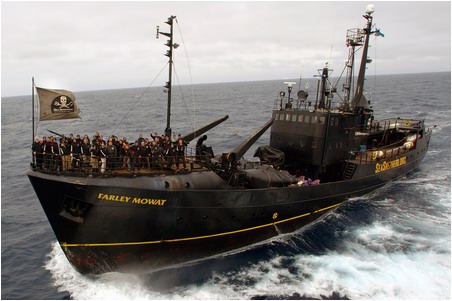
A few weeks ago, I asked readers to voice their support for a proposed anti-shark finning bill in Hawaii. Those of you who follow me on Twitter have seen numerous updates about this important issue. I am pleased to report that the bill passed both the House and Senate this morning, and it will soon go to the desk of the Governor of Hawaii. If signed (and everyone is pretty optimistic that it will be signed), it will be the strongest shark conservation law in North America- and one of the strongest in the world. Stefanie Brendl, President of Shark Allies and owner of Hawaii Shark Encounter worked harder than anyone on this issue, and she has agreed to answer a few questions about it for us.
Category: Conservation
The brilliantly funny Douglas Adams shares the adventures he had while writing Last Chance to See. Since he gave this talk, the Yangtze River Dolphin has been declared extinct and only 123 Kakapo remain. Komodo dragons are now listed as vulnerable, and although their population appears quite large, it was recently discovered that Komodo dragons … Read More “Douglas Adams on Evolution, Endangered Species, Conservation, and writing Last Chance to See” »

The death of Sea World trainer Dawn Branchaeu revived an old debate over whether it is appropriate to keep orca whales in captivity. Many people are calling for all captive orcas to be set free, but I continue to support aquariums because of the roles they serve as educators and conservationists. Although several readers have pointed out that the sea world incident itself would make for a solid ethical debate, I am instead going to take you back more than 15 years to a movie that started this whole movement: Free Willy.
This post was originally published on Earth Day, 2009. The responses I received from it were tremendous, both positive and negative. Were I to write it again today, I would include a discussion of Carbon Offsets and Eco-Guilt.
There is a real challenge in the environmental movement. On one hand, the science is on our side, but on the other hand, there is a growing group within the movement committed to dogma and willing to sacrifice facts for pseudoscience. So, this Earth day, we once again bring you “What the hell happened to the environmental movement?”
Forty-seven years ago, a brilliant, passionate scientist who understood the power of public outreach, noticed a decline in songbird populations, discovered a trend of decreasing egg shell thickness, and correlated this effect with the increase in the use of DDT as a pesticide. After thoroughly and rigorously verifying her results and conclusions, she did something revolutionary; she wrote a book. The publication of Silent Spring in 1962 marks the beginning of the modern environmental movement in America. Its simple, elegant prose made the complex interaction between humankind and the environment accessible to a public that had limited exposure to scientific writing. Like other works of literary science, Silent Spring, wove the scientific method into a narrative; observations, questions, conflicts, discoveries, joy and sorrow. To struggle and to understand, never the last without the first. The beauty of her words still echo with that same power today.
Read More “What the hell happened to the environmental movement?” »

Did you ever meet that gear-head who had a shelf full of Nalgenes or a trunk full of those reusable shopping bags? At the time, did you stop and think about the environmental impact of these eco-friendly products? In honor of Earth Day, I’d like to take a moment to step back and evaluate the state of our environmental movement.
Yes, at some level these things reduce your personal environmental impact. They save millions of plastic bags and cups from entering the waste stream and therefore our biosphere. At the same time, they promote the consumer culture that created many of our environmental issues in the first place.
When presented with a threatened population in need of conservation, the simplest and most basic question a manager can ask is “how big is it?” Unfortunately, this is one of the most challenging questions to answer. Determining the number of individuals in a population is fundamental to effective management. Small, concentrated populations can be destroyed in a single sweep, while large, broadly distributed populations require more resources and complex management involving many stakeholders.
A population that is easy to sample is rare. Animals move – sometimes over enormous distances. Habitats are difficult or impossible to access. Entire popualtions may be adept at avoiding capture. For most populations, it is impossible to count every individual. In marine ecosystems populations can span the entire globe, and the cost of mounting an expedition to systematically sample all members is huge. In order to get accurate estimates of the number of individuals, ecologists have had to devise statistical techniques to estimate the size of a population.
Read More “Crowdsourcing ConGen – Effective size of a population in flux” »
Lots has been written about the recent failure of CITES to protect marine species. Most of it focuses on blaming countries like Japan and China for putting commerce ahead of science and conservation. However, SCUBA operator and blogger Mike Da Shark has a different perspective- he criticizes the NGOs who advocated for conservation.
from The Right Blue ~Southern Fried Scientist
Our latest reader mail comes from my friend Mike, who writes for the conservative political blog SaveTheGop. Though we don’t agree on much, he’s usually a reasonable guy. His question concerns a post I recently wrote about Hawaii’s proposed bill to ban the sale of shark fins within their state.
A documentary produced by Ashwin Bhandiwad and premiered at the Benthic Ecology 2010, enjoy! Shifting Sands: The Fight for the Outer Banks from Ashwin Bhandiwad on Vimeo.